Updated:October 12, 2026

6 min
6 min

Want to invest in Bitcoin in Canada inside your RRSP or TFSA? Bitcoin ETFs (exchange traded funds) allow you to do just that. The fund holds Bitcoin, and by buying the ETF you own a portion of those Bitcoins. The ETF moves up and down, typically with the same daily price movements as Bitcoin.

Author

Most Canadian Bitcoin ETFs currently trade between $5 and $10 per share. You can buy as many or as few shares as you like. This makes Bitcoin investing accessible to everyone, even those with only small amounts of capital.

There are many Bitcoin ETFs in Canada with similar features, so it can be overwhelming when trying to decide on one. I went through the most commonly used Bitcoin ETFs and narrowed it down to the top Bitcoin ETFs for you to consider. All ETFs on this list use cold storage, which means the Bitcoins can’t be hacked.
This ETF has the lowest management fee and tracks the price of Bitcoin. Its simple design mimics investing in Bitcoin directly.
The CI Galaxy Bitcoin ETF is my top pick for Canadian Bitcoin ETFs. It trades under two ticker symbols:
The fund has a management expense ratio (MER) of 0.83% per year — the lowest of all the Bitcoin ETFs available. The MER is the yearly fee deducted from the performance of the ETF. The lower the fee, the more in your pocket.
It commenced trading in 2021 and has approximately $219 million in assets under management. That also makes it one of the largest cryptocurrency ETFs in Canada. There are several other Bitcoin ETFs which have similar functionality to the CI Galaxy fund, but because of the higher management fees, they are a less attractive choice.
The Fidelity Advantage Bitcoin ETF (FBTC.TO – CAD dollars and FBTC.U.TO – US dollars) has a 0.96% MER and has slightly underperformed the CI Galaxy ETF. The 3iQ CoinShares Bitcoin ETF (BTCQ.TO – CAD dollars and BTCQ.U.TO – US dollars) has an even higher management fee at 1.4%.
This ETF uses part of the management fee to offset the carbon footprint caused by Bitcoin mining.
This may appeal to Canadian investors who want to invest in “green” companies. The downside is that it charges a higher management fee.
The Ninepoint Bitcoin ETF is an environmentally-conscious crypto asset ETF.

It trades under two symbols:
This ETF has the highest management expense ratio, at 1.45%, of the ETFs discussed so far. The ETF was formed in 2021 and has $21 million in assets under management. This makes it one of the smallest ETFs on the market.
The problem with small ETFs is that they tend to close down; it isn’t worth it for the fund operator to keep the fund open if few people invest in it. If a fund closes down, you get your money back, but then you’re back at square one finding a new fund.
This choice is beneficial if you are interested in hedging your currency risk.
If you buy a Bitcoin ETF in Canadian dollars, the Bitcoin owned by the fund is priced in US dollars. This means your return is not only affected by Bitcoin, but also by the US dollar.
Not all investors want to worry or think about which currency to use, or how their choice may affect their returns. The Purpose Bitcoin ETF (BTCC.TO) is priced in Canadian dollars, but the fund hedges the US dollar exposure related to the price of bitcoin.
Essentially, whatever the performance of Bitcoin is, in US dollars, you will get that return on your Canadian investment, less the management fee. The fund has a 1.49% expense ratio, which is capped at 1.5%. The ETF commenced trading in 2021, and is also the largest fund in terms of assets under management.
This ETF is unique in that it pays a dividend or has a yield of about 7% per year. Bitcoin doesn’t pay a dividend; the management team attempts to create an income stream by writing covered calls on the Bitcoin positions they own.
The Purpose Bitcoin Yield ETF may appeal to you if you want regular income from a Bitcoin investment. It trades under three ticker symbols:
Each of these ticker symbols pays a yield. Which one you pick depends on whether you want to buy the ETF with US dollars or Canadian dollars. There is also the option of picking a hedged version.
The downside of this ETF is that while you receive income, it has underperformed the aforementioned ETFs by about 7%. That means you get paid out 7% per year, but your capital gains end up being about 7% worse off than with the other ETFs — at least, that has been the trend in recent history.
Since there tends to be no monetary advantage to investing in this ETF over the top choice, it really comes down to whether you want income. These funds are relatively small, with only about $50 million in assets under management, and the expense ratio is 1.28%.
Bitcoin attracted a lot of attention because of its possibility of huge returns. But with those returns also came substantial price drops. Bitcoin investors should consider whether they can handle Bitcoin volatility before investing.
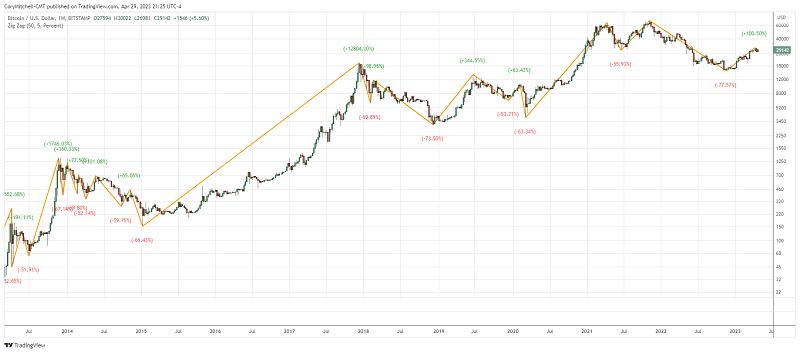
As of April 29 of 2023, Bitcoin is up 203% over the last five years. Over the last 10 years, it is up 24,908%, and that is why it has piqued so many people’s interest.
It has not been a smooth rise. Over that ten years, Bitcoin has had 13 drops of 50% or more (after having rallied at least 50% from a low point). That means, on average, you can expect a 50% every year, and possibly even more often, you are invested.
Bitcoin ETFs can be used for day trading, swing trading, and investing.
Find Your Perfect Broker: Explore Our List Now!
Choose the best with our expert-selected options

Find Your Perfect Broker: Explore Our List Now!
Choose the best with our expert-selected options
Discover top binary options brokers tailored to your region. Browse our curated lists by country:
4110