Updated:October 12, 2026

12 min

How to use a scalping strategy for options trading?
An options scalping strategy utilizes options for making quick trades, often multiple times per day. Gains add up quickly; even one trade can result in a big percentage return.

Saqib Iqbal
Author

I’ll show you how to scalp options effectively. Whether you want to take multiple trades or just one, you can start earning profits by following these steps.
What is options trading?
First, I’ll show you exactly what options trading is. It may seem daunting, but I’ll give you an easy-to-understand overview.
Options trading allows you to buy or sell stocks, ETFs, and other securities at a predetermined price and on a specific date. They derive their value from the underlying asset (what the option is based on).
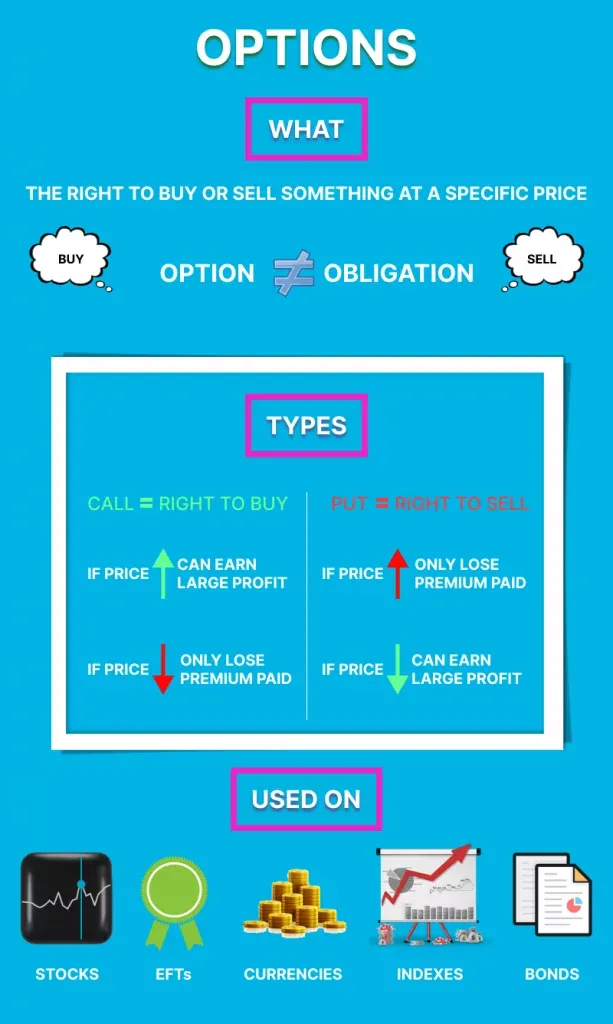
Options are divided into “call” and “put” options.
- Call options allow the trader to purchase the right to buy a specified underlying asset at a pre-determined price in the future (the expiry date).
- Put options allow the trader to acquire the right to sell a specified underlying asset at a predetermined price in the future (expiry date).
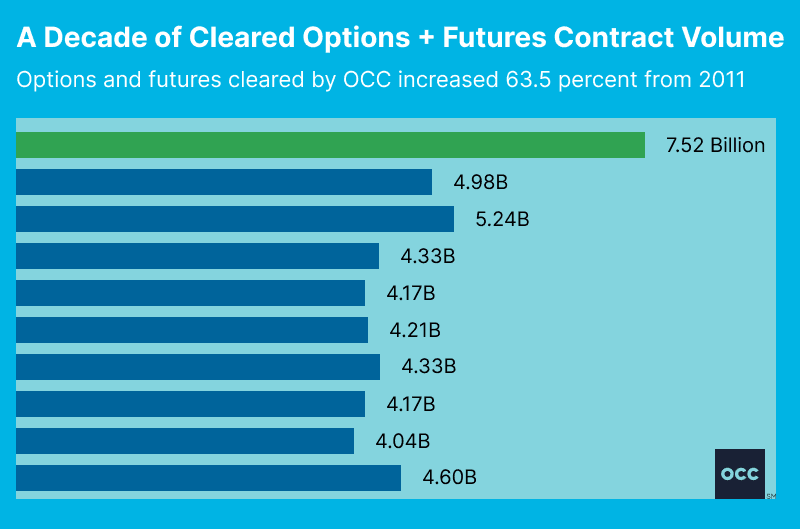
Another way to look at it is that “call” options are bullish, while “put” options are bearish. Do you know options trading hit 7.47 billion contracts in 2020?
There are some other key terms you need to know regarding options trading.
- The strike price is the price at which you agree to buy the underlying asset through the option.
- The premium is the current price or value of the option.
- The expiry is when the option is no longer active. The option can be bought and sold up to the expiry date. Expiry doesn’t mean you have to hold the option until expiry. The premium or value of options is constantly changing, so you can buy and sell them any time until expiry.
The premium is the amount you pay for that trade. It is also the amount you get when you sell the option.
- The value of the option (the premium) changes due to a number of factors, but mainly based on how far the price is from the strike price, the volatility of the underlying asset, and how long the option has till expiration.
- “Out of the money” means the underlying asset’s current price is below the strike price for a call option or above the strike price for a put option.
- “In the money” means the underlying asset’s current price is above the strike price for a call option and below the strike price for a put option.
- Each options contract includes 100 shares. If the option premium is $1, buying the option costs $100 ($1 x 100 shares). You can buy as many contracts as you like, but each contract is for 100 shares.
Those are the basic building blocks of an option. Now, let’s quickly tie together how it works, and then I’ll show you how to build profits using options scalping. Looking for an options broker, check out our review on Exante.
Quick Example of How an Option Works
That is a lot of terminology. So let’s look at an actual example and so you can see how this works in action.
Apple Inc. is a high volume stock with lots of options activity. Assume the stock currently trades at $142.36.
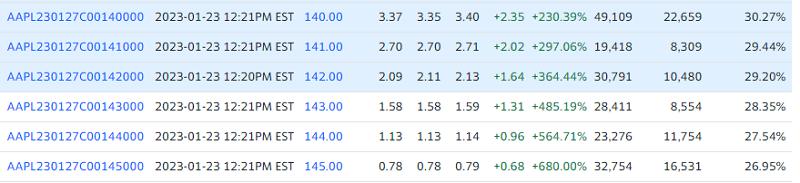
Yahoo! Finance provides free options quotes.
Those long strings of numbers on the left are the contract details – but it actually isn’t that complicated.
- AAPL is the stock
- 23 is the year 2023
- 0127 is the option expiry date – January 27
- C stands for Call
- 140, 141, etc is the strike price
The last price is the last price the option traded at. The bid is the price someone is willing to pay for the option right now, and the offer is the price some is willing to sell at right now.
Change and % change show the change in price since the prior day. You can see there is a big price movement in options. Hundreds of percent in profits in short amounts of time. We’ll talk about that in the options scalping strategy sections below.
Volume is how many options have changed hands in the day so far. The options highlighted in blue are “in the money” because those strike prices are below the asset’s current price. At the time of this snapshot the stock price was $142.36, so all strike prices below $142 are in the money.
That means that if the option were to expire right now, that option would be worth something. All options in white are out of the money. If the option were to expire right now, the option expires worthless. Why? Because the call gives the right to buy the stock at the strike price.
Why would you choose to use your option and buy at $143 or $144 when the stock is currently trading at $142.36 (and you can buy it at that price)? But, up until expiration, each option still has a premium (value) because there is a chance that the option could move into the money.
That’s how it works, and you also saw how options can make huge percentage gains in short amounts of time. On this particular day, APPL stock was up 3%, yet that translated into 200%, 300%, and even 600% moves in some of those options.
Do you feel confused in these complex calculations? Well, that’s not a problem. You can check out stock options calculator to perform different calculations that help you manage your risk efficiently.
What is an options scalping strategy?
Scalping options is taking advantage of the price movements in the premium. If you pay a premium of $0.20 for an option contract, and the option premium increases to $0.30 and you sell it, you make a quick 50%. That could occur in as little as a few seconds.
Scalping is a short-term trading method, often involving multiple trades per day. But there is no requirement on the number of trades taken. Some traders may only take one trade in a day or week. Such trades may only take a few minutes. Other traders are scalping options all day long, taking multiple trades.
Scalpers look for options contracts with lots of volume. This means they can enter and exit trades quickly because there are other participants to buy from and sell to.
Options with lots of volume are generally associated with stocks that have lots of volume, and that are well known. Such as stocks like Apple or Tesla Inc. (TSLA).
Traders use different options scalping techniques. Next, we’ll look at an example.
How does options scalping work?
You now know about options and what scalping is. Now let’s look at an options scalping strategy that you can use as a building block for developing your own methodology.
Small moves in the stock price can result in large percentage changes in the options premium.
- For this to happen, focus on options where the strike price is close to the asset’s price and the option is within a week or so of expiration.
As the option gets close to expiration, premiums generally move with the underlying asset’s price. This makes it less complicated, because option premium prices can move for other reasons, such as increases or decreases in volatility. The factors that affect the premium of an option are called “Greeks”.
- Study the asset’s price to determine where the stock price could go and thus which option to buy.
For example, using the Apple example above, the price of Apple stock had been trending higher for a couple of weeks. This tells you to focus on call options for your options scalping trades, as the stock price is rising and call options increase in value (the premium) when the stock price rises.
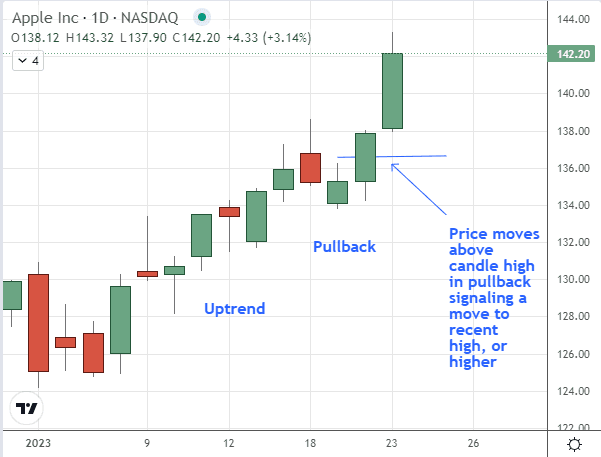
- If the trend is up on the daily chart, focus on calls.
- If the trend is down on the daily chart, focus on puts.
Looking at the trend over the last week or two is often enough to get a sense of the direction of the stock.
On the second last day, when the price moved above the last candle high in the pullback, that was an opportunity to buy. As the price increases, so will the price of the option. Sell it right away for a nice profit, or at the latest, sell by the end of the trading day.
The daily chart may seem like a big time frame for options scalping. But it can be used. You can also use short time frames. This can also be done on a 5-minute chart using the same approach. Using a five minute chart, most of these trades would last 10 to 30 minutes.
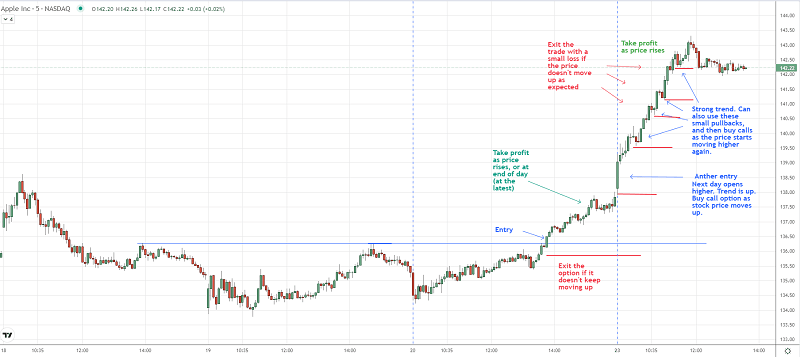
Notice how many opportunities there were for this options scalping strategy once the price starts moving up out of the pullback shown on the daily chart. On the five-minute chart, as long as there is an uptrend on the daily and the 5-minute, there is an opportunity to buy calls as the price rises out of a pullback.
- Cut losses quickly if the stock price fails to move in the anticipated direction. This option scalping strategy is about making quick profits, not holding onto losers or trades that didn’t do what you expected.
With options scalping our job is to get in and out quickly. You can definitely let profits get bigger, but you were expecting the price to rise (for a call) so if it falls below the swing low that just formed, then cut the loss quickly and await another opportunity. The red lines mark potential exit points for the entry signal that just occurred if an entry doesn’t work out.
- Take profits regularly. Options scalping isn’t about holding all day. If the trend is up. take profits when the stock price moves slightly above the prior swing high. Hold it until momentum stalls. Once the stock price is past the prior swing high, consider exiting on any red/down/reversal candle.
The same concept would apply to buying puts in a downtrend. Exit quickly at a small loss if the price rises instead of falls. Consider taking profits as the price moves below prior swing lows.
With scalping, if the option increases 400% in a day, the goal is not to make 400% on one trade. Although you could do that if you prefer holding the position all day.
Rather, we may make multiple trades resulting in a 50% profit, a 60% profit, a 10% loss, a 70% profit, and a 20% loss. We keep losses small so that our winning trades are bigger than our losing trades. This is called risk/reward.
Best indicators to use for scalping options trading
Options scalping strategies don’t require technical indicators. Since the trades often last only a few minutes, most indicators lag too much to be effective.

That said, there are some widely used indicators which you can use to help confirm trades, highlight the trend direction, or use for entry and exit signals. Here are some indicators to consider for options scalping?
Scalping Options with RSI
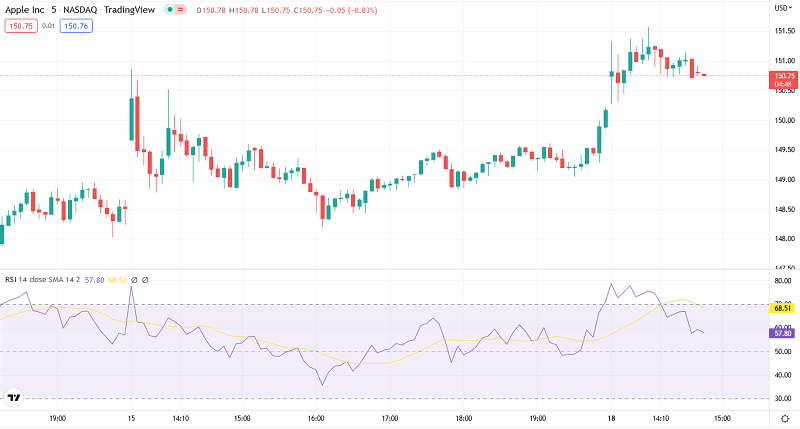
J. Welles Wilder developed the Relative Strength Index (RSI), a momentum oscillator. The RSI measures the speed and rate of change in market price fluctuations.
When it rises above 70, it is considered overbought; when it falls below 30, it is deemed oversold. However, there is far more to it than that. You can use the RSI to detect failure swings, divergences, and centerline crossovers.
Bollinger Bands for Options Scalping
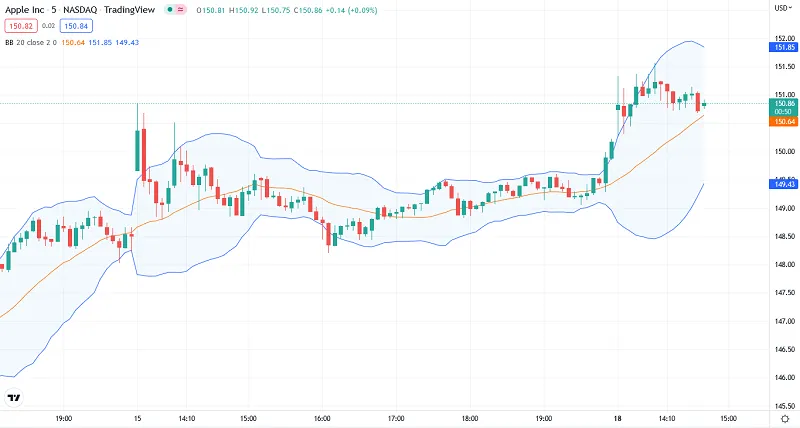
Volatility is important to all options traders, and Bollinger Bands are a common indicator to gauge volatility. The bands widen as volatility rises and contract as volatility falls. The closer the price gets to the top band, the more overbought the security is. Conversely, the closer the price gets to the lower band, the more oversold it is.
Moving Averages For Trend Confirmation
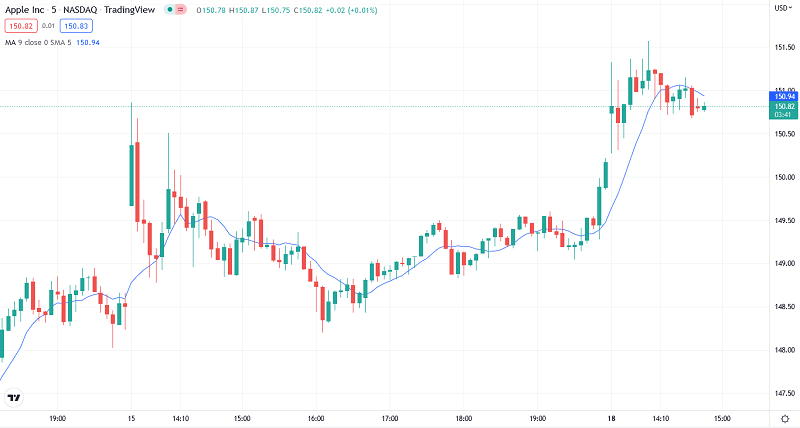
“Moving averages” smooth out the choppiness of the price candles to reveal underlying trends. The two most common moving averages are exponential (EMAs) and simple moving averages (SMAs).
Moving averages calculate the closing prices for a given duration. A 20-period simple moving average on a five-minute chart, for example, would calculate the average of the last 20 closes of the 5-minute candles.
Also check Bill Williams Indicators such as Fractals and the Alligator.
Tips for Scalping Options
Scalping can be highly profitable, but without risk management, losses can stack up quickly. Here I’ll mention three tips you should keep in mind.
1. Plan the exit before the trade
Have an exit strategy for whether the trade does well or poorly. Set your upside and downside exit points ahead of time.
The trade examples above showed entry and stop loss locations (when to exit the trade isn’t working). In uptrends take profits above prior swing highs when the price stalls or shows any signs of reversing. The same concept applies to downtrends with the price dropping below prior swing lows.
2. Trade with your head, not your gut
No matter what options scalping strategy you use, not every trade will be profitable. With scalping, we want to see our trades work quickly. Don’t hold onto losses. If you “feel” something is going to go up or down, instead bring your focus back to your strategy. What is it telling you to do? Do that.
Stick with your plan. If you lose, don’t beat yourself up; every trading has losing trades. If strong emotions come up, talk yourself through them and re-state to yourself what your plan is. Stick to the plan, not the feelings.
3. Choose the right position size for options scalping
Most position sizing mistakes are caused by one of two things: fear, or greed. Fear can result in a position size that is too small to see any real benefits. On the other hand, if you make judgments based on greed, you may wind up trading with a position size that is too large for your account.
Losses should result in the total account losing 2% or less. This means you typically don’t want to be putting your whole account into one options trade, because options can easily move 10% or more in a few seconds.
Test out your options scalping skills in a demo account to see what your largest losing trade is in dollars. That dollar amount should be less than 2% of the account (most pros risk 1% or less of their account).
This lets you know if you are scalping options with too large of a position size or too small. Adjust accordingly. When starting out, err on the side of the position size being too small until you prove you are profitable.
Find Your Perfect Broker: Explore Our List Now!
Choose the best with our expert-selected options

Find Your Perfect Broker: Explore Our List Now!
Choose the best with our expert-selected options
Discover top binary options brokers tailored to your region. Browse our curated lists by country: