CrossCurrency
Crypto
Cross currency exchange rates table
Cross Currency Calculator
A cross currency exchange rates table shows what one currency is worth against another without routing the quote through the dollar first. That is the whole point of it. Most retail traders spend an hour or two a day in front of the screen, and a grid like this saves a slice of that: nine currencies, every pairing visible at once, no mental arithmetic. This page explains what the calculator above does, the formula behind a cross rate, and a worked example you can check with a pen.
Updated October 23, 2026
Finding accurate cross currency exchange rates
What is a cross rate? Example explained
Start with the plain definition. A cross rate is the price of one currency in terms of another when neither side is the dollar. If you hold euros and you want Swiss francs, what either is worth in dollars does not matter to you. What matters is the single number that connects them.
That number does not appear out of nowhere. Currency pairs fall into three groups, and the group a pair belongs to decides whether its quote exists on its own or has to be built out of two other quotes.
Majors are the pairs that include the United States dollar. In a major the dollar sits on one side of the quote, and it is the dollar leg that effectively sets the level between the two currencies.
The dollar dominates the flow. The figure cited on this page is 89% of trades, up from 87% three years earlier. Whatever the exact number is today, the direction is not in doubt. Almost every quote you look at has passed through the dollar at some point in its construction.
Minors are the mirror image. They pair two significant currencies with the dollar left out, which is why they are also called crosses. For scale, roughly 75% of forex trades happen in forex majors, and everything else shares what is left over.
Take EUR/GBP. Both sides belong to major economies, yet neither side is the dollar. Volume in pairs like this is thinner than in EUR/USD or USD/JPY, spreads run wider, and the level you see on the screen is derived from what each currency is doing against the dollar.
Does trading crosses lift your win rate on its own? No. What it does is remove a leg. Instead of selling euros for dollars and then buying pounds with those dollars, you cross one spread rather than two. That is a saving on cost, not an edge on direction.
The mechanics are worth spelling out. When the United States dollar is the base, its value is one by definition. Building a cross by hand therefore means two conversions: out of your currency into dollars, then out of dollars into the currency you actually want. The table above does both steps in one go.
How does the Trading.biz cross-currency tool work?
The tool sits on the homepage. Open the Analytics menu and it is there, next to the broker reviews and the rest of the analytics block.
The top half of the screen is a grid. Nine currencies down the side, the same nine across, and a rate in every cell where a row meets a column.
Read a cell the way you read any quote. The row currency is the base, the column currency is the quote, and the number says how many units of the second you get for one unit of the first.
So you need to know which side is which. In GBP/USD, GBP is the base and the dollar is the quote. Get that backwards and you will read every cell in the grid upside down.
It is the most common beginner mistake, and the first thing to check when a number looks absurd. The grid covers nine currencies: EUR, USD, JPY, GBP, CHF, AUD, CAD, NZD and CNY.
The last one usually raises an eyebrow. CNY is not a classic major, so what is it doing here?
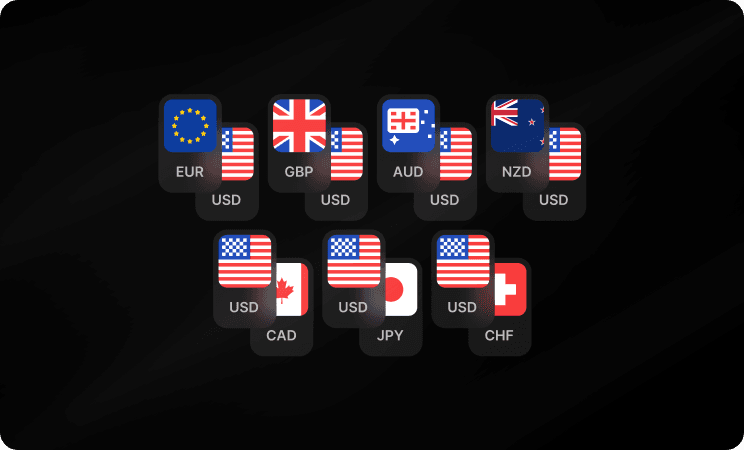
image (24).png
It earns its place through the weight China carries in world trade. Every other currency in the grid belongs to a forex major. CNY is the exception, included for economic influence rather than for its share of pair volume.
Major pairs account for 67.4% of the forex market's daily volume, a figure credited on this page to Investopedia. The seven classic majors are EUR/USD, USD/JPY, GBP/USD, USD/CHF, AUD/USD, USD/CAD and NZD/USD.
Each cell is clickable. Click a block and it opens the matching chart on the Tradingview page. Click the United States dollar block in the EUR row, for instance, and you land on the EUR/USD chart with its full history.
Below the grid sits the converter. Choose two currencies, type an amount, and it returns the converted figure at the current rate. There is nothing to configure and nothing to install.
The currency list is not limited to the nine in the grid. Majors appear at the top because that is what most people need, everything else is searchable, and the quote refreshes with the live price.
How to do a cross-rate calculation?
Working a cross by hand takes one line of arithmetic. The reason to learn it is not speed. It is verification: when a quoted cross looks wrong, this is how you catch it.
First, how a pair is quoted. The first currency is the base, the second is the quote, and the price tells you what one unit of the base costs. To build a cross through the dollar you sell one currency for the United States dollar, then spend those dollars on the currency you want.
Both legs collapse into a single equation, and it never changes:

Screenshot 2025-01-17 at 12.44.17 AM.png
A / B = (A / USD) x (USD /B).
Read it as cancellation.
Given JPY against USD and USD against EUR, the dollar terms cancel and what survives is JPY/EUR. The same trick works for any three currencies as long as two of the quotes run through the dollar.
A worked example
Say the screen shows GBP/USD at 1.2700 and USD/JPY at 148.00. Those are sample figures for the arithmetic, not live quotes. You want GBP/JPY, which is not a dollar pair, so multiply: 1.2700 × 148.00 = 187.96. One pound buys 187.96 yen. Now the part that matters. If your broker shows GBP/JPY at 188.40, the difference is 44 pips, and that difference is spread and markup rather than a gift. The division case works the same way: EUR/USD at 1.0850 divided by GBP/USD at 1.2700 gives EUR/GBP at 0.8543.
Some traders use this to hunt arbitrage between a quoted cross and the one they calculate. Be realistic. Gaps like that close in fractions of a second, and the spread swallows most of what is left, so treat the arithmetic as a sanity check rather than a strategy.
Indirect quotations
An indirect quotation tells you how much of the base you need in order to buy one unit of the quote. Take EUR/GBP again, this time built from EUR/USD and GBP/USD.
Start with the bid and ask on EUR/USD and GBP/USD. The United States dollar as a base is always 1. In both of those pairs the dollar is the quote rather than the base, so the first pair has to be inverted before the arithmetic lines up.
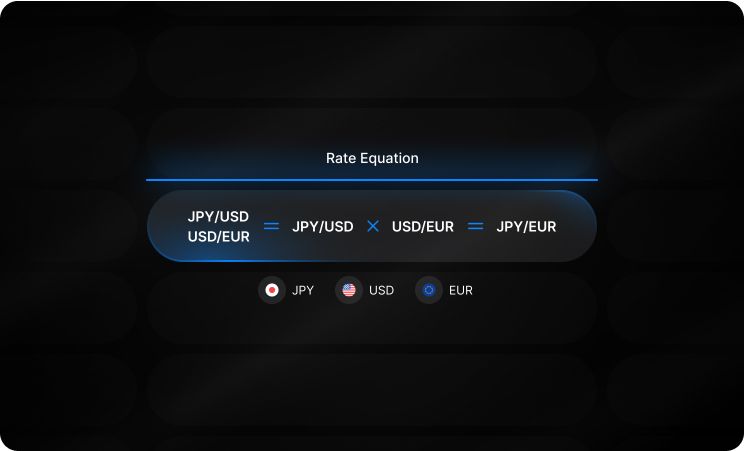
image (8).jpg
EUR/USD becomes USD/EUR. The formula then works with:
USD/EUR
GBP/USD.
Divide the current bid by the current ask, then the reverse for the other side, and you have the EUR/GBP level along with its own spread.
Direct quotations
A direct quotation is the reverse. It says how much of the quote currency you need for one unit of the base. Same example, different arrangement.
Here the first pair is not inverted, so the formula works with:
EUR/USD
GBP/USD,
From those two you get EUR/GBP directly. The same logic stretches across three currencies. Say you hold British pounds and need Swedish krona: almost nobody quotes krona in pounds.
So you route through the euro. Pounds into euros, euros into krona, two legs instead of one. That is a three-way trade and it runs in either direction. Whether it is worth doing comes down to one question: do the two spreads together cost less than the single quoted cross?
Why are cross-currency exchange rates important?
Rates carry information about the economy behind the currency, and they shape how much a country trades and on what terms. Three practical reasons they matter at the screen follow.
image (26).png
Crosses became routine once the gold standard ended and trade went global. Before that, currencies were pegged to metal and through it to each other. Once they floated, a market grew up to price them against one another directly.
For a trader, crosses widen the menu. A view on the yen no longer has to be expressed against the dollar. If you think the pound is weak and the yen is strong, GBP/JPY says exactly that, with no dollar opinion muddying the position.
They also make transfers cheaper. Sending euros to Sweden through a dollar leg means paying on the way in and again on the way out. A direct quote means paying once.
That is the cost argument in one line: one transaction, one spread crossed, no dollar leg sitting in the middle. Non-USD pairs change hands in real size, so liquidity in the main crosses is rarely the problem people expect it to be.
Final Thoughts
A cross rate is two quotes multiplied or divided, and nothing more complicated than that. Knowing the arithmetic lets you check what a platform hands you and see what the convenience costs. Use the table above for a quick read of the market and the formula when a number looks wrong. Where you place the trade matters as much as the rate: spreads on crosses run wider than on majors, so compare them before you commit. Our broker comparison lists the spreads and the fees side by side.
FAQ
What is a cross currency exchange rates table?
A grid that gives the rate between every pair of the currencies it lists, without routing the quote through the dollar. The table on this page covers nine: EUR, USD, JPY, GBP, CHF, AUD, CAD, NZD and CNY. Every cell links through to the matching chart.
How does the calculator work?
Pick the currency you hold and the one you want, enter an amount, and the converter returns the result at the current rate. It draws on the same feed as the grid, so the figure moves with the market. Majors sit at the top of the list and everything else is searchable.
How is the result calculated?
Through the dollar. The equation is A/B = (A/USD) x (USD/B), and the dollar terms cancel out. With GBP/USD at 1.2700 and USD/JPY at 148.00, GBP/JPY comes to 187.96. Those numbers are illustrative, so run the same steps with live quotes.
What values do I need to enter?
Two currencies and an amount, nothing more. If you are doing the arithmetic by hand instead, you need the bid and the ask on both dollar pairs, and you need to know which currency is the base in each of them before you divide.
Can I use it for crypto as well as forex?
The cross currency grid covers fiat. Digital assets sit under the separate Crypto tab at the top of the page. The arithmetic behind both is identical: two quotes against a shared third asset, multiplied or divided depending on which side the shared asset is on.
