Updated:October 09, 2026

1 min

Ultimate Guide to Choosing the Best Cryptocurrency Exchange in 2026
Whenever I open a website for my daily market news, a crypto ad pops up. It asks to sign up for the crypto exchange and start trading.

Saqib Iqbal
Author
The search for the best white-label solutions is a popular concept in the world of the modern cryptocurrency exchange industry. A white-label exchange solution offers rapid deployment, relying on quality crypto exchange software.
Whenever I open a website for my daily market news, a crypto ad pops up. It asks to sign up for the exchange platforms and start trading, tailoring its message to a specific target audience. The concept of white-label solutions is also gaining traction. A white-label crypto exchange simplifies the launch process, giving a head start to a new crypto business.
The buying company (client) pays a fee to the provider to rebrand the platform with their logo, colors, and unique interface. Customization options for the user interface and branding are important for differentiating your exchange in the market.
How many questions pop up when we hear the word “cryptocurrency”? What is it? Can I earn $10,000 every month (which involves careful risk management) and how to buy/sell digital assets profitably? Let's try to break it down.
A BRIEF HISTORY OF CRYPTOCURRENCY AND THE RISE OF BLOCKCHAIN TECHNOLOGY
Before I delve into some fancy details, I want to take you back in time. The rise of cryptocurrency and blockchain is a fascinating story. I'm sure you are up for some history lessons. So, let's rewind the clock!

The idea of cryptocurrency began in the 1980s. The concept was to create a currency independent of a central bank, challenging traditional financial institutions. The emergence of a white-label crypto exchange model was still decades away.

The process developed and came in the 1990s. In 1995, cryptographer David Chaum developed the first electronic currency, Digicash. Did you know a cryptographer writes the code to secure data? Modern exchange platforms rely on such security measures.
Three years later, we had Bit Gold, another form of electronic currency. Fast-forward to 2008, and we got Bitcoin. Yes, the good ol' BTC is currently changing our financial system. Trading digital assets on a modern crypto exchange platform is now commonplace. The anonymous figure behind the making was Satoshi Nakamoto.
Nobody knows what that person looks like. However, the development of BTC was because of the 2008 financial crisis. The technology that BTC uses is blockchain technology, which also enables the functionality of smart contracts. The technology is super-hard to explain, but I'll make it simple.
Think of a blockchain as a secure means to store all the data. Blockchain protects sensitive data. It's nearly impossible to hack blockchain tech, provided it employs robust security measures. Security is often boosted by advanced data encryption techniques. Whoops, but recently hacking the tech has increased. After the creation of BTC, there was a mad rush. Especially after 2015, the cryptocurrency exchange market expanded, leading to a shift markets dynamic. The rapid growth also fueled the need for a white-label crypto exchange solution. Many of those use high-quality white-label software.
The demand for a quality white-label crypto exchange has surged, requiring robust regulatory readiness. A fully featured white-label cryptocurrency exchange can be launched quickly.
The development process for a white-label crypto exchange includes discovery and planning, system architecture design, platform development, customization and branding, quality assurance and testing, and deployment and launch. Pre-built features include user management, KYC/AML, payment gateways, crypto-fiat conversion, and staking.
Crypto exchanges popped up, and people started trading. Leading the charts of the cryptocurrency exchange market are BTC, ETH, USDT, and other digital assets. The role of professional market makers is vital for maintaining tight spreads. The crypto market has been seeing a flock since the pandemic began. So, that's how we got where we are now.
The flexibility of a white-label crypto exchange allowed new white-label solutions to enter the market quickly. Every new white-label crypto exchange adds to the competition in the crypto exchange business. The success, however, rests with the diligence and vision of the exchange owners.
WHY IS CRYPTOCURRENCY SO VALUABLE?
Many see a need to change our financial system. The pandemic connected several dots of this theory. The rise during the pandemic is a story in itself. So, the demand went crazy, and these crypto assets became valuable.
And don't worry, we are going to see more of this. It is the age of cryptocurrency. And this is how bitcoin and digital money are challenging the global economic order, often by providing an alternative to existing systems.
WHY INVEST IN CRYPTOCURRENCIES?
Above, I mentioned why people are rushing to the crypto market. It seems like a gold rush; everyone wants to hop on the bandwagon. But the question is, “Is crypto worth a try”? Well, let's see.
With all the hype and puff, cryptocurrencies are a viable investment, which often starts with finding the right white-label provider. A white-label crypto exchange can save development time by focusing on the needs of its target audience. You see, our global financial system does need a change. The central banks' ability to control everything caused the 2008 financial crisis. So, the crypto market provides a sigh of relief, especially for those concerned with risk management.
Invest in cryptocurrencies 2026
Soon, we can see cryptocurrencies replacing fiat currencies. Many countries are working on it, and they think we need to change this. Hence, we can see a significant rise in the longer term, and it's great for investing. But not every cryptocurrency is worth the try.
It's handy to pick only the fruitier ones and create a cryptocurrency investment strategy. When looking for the top cryptocurrencies of 2026, many names pop up. These include BTC, ETH, USDT, SOL, DOGE, ADA, etc.
They are the best cryptocurrencies for investment in 2026. Did you know you can earn free cryptocurrencies? No, I'm not joking, or this is the opposite day. You can earn cool coins for free. All you have to do is do some tasks, and voila!
TYPES OF CRYPTO EXCHANGES & THE DIFFERENT WAYS YOU CAN TRADE ON THEM
If you want to make moola in cryptocurrencies, you need an exchange. It's a marketplace for buying and selling cryptocurrencies. But how does all of this work? Let's solve the puzzle.
Every successful cryptocurrency exchange often considers a white-label crypto exchange solution for faster scaling. The underlying crypto exchange software for a white-label crypto exchange is pre-built. It offers a complete white-label exchange software package.
The provider handles core tech, security, and features of the white-label exchange, allowing the client to focus on branding and marketing. The business licensed the ready-made software and focuses on customization and operations.
Customization of the white-label exchange platform involves transforming the solution into a branded exchange by integrating branding elements and tailoring functionalities to specific needs. The adaptable nature of white-label crypto exchange platforms allows for easy customization and future feature integration. It ensures the solution evolves alongside the business. Integrating essential APIs into the white-label exchange enhances functionality and user experience by connecting to various services, such as fiat gateways and liquidity providers.
When you search for the cryptocurrency exchanges list, you'll find many names, like EXMO or Coinbase. For instance, if someone searches for “cryptocurrency exchanges Australia,” every crypto exchange rate differs across different exchange platforms.
The choice of a good cryptocurrency exchange platform is crucial. There are three types of exchanges. We have CEX, DEX, and hybrid. It's essential to research the trading fees and fee structure of every white-label crypto exchange.
Centralized exchanges, also known as CEXs, allow digital asset trading in a centralized setting where the exchange acts as a mediator. A governing body regulates CEX. It stores user funds and organizes money transfers.
DEX is a decentralized exchange and has no central authority. On a decentralized crypto exchange, users maintain control of their private keys, often secured with multi-signature wallets.
The third form is a hybrid one. It's a combo of CEX and DEX. Hybrid exchanges offer a balance between centralization and decentralization features. It provides low-latency trading in a centralized setting while ensuring enhanced privacy.
Operating a white-label crypto exchange often involves choosing a CEX or DEX business model designed to generate revenue. The backend of a white-label crypto exchange handles all operations, but to succeed, the supplier must provide ongoing support and an intuitive user interface.
On all these kinds of exchange platforms, there are many ways to buy/sell cryptos. Building a white-label crypto exchange requires a robust trading engine. It is often powered by a high-speed matching engine that can support key and advanced trading features. This includes simple transactions, like spot trading.
I'll explain more about buying or selling cryptos in the next section. You can buy/sell a forex pair or a stock through a broker. You can have a peer-to-peer exchange. You can trade through derivatives, or even via advanced methods, like derivatives trading.
HOW TO BUY OR SELL BITCOIN ON CRYPTO EXCHANGE PLATFORMS?
As we are unwrapping layers of Bitcoin cabbage, one thing is key to mention. I'm talking about buying and selling BTC. Many newbies don't read the Bitcoin buying guide before they start trading. To buy/sell BTC, you have to follow certain steps. First, you have to open an account with a crypto exchange, a process that usually requires a robust user verification process.
There are many popular exchanges. I'll mention the 2026 list of exchanges later. After opening the account, you have to deposit funds. Next, you use the crypto exchange platform to trade (buy or sell). For beginners, simple spot trading is often the recommended starting point.
And that's it; now you can call yourself a crypto investor. If you ask, “Which crypto will make me a millionaire”? Well, all cryptos can earn you some serious dough. The success of a trader depends more on trading strategies and asset management than on the type of white-label crypto exchange they use. The best white-label crypto exchange has low latency, often due to strong ties with liquidity providers and crucial deep liquidity connections. Access to deep liquidity ensures minimal slippage on large trades.
However, this isn't a money tree. And you don't have to rush the process. You have to follow the plan, keep your composure, and triumph will come. Cryptocurrencies can also be traded via crypto binary options.
How to calculate cryptocurrency profit?
I know you have to keep track of your profits. This helps you monitor the winning trades and allows you to evaluate your trading. So, to calculate, all you have to do is head over to Trading.biz profit tool. It allows you to monitor profitability by putting all the values.
HOW DO I DEPOSIT FUNDS INTO MY CRYPTO EXCHANGE ACCOUNT?
Now you need funds to trade, right? So, there are many different ways to deposit into your crypto exchange account. You can use the wallet, credit/debit cards, third-party payment apps, and bank transfers.
Efficient and secure money transfers are a core expectation. Many white-label crypto exchange solutions integrate multiple payment modes and offer multi-currency support. Reliable fiat gateways are critical for converting traditional money to crypto. Furthermore, they must be able to integrate fiat gateways to simplify deposits for users.
Many of you are wondering what the hell a wallet is. Well, think of it as a place to store cryptos. Each wallet comes with an address. If you want to give or lend, you can do so with an address.
For instance, 1htcFGH3Dcbktasv is a Bitcoin wallet address (I made it up for demonstration purposes). When talking about third-party apps, you can use CryptoPay. I have read the CryptoPay mobile app iPhone review, and it's good. Besides, there is an Android app. When dealing with crypto, beware of scams like MoonBitcoins.
THE COMPLETE GUIDE TO CRYPTO TRADING: WHAT YOU SHOULD KNOW BEFORE YOU TRADE BITCOIN & ALTCOINS
It's always good to shuffle several pages as an investor. You have to know different aspects of investing in cryptos. Here, I'm going to present an overall picture of crypto trading. So, fasten your seat belts!
With all the buzz and hype, it's important to cut through the noise. You see, the crypto market is highly volatile. Prices can jump and fall like crazy. You have to make an investment strategy, so you know when to enter.
Your trading plan should revolve around buying the dip. There are many Bitcoin trading sites, so you can sign up, and voila! In the heading, I mentioned Bitcoin and altcoin. So, what is an altcoin?
Altcoins represent alternative cryptos to BTC. The altcoin trading process is similar to BTC's. You have to develop a strategy and then enter the crypto pool.
THE BEST BITCOIN EXCHANGES IN 2026
The BTC is the largest cryptocurrency. The sheer market cap of $1,860 billion speaks for itself. It attracts more eyeballs than any other. Even a specialized white-label crypto exchange will likely prioritize BTC, requiring a scalable infrastructure. So, it's key to mention “best bitcoin exchange list 2026”. Here are some of the best Bitcoin exchanges:
- Crypto.com
- Binance
- Coinbase
- Kraken
- Gemini
All of these trading platforms provide excellent trading conditions for BTC. Now, let's move to the top cryptocurrency exchange platforms and learn that each has unique key features.
WHAT ARE THE BEST CRYPTO EXCHANGES IN THE MARKET?
Here are the top crypto exchanges you can try:
- Coinbase
- Crypto.com
- Binance
- Kraken
- Gemini
- FTX
- eToro
- Robinhood
- BlockFi
These services get more volume each day, and that's why they are on top of the food chain. While the above are great exchanges to consider, Mercatox is an example of an exchange to avoid.
HOW TO CHOOSE THE BEST BITCOIN EXCHANGE FOR YOUR NEEDS?
Amidst all the buzz, we shouldn't forget how to choose the bitcoin exchange. A structured evaluation process helps avoid long-term issues when selecting a white-label provider. It's important to dig deeper into this as we invest real money, and you should prioritize security. So, it's important to look at several different factors. Here are the things you need to know before choosing a Bitcoin exchange:
- Accessibility.
- Security, including advanced features like Two-Factor Authentication.
- Fees.
- Margin, including margin trading options and institutional-grade performance.
- Customer support.
Trading platforms must actively ensure regulatory compliance to operate globally. Compliance with regulations like KYC and AML is crucial for the operation of a white-label crypto exchange.
Requesting live demos and exploring documentation can help in evaluating potential white-label providers. Assessing the total cost of ownership is also important when selecting a white-label crypto exchange provider. To get a bigger picture, here's the crypto exchange comparison chart 2026:
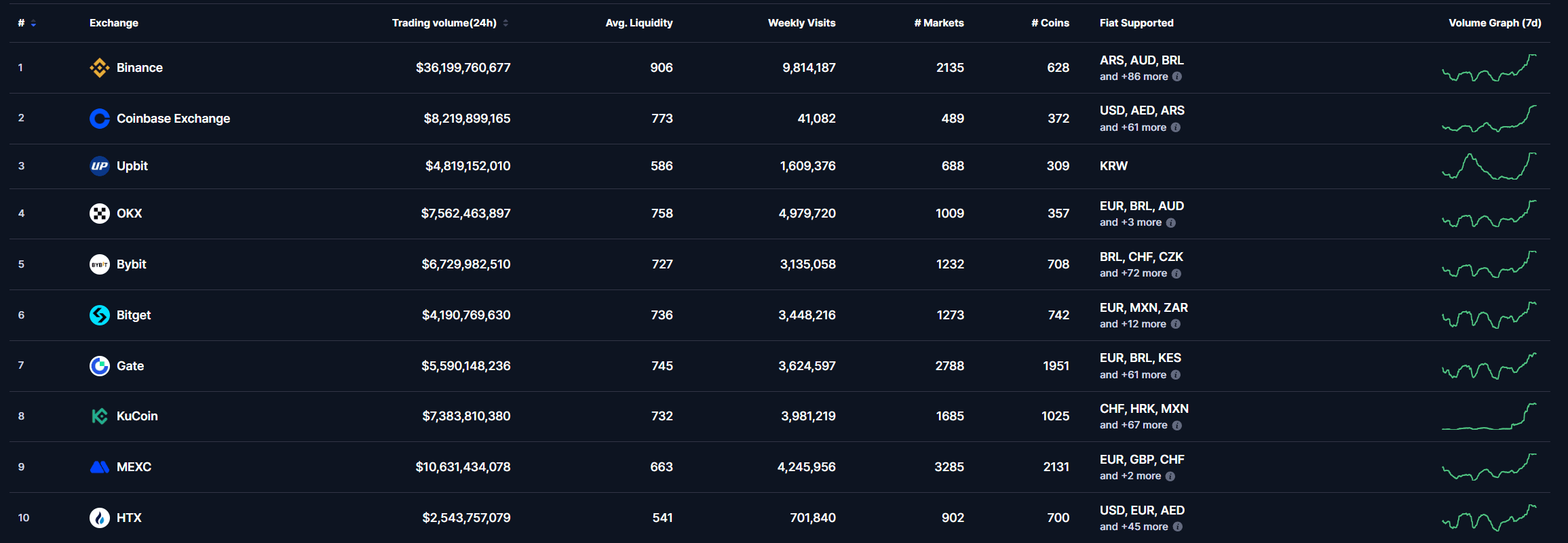
Crypto exchanges by volume
If you are looking for a live crypto exchange rate, you can check Trading.biz converter tool.
HOW TO CHOOSE WHICH CRYPTO EXCHANGE IS RIGHT FOR YOU?
Let's move to which cryptocurrency exchange is right for you? The answer to this question is simple: it all depends on you.
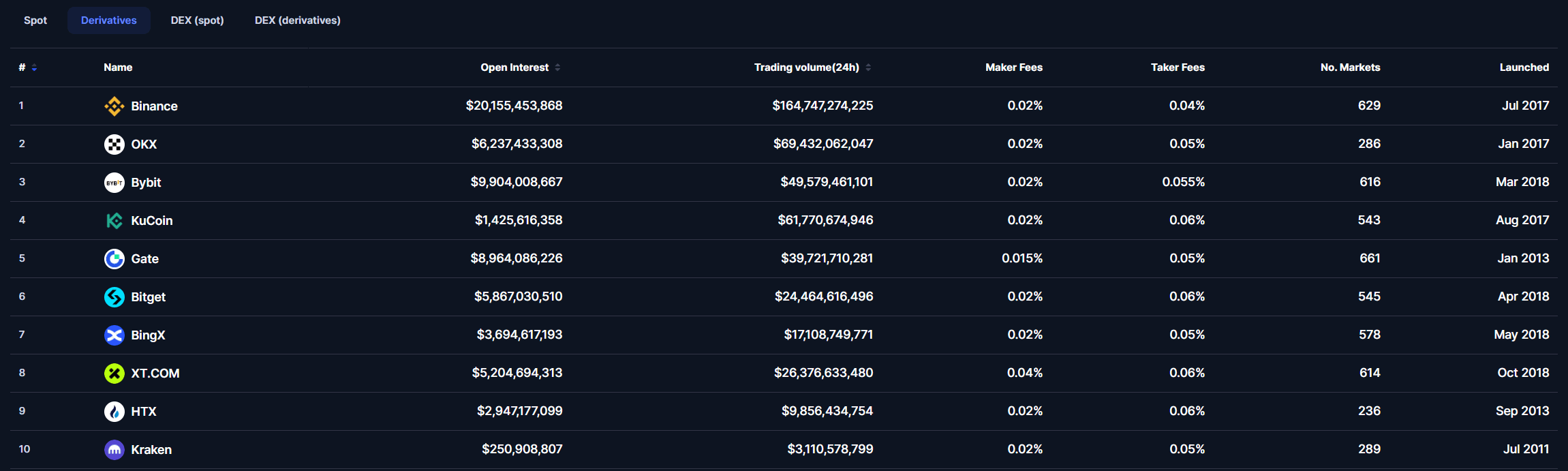
When thinking about what's best for you, you have to consider several options. Here's the crypto trade platform comparison chart 2026:
Crypto exchanges online
I read some forums asking, “How to research cryptocurrency”? By looking at the chart and considering the platform's core technologies, the simplicity of its user interface, and evaluating liquidity, you can come up with the best available option.
WHICH CRYPTO EXCHANGE HAS THE MOST COINS?
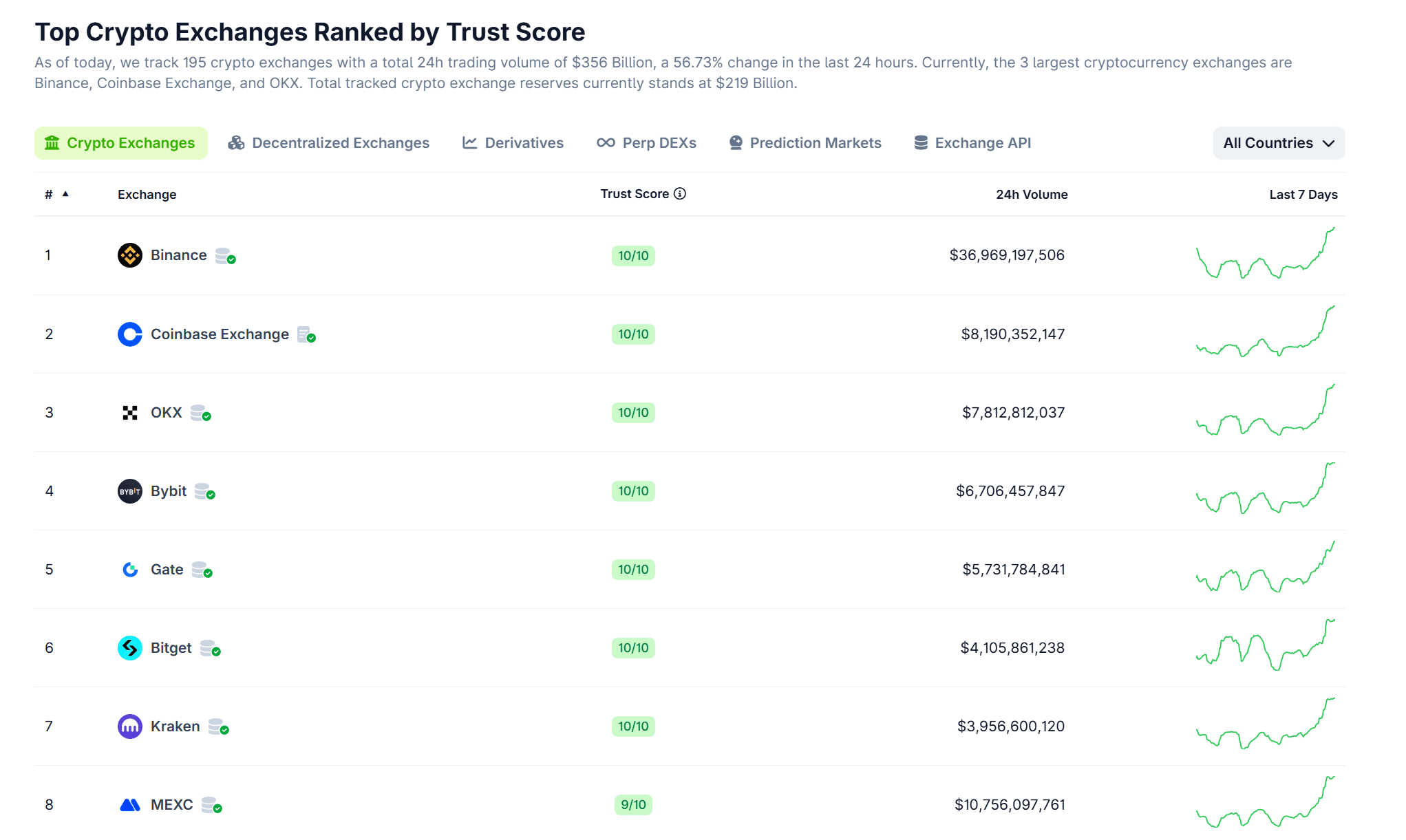
You saw I added the comparison chart above. It presents the overall picture of the market. So, which crypto exchange has the most coins? Let's find out.
Top crypto exchanges
According to CoinMarketCap, Binance tops the chart. The average volume it gets is massive compared to other platforms. It supports 400+ assets. You can open an account in 180 countries. The platform offers a low trading fee and supports 46 fiat currencies. A reliable white-label crypto exchange will offer a wide selection of assets, backed by robust label crypto exchange software. Want to know more? Read our article about the Bitcoin Fund.
Try online trading right now.
null
Your capital might be at risk. The financial services provided by this website carry a high level of risk and can result in the loss of all your funds. You should never invest money that you cannot afford to lose.
Find Your Perfect Broker: Explore Our List Now!
Choose the best with our expert-selected options
Find Your Perfect Broker: Explore Our List Now!
Choose the best with our expert-selected options
Discover top binary options brokers tailored to your region. Browse our curated lists by country: