Updated:November 11, 2026

10 min

How much money is there in the world?
Interesting question, right? The total money in the world has more than one answer, because it depends on what you count as money. Do you only want to consider all the physical cash and coins in the world? But what about all the money in our bank accounts?

Pejman Zwin
Author

Updated October 23, 2026
Interesting question, right? The total money in the world has more than one answer, because it depends on what you count as money. Do you only want to consider all the physical cash and coins in the world? But what about all the money in our bank accounts?
And all the investments in the stock market, real estate, cryptocurrencies, and gold; are they considered “money” as well? Let’s find out together. The other day, I was watching TV and this show came on… I’m sure all of you know it. Everyone has come across “Who Wants to be a Millionaire?” at least once in their lifetime.
Short version: if you only count notes and coins, roughly 11.4 trillion dollars exists across every country and currency. Widen the definition to include bank accounts and the figure runs to 148.5 trillion. Which of those is the right answer depends entirely on which question you are asking, so it is worth understanding the difference before quoting either.
The quote made me wonder: if we divide all the money in the world between all people, how much would each person get? I knew this was merely a fantasy and would never happen, but I couldn’t stop my curiosity from finding the answers to these questions.
So let’s get started with the first step: to find out how much money is in the world, we first have to figure out how to categorize the different types of money there are.
Money Aggregates
Different stages of Money are typically classified as “M” s.They range from the narrowest M0 to the broadest M3, depending on the policy formulation of the country’s central bank.
For instance, the Federal Reserve System - the central bank of the United States of America -publishes the money supply data for the US. In order to understand the different money aggregates better, let’s first talk about how new money is created. In the most simple terms, new money can be created in two ways:
In almost every country on earth, one of the ways new money can be born is through a central bank. Let’s say that David runs the central bank in your country.
He is really smart and pays close attention to your country’s economy. So if David feels that an increase in the money supply would benefit the economy, well, he can just make more money. It’s that easy! It doesn’t need to be printed as physical cash to be born.
The next step involves commercial banks like Bank of America and Citigroup. These are the banks that you and I use. All the central bank needs to do is buy some things (for example, precious metals like gold) from commercial banks using the money it just made. Now commercial banks have more money, or in other words, new money was created.
There’s another way money can be born; it involves commercial banks and gets to the heart of our question.

The competition on live television
If I go to the bank and deposit $5, the bank will gladly hold on to that money for me. I get to spend or withdraw that $5 whenever I want.
The thing is, legally, banks only need to reserve a fraction of the money they are given. This is known as Fractional Reserve Banking, which happens in almost every country.
It means that if someone else comes along, my friend Jake for example, and he wants to borrow $3, the bank can lend him the money from my $5. Now, whenever he wants, Jake can spend his $3.
But here’s the thing: Jake can spend $3, and I can spend $5 for a total of $8 despite the fact that there is only $5 in the bank. Thus, new money has been born. If you want to count all the spendable money in the world, we will need to include this type of money that fractional reserve banking creates.
Scale that mechanism up across every bank and every loan and you get the single most important fact on this page: most of the world's money was created by lending, not by printing. It is why M1 comes out roughly seven times larger than M0.
It also explains why bank runs are dangerous. If every depositor asked for their money on the same morning, it would not be there, because most of it was lent out and is circulating somewhere else entirely.
Now that you know how new money is born, I’m going to define different money aggregates for you so you can understand how the total amount of money in the world can be calculated:
M0: the total amount of physical cash (notes and coins) that exists on the entire planet. M0 is an aggregate of all coins and banknotes. The $11.4 trillion figure I stated earlier is the current global M0 value.
M1: includes all the money in M0 plus money that people can access quickly - like money in your checking or instant savings account.
Since the usage of digital money (like credit or debit cards) is vastly increasing worldwide and hence decreasing the use of physical cash, the M1 money aggregate figure is almost 7 times bigger than M0. The current M1 figure is estimated to be equivalent to $76.5 trillion.
M2: an even broader definition of money, which includes all the money in M1 plus money that you can’t necessarily spend right away or in other words, aren’t very liquid. For instance, savings accounts or Certificates of Deposits (CDs) under $100,000.
M3: the broadest definition of money that includes all currencies (notes and coins), checking accounts, savings accounts, small CDs, and large long-time deposits. In other words, the M3 money aggregate is M2 plus large long-time deposits.
The Federal Reserve of the US doesn’t report M3 since 2006, as it doesn’t convey any additional information about economic activity that is not already embodied in M2.
These money aggregates are measured by the Federal Reserve Board in the US, but in other countries, it is done by their respective central banks. For instance, the European Central Bank (ECB) measures the money supply for different European countries. Now let’s find out the equivalent figures of each of these aggregates and, eventually, how much money is in the world.
How much money is there in the world?
Now that you have understood the different money aggregates, this question becomes much easier to answer. I have calculated all the countries’ total money aggregates for you using the most recent references from December 2022.

Money Aggregates
Since I didn’t want to use outdated data, I personally calculated the money aggregates for you, which took a significant amount of time and energy. So stay with me as we finally get to the numbers!
Globally, M0 is estimated to be the equivalent of $11.4 trillion across all countries and currencies, according to most recent references. Let me show you how big that number is: $11,400,000,000,000.
That means if we were to divide M0 between every person in the world, each person would receive around $1,400. And that is just the aggregate of all the physical cash in the world.
According to most recent references, the next money aggregate, M1, is estimated to be the equivalent of $76.5 trillion globally. So if we were to divide M1 between every person in the world, each person would receive $9,500.
Across all countries and currencies, the M2 aggregate is estimated to be an equivalent of $130.5 trillion, according to most recent references. If this amount was to be divided between every person in the world, each one would receive around $16,000.
Finally, the broadest money aggregate, M3, is estimated to be an equivalent of $148.5 trillion globally, according to most recent references. If we were to divide this amount between all the people in the world, each person would receive around $18,500.
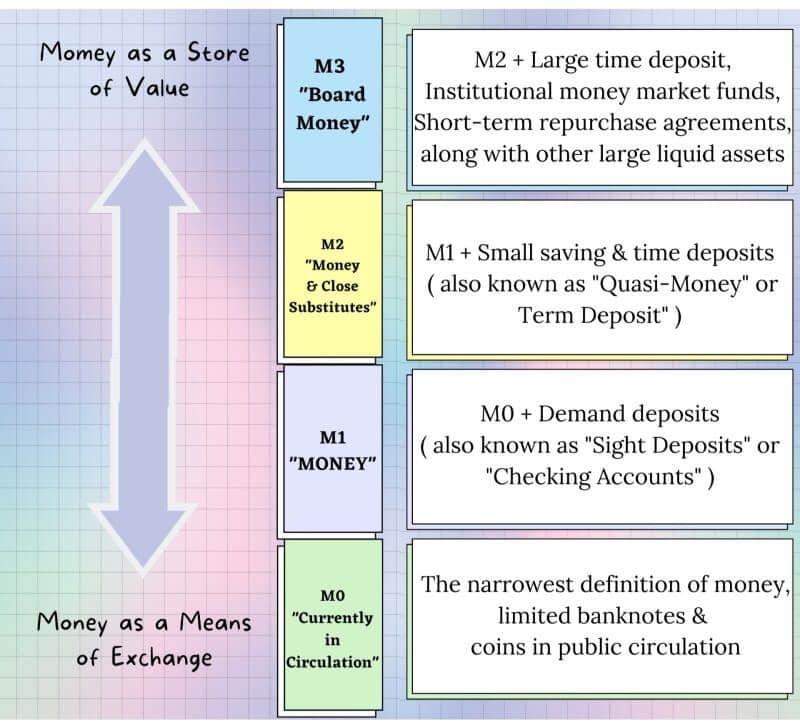
Money as a means of exchange
What these figures leave out
Money and wealth are not the same thing, and the aggregates above measure only the first.
Shares are not money. A holding has a market value that moves second by second, and turning it into money means finding a buyer. Property works the same way, only slower. Gold is a commodity: it has been money historically and can be sold for money, but no aggregate counts it.
Cryptocurrency sits outside the framework altogether, since central banks compile these numbers from the banking systems they supervise. Its market capitalisation is reported separately.

How Much Money is There in the World?
Add all of that together and the global wealth figure comes out several times larger than the money supply. Both are real, they just answer different questions. When someone quotes a total in the hundreds of trillions, they are counting assets rather than money.
Why published totals disagree
Look this up in three places and you will get three different numbers, for structural reasons rather than sloppy ones.
Countries define the aggregates differently, so what one central bank counts in M1 another puts in M2. Exchange rates move, and since dozens of currencies are converted into dollars at some rate on some date, the total shifts with the rate alone. National figures publish on different schedules, so any global aggregate mixes data of varying freshness.
Use these numbers for scale, not precision.
Why the money supply matters to traders
This is not trivia. The money supply is one of the primary forces behind the markets people trade.
Expanding supply tends to weaken a currency against others and lift nominal asset prices; contracting supply does the reverse. Central bank decisions on tightening or easing are among the most watched events in the calendar for exactly that reason.
For a currency trader, the relative growth of two countries' money supplies is part of the fundamental case for a pair moving. For anyone holding assets, monetary expansion is the backdrop against which nominal returns should be read: a portfolio up 5 percent while supply grows faster has not gained purchasing power. Our economic calendar tracks the announcements that move these numbers, and the brokers hub covers platforms for trading the currencies affected.
That gives you the full range, from the narrowest definition of money to the broadest. Quote the figure that matches your question: cash in circulation is one thing, everything sitting in the world's bank accounts is quite another.
FAQ
What is the total money in the world?
It depends on the definition. Physical cash worldwide comes to about 11.4 trillion dollars. Include current accounts and instant savings and it reaches around 76.5 trillion. Add less liquid deposits for roughly 130.5 trillion, and the broadest measure including large time deposits is about 148.5 trillion.
How is the world's money supply measured?
Through aggregates labelled M0 to M3, each compiled by the relevant central bank for its own currency. M0 is physical cash, M1 adds immediately accessible accounts, M2 adds savings and small certificates of deposit, M3 adds large long-term deposits. A global figure means summing dozens of national datasets.
Does the money supply include crypto, shares and property?
No. The aggregates measure money, not wealth. Shares, property and gold can be sold for money but are not counted in M0 to M3. Cryptocurrency sits outside the banking systems central banks measure, so it is reported separately as market capitalisation.
Why do different sources give different totals?
Country definitions of each aggregate vary, so global totals reconcile inconsistent categories. Exchange rates move, changing the dollar total without any underlying change. National figures publish on different schedules. And the supply itself changes continuously through central bank operations and bank lending.
Find Your Perfect Broker: Explore Our List Now!
Choose the best with our expert-selected options

Find Your Perfect Broker: Explore Our List Now!
Choose the best with our expert-selected options
Discover top binary options brokers tailored to your region. Browse our curated lists by country: