Updated:November 25, 2026

9 min

How arbitrage trading works: forex, crypto and P2P examples
Bitcoin can show a $300 price difference between exchanges while a 0.10 BTC trade leaves only $12.97 after assumed fees. Calculate both executable legs and the cost of restoring your balances.

Chris Cartwright
Author

Exchange A offers Bitcoin at $60,000. Exchange B displays $60,300. A 0.10 BTC purchase and sale appear to leave $30. Two trading fees and a transfer charge can reduce that to $12.97, and the second price can disappear before the coin arrives.
Arbitrage trading starts with that complete transaction. You need a quantity both sides can execute, compatible assets and a way to settle or rebalance the positions. A price discrepancy on a screen supplies a candidate for calculation.
Arbitrage definition and meaning
The strict arbitrage definition describes transactions that exploit inconsistent prices without requiring a favourable directional move under their stated assumptions. Retail discussions often extend the word to arrangements with substantial execution, financing or counterparty exposure. Identify those remaining risks before describing the return.
The arbitrage trading meaning is easiest to see through two simultaneous trades in the same asset. Buy the cheaper executable offer and sell the more expensive executable bid. If one leg is delayed, rejected or priced differently, the combined result can depend on the market's next move.
Quoted last prices are unsuitable inputs for that calculation. A venue's last transaction may have occurred several seconds ago or involved a tiny quantity. Use bid and ask depth for the size you intend to transact, then include charges for completing the entire cycle.
Arbitrage in trading also includes relationships between instruments, such as spot and futures. Their payoffs and settlement must be compatible. A different token wrapper, maturity, delivery rule or collateral currency can create a basis risk that a shared name conceals.
Currency arbitrage: triangular and cross-broker
Triangular arbitrage converts through three currencies and returns to the starting currency. Each step uses the rate available for the direction of that conversion. Inverting a quoted ask as though it were a bid can create a fictitious profit.
Consider hypothetical executable quotes: EUR/USD ask 1.1000, EUR/GBP bid 0.8600 and GBP/USD bid 1.2850. Starting with $10,000, buy €9,090.91, sell those euros for about £7,818.18, then sell the pounds for about $10,046.36. The gross difference is $46.36 before commissions and other costs.
The calculation assumes every quantity fills at the stated quote. At a hypothetical 0.1% charge on each conversion, the three-step amount becomes approximately $10,016.25. A smaller available quantity or adverse quote change can remove that remaining $16.25.
Cross-broker arbitrage adds account and contractual differences. Two EUR/USD symbols may use different quote conventions, financing or execution policies. An apparent stale-price opportunity may not remain executable when the order reaches the venue. Check the agreement and actual fills before treating the displayed gap as income.
An arbitrage trading bot also needs a response to partial completion. If step one fills and step two fails, define whether it cancels, retries within a price limit or closes the exposure. Unlimited retries can turn a small quoted advantage into an uncontrolled directional position.
Crypto arbitrage between exchanges
Return to the opening 0.10 BTC example. Assume A's available ask is $60,000 and B's available bid is $60,300 for at least 0.10 BTC. The purchase costs $6,000 and the sale produces $6,030 before charges.
The table uses hypothetical 0.1% trading fees and a $5 transfer cost. It excludes tax, inventory financing and any additional rebalancing charge. Those omissions must be added when they apply to a real cycle.
| Item | Calculation | Cash effect |
|---|---|---|
| Gross price difference | $6,030 minus $6,000 | +$30.00 |
| Buy fee | $6,000 × 0.1% | −$6.00 |
| Sell fee | $6,030 × 0.1% | −$6.03 |
| Assumed transfer charge | Stated example | −$5.00 |
| Amount remaining | Sum of the above | +$12.97 |
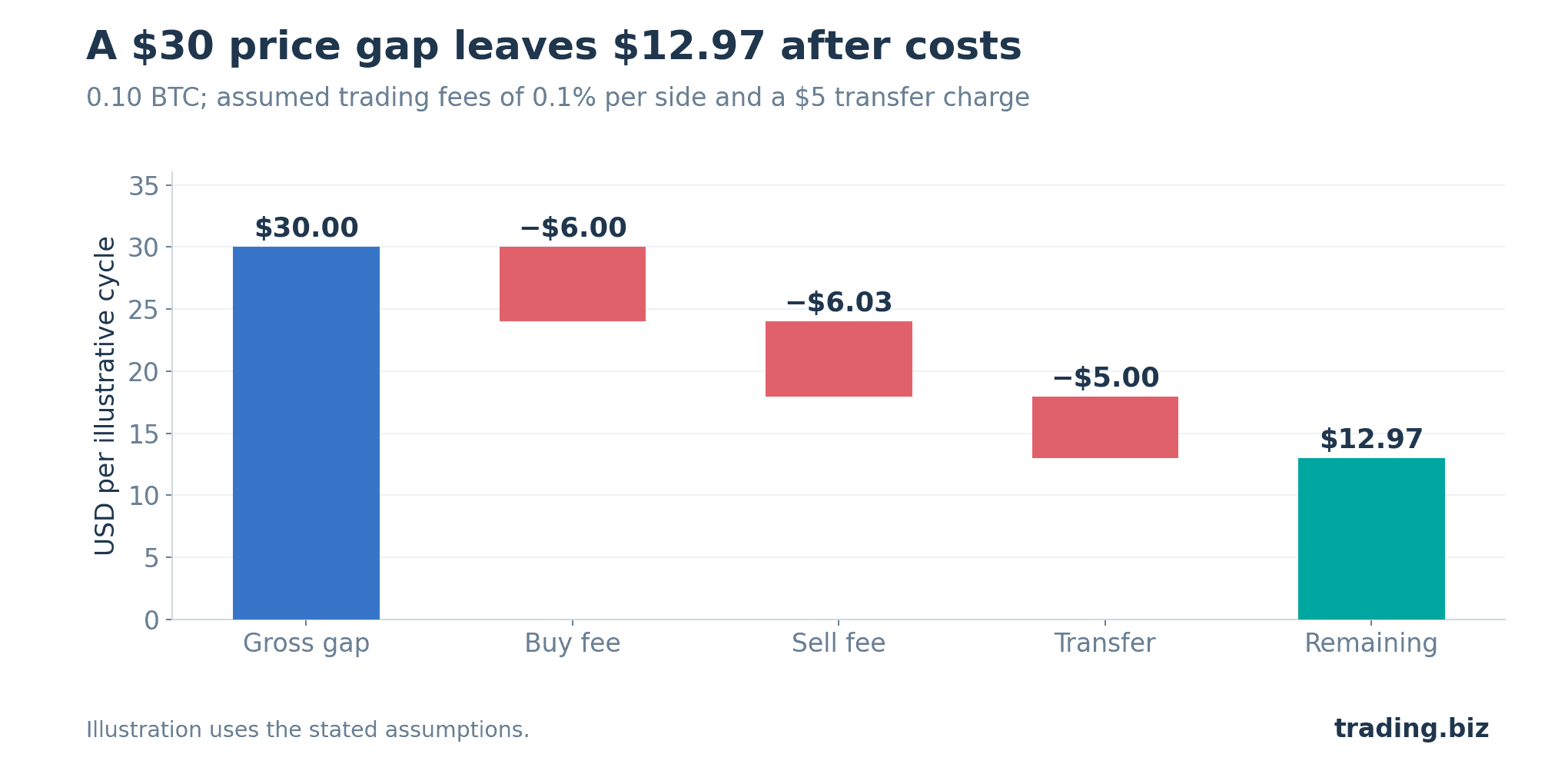
Figure 1. Hypothetical costs reduce a $30 cross-exchange price difference to $12.97. The illustration assumes both prices remain executable and excludes additional rebalancing expenses.
If you buy first and transfer the asset before selling, B's later bid determines the outcome. Blockchain confirmation, deposit processing and venue checks can delay the second leg. The displayed gap is still exposed to price changes during that interval.
Holding cash on A and Bitcoin on B allows buying and selling without waiting for that transfer. Afterward, the inventory has moved between venues and needs rebalancing. Include the funding tied up on both sides and the cost of restoring the starting balances.
A crypto arbitrage scanner can identify quoted discrepancies. It may omit depth, withdrawal status, networks, account limits or your personal fee tier. Reproduce its calculation independently using the asset and network you can actually deposit and withdraw.
P2P arbitrage: buying and selling across payment methods
P2P arbitrage compares prices across fiat payment arrangements or counterparties. A USDT advertisement can carry a premium because of payment speed, limits, access or settlement risk. Check the conditions attached to the price before comparing two advertisements.
For a hypothetical INR example, buying 1,000 USDT at ₹83 and selling at ₹84 produces a ₹1,000 gross difference on ₹83,000 spent. Platform charges, bank costs, tax treatment and payment disputes can change the net result. These example rates are inputs for arithmetic, without a claim about current market prices.
Binance's P2P fraud guidance discusses chargebacks and third-party payments. Confirm receipt through the actual bank or wallet account, verify the counterparty details and use the platform's transaction and dispute process. A screenshot or message saying paid cannot establish final settlement.
Arbitrage between payment methods can also involve restrictions on commercial use, account limits and local rules. Establish that the complete transaction is permitted for your residence and payment accounts. A profitable conversion calculation supplies no permission to bypass those conditions.
Keep fiat settlement and crypto release as separate events in the record. If a payment can be reversed, a completed token transfer may leave you unable to reverse your own leg. The advertised premium must be assessed beside that exposure.
Costs that erase the gap: fees, spreads and transfer time
Use a cycle-level calculation: final available assets minus starting assets, less all outstanding liabilities and costs. Include trading charges, borrow interest, network fees, currency conversion and the cost of returning inventory to its original location.
Arbitrage in futures trading requires another timeline. In a simplified cash-and-carry example, spot Bitcoin costs $60,000 and a compatible future is $61,500. Buying 0.10 BTC and shorting equivalent futures exposure gives an initial $150 price difference, subject to the contract's settlement mechanics.
Assume the $6,000 spot purchase is financed for 90 days at a hypothetical 6% simple annual rate using 365 days. Financing is approximately $88.77. With another assumed $20 in costs, the remaining amount is $41.23 before any additional collateral or operational expense.
That amount does not describe the cash you may need along the way. The Dallas Fed's analysis of cash-futures basis trades discusses sensitivity to financing conditions. A widening basis or changing funding terms can create pressure before the intended convergence or settlement date.
Perpetual futures introduce funding payments with a rate that can change. A currently positive funding receipt cannot be projected unchanged for 90 days. Model adverse rates, collateral needs and the cost of closing both legs before calling a spot-perpetual arrangement profitable.
Calculate a break-even gap for the intended quantity. In the 0.10 BTC example, trading fees and the assumed transfer charge total $17.03 at the stated prices. Dividing that amount by 0.10 BTC gives about $170.30 per BTC. A smaller quoted difference would fail to cover those costs, even before adding a safety allowance or rebalancing.
The cost floor can change with quantity. A fixed $5 transfer charge equals 0.5% of a $1,000 transfer and 0.05% of a $10,000 transfer. Increasing size reduces that percentage while increasing the funds exposed to the venue and available-depth constraints. Recalculate both effects instead of scaling a small result linearly.
Measure the capital committed to the whole arrangement. If buying requires $6,000 on A while selling relies on roughly $6,030 of Bitcoin already on B, the cycle uses inventory at both locations. A $12.97 result is about 0.108% of $12,030, before further costs. Reporting it solely against the $6,000 purchase balance would describe a different denominator.
Add a completion deadline to the record. A cycle completed in ten minutes and one delayed for three days can show the same cash difference while tying up capital for very different periods. Do not annualise a short observation until the calculation includes idle time, failed cycles and the opportunity to repeat the transaction at the assumed size.
Risks: execution, withdrawal limits and scams
Execution risk begins with the first unmatched fill. Keep a maximum price deviation, exposure cap and response for a failed leg. If the quoted advantage is $12.97, a recovery order costing $20 turns the completed cycle negative.
Counterparty risk remains when funds sit on a venue. A price premium can coincide with difficulty withdrawing assets or fiat. Establish withdrawal availability, limits and expected processing before transferring more capital to capture the premium.
Asset compatibility matters as well. Tokens with similar tickers can exist on incompatible networks or represent different claims. Check the exact asset, network, address requirements and deposit policy on both sides. A transfer error can overwhelm many small successful cycles.
Software introduces its own failure modes: stale timestamps, duplicated orders, rate limits and lost connections. Test with limited exposure and reconcile each venue's actual balances. An alert that orders were sent cannot prove that both were filled.
Be sceptical of a service offering fixed daily arbitrage returns without showing venues, counterparties and complete account records. A claimed 1% every day is a performance claim requiring evidence. Referral payments and a dashboard balance do not establish an executable trading process.
Terms used in arbitrage calculations
These definitions help identify where the remaining exposure sits. Attach each cost and obligation to a specific leg before comparing two proposed cycles.
| Term | Meaning |
|---|---|
| Executable bid or ask | Price available for a stated quantity and direction |
| Basis | Price difference between related instruments |
| Leg risk | Exposure created when only part of a transaction executes |
| Rebalancing | Restoring the intended cash and asset distribution |
| Financing cost | Expense of funding inventory or collateral over time |
FAQ
What is arbitrage in trading useful for?
It provides a way to examine inconsistent prices and the transactions that could connect them. The proposed cycle still needs executable quotes, compatible settlement and a complete cost calculation.
Can a beginner use a crypto arbitrage trading bot?
Only after understanding its permissions, sizing and failed-leg controls. Start by reproducing its quote calculation and comparing it with actual fills. Automation increases the speed at which both correct and incorrect rules can operate.
Is P2P arbitrage risk-free?
Payment reversals, counterparty disputes, account restrictions and local requirements can affect the result. Verify the settlement route and calculate the complete cycle before committing funds.
What should I calculate first?
Write the starting balances, quantity, executable prices and ending balances for one complete cycle. Add every cost needed to restore the starting arrangement. Recheck the available quotes before any order is submitted.
Find Your Perfect Broker: Explore Our List Now!
Choose the best with our expert-selected options
Find Your Perfect Broker: Explore Our List Now!
Choose the best with our expert-selected options
Discover top binary options brokers tailored to your region. Browse our curated lists by country: