Updated:November 25, 2026

10 min

0
How to find a low fee crypto exchange: maker, taker, withdrawals
Maker and taker rates are only part of an exchange bill. Compare current base fees, order execution, funding, currency conversion and withdrawals for the route you will actually use, with dated examples and a complete transaction calculation.

Joel Lim
Author
A $500 crypto purchase can carry a $0.50 trading fee and a $5 withdrawal charge. The smaller percentage on the trading page has little influence on that particular bill.
A useful low fee crypto exchange comparison follows the full route: funding the account, executing the order, holding the position and moving the proceeds. Start with the product and the legal entity available in your country.
How crypto exchange fees work: maker, taker and spread
A maker order adds resting liquidity to an order book. A taker order executes against available liquidity. The exchange applies the relevant rate to the filled quantity or value under the product's rules.
A limit order can be a taker. If you submit a buy limit at a price that immediately matches an existing ask, that fill removes liquidity. A post-only instruction can help enforce maker behaviour where supported, with the possibility that the exchange rejects or cancels an immediately marketable order.
One order can also contain different fills. Its immediately executed portion can pay a taker rate, while a remaining resting portion later earns maker treatment. Read the execution report before assuming the order ticket's label determined every fee.
The spread is the difference between the best bid and ask. Buying immediately at the ask and selling immediately at the bid crosses that difference. It is an execution cost separate from the explicit crypto exchange fee.
Depth adds another layer. A $100 market order might fill at the best ask, while a $50,000 order can consume several price levels. Compare the expected average execution price at your size, especially on less liquid pairs.
For a $1,000 trade at a 0.10% rate, the explicit fee is $1. An unchanged-value sale at the same rate adds another $1. The $2 round-trip fee excludes spread, price movement and all funding or transfer expenses.
Lowest spot and futures fees compared in a table
The table is a bounded comparison of selected published entry-level schedules checked on 25 November 2026. Quoted figures are percentages per fill, shown as maker / taker. Binance derivatives require a separate account-rate check. They exclude VIP rates, native-token discounts, special pairs, temporary promotions and other product charges.
| Platform and schedule | Spot maker / taker | Futures or perpetual maker / taker | Scope |
|---|---|---|---|
| Binance global, regular user | 0.10% / 0.10% | Check account fee screen | Standard spot; derivatives use their own schedule |
| Bybit global, non-VIP | 0.10% / 0.10% | 0.02% / 0.055% | Published spot and perpetual/futures base fees |
| Kraken Pro, Tier 1 | 0.40% / 0.80% | 0.02% / 0.05% | Published entry tier for the listed products |
Sources are the official Binance spot table, Binance USDⓈ-M table, Bybit fee guide and Kraken Pro schedule. Check the logged-in product fee screen before submitting an order; eligibility and entity-specific terms can change the applicable rate.
Within these selected standard entry-level spot schedules, Binance and Bybit show the lower listed rates. That statement does not establish the lowest fee crypto exchange across every jurisdiction, pair, account tier or promotion. Other venues and specialised markets can have different pricing.
Kraken's current displayed entry tier differs from older comparisons quoting 0.25% maker and 0.40% taker. Its published schedule also includes lower tiers reached through qualifying activity or assets. Date the source when comparing articles from different periods.
Spot ownership and a leveraged futures position are different exposures. A lower derivatives fee does not make a futures contract an interchangeable way to hold an asset. Funding, margin requirements and liquidation can dominate the cost difference.
For a $10,000 contract value, 0.05% costs $5 for one taker fill. At 0.02%, a maker fill costs $2. If the margin posted is $1,000, those fees still follow the $10,000 position value under this simplified example.
Maker pricing also has an execution trade-off. A resting buy can remain unfilled while the market rises, or fill just before a further decline. Estimate the strategy with its actual fill assumptions. Counting every desired maker order as completed can exaggerate the saving relative to an immediately executable route.
Keep a monthly cost record using your own activity. Separate explicit trading fees, funding, transfers and currency conversion. For spread and slippage, use a consistent benchmark timestamp and avoid counting the same price difference twice. A decision-price-to-fill estimate can already include the spread.
Check minimum order sizes and fee rounding as well. A fee charged in the received token can leave a smaller sellable balance than the order quantity suggests. Repeated small orders may create residual amounts below a platform's withdrawal or trading minimum. Those balances matter when you intend to empty the account after a short project.
Withdrawal and network fees
An exchange withdrawal charge and a blockchain network fee describe different items. The exchange can set a withdrawal tariff that does not exactly equal the network cost of processing its transaction. Check the fee, minimum amount and amount arriving at the destination.
The same token can be withdrawable on several networks. Both sender and recipient must support the network you choose. A lower fee does not make an unsupported destination compatible, and recovering an incorrectly routed transfer can be difficult or impossible.
Consider two hypothetical venues. Venue A charges 0.10% to buy $500 and $5 to withdraw. Venue B charges 0.25% to buy and $1 to withdraw. Assuming identical purchase prices, Venue A's explicit total is $5.50 and Venue B's is $2.25.
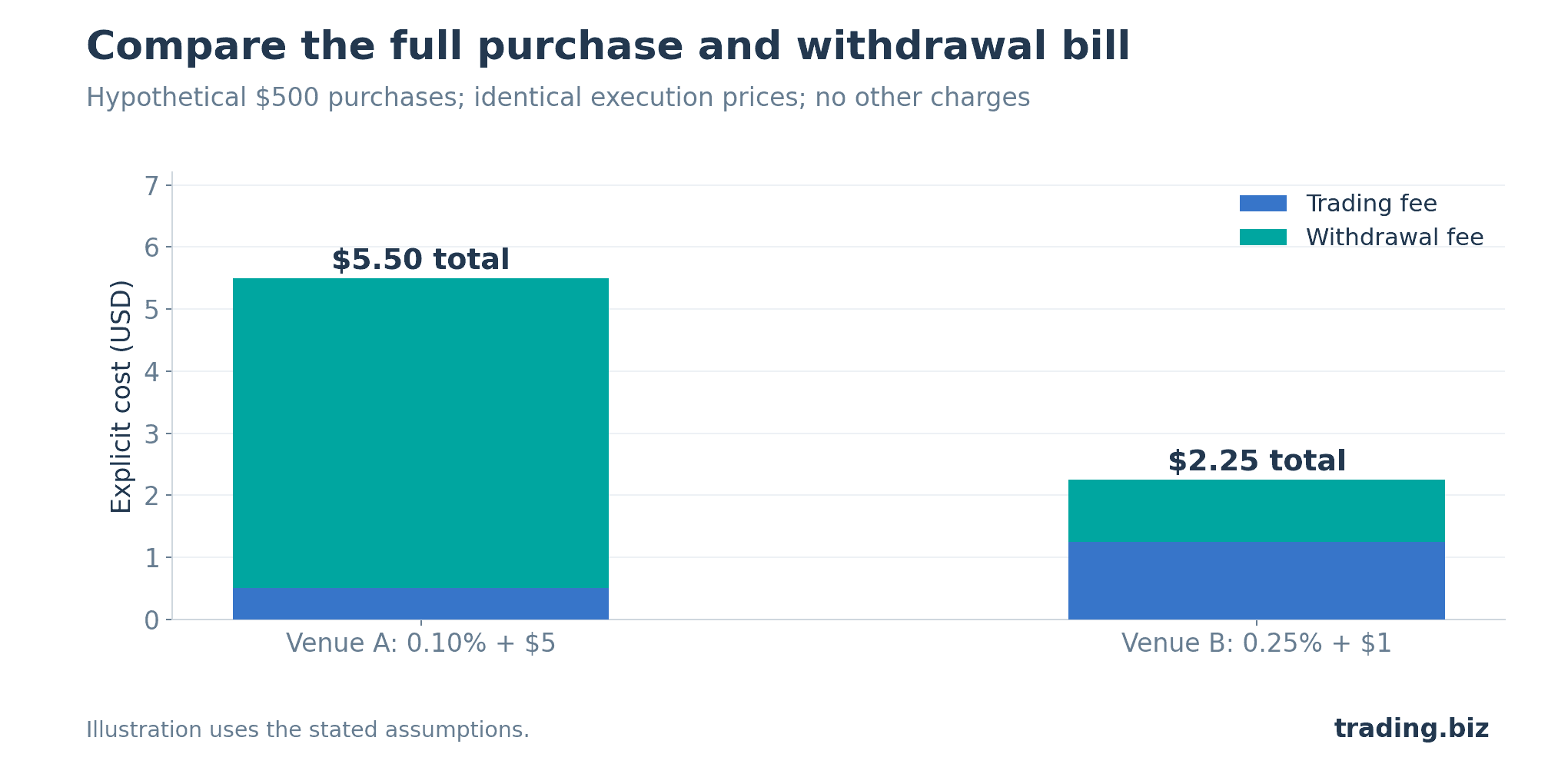
Figure 1. Illustrative $500 purchases: Venue A charges $0.50 for trading plus $5 for withdrawal; Venue B charges $1.25 plus $1. Identical execution prices and no other costs are assumed. These are hypothetical venues.
For larger balances, the percentage fee carries more weight. At $10,000, the same assumed tariffs produce $15 total at Venue A and $26 at Venue B. Your expected transaction size can reverse the cost result.
Withdrawal frequency matters too. Four $5 withdrawals cost $20, while one costs $5 if the tariff stays unchanged. Batching can reduce fixed charges, but keeping assets on an exchange for longer increases the balance exposed to its custody and access arrangements.
Before the main transfer, test the exact asset and network with an appropriate small amount. Confirm whether the destination requires a memo or tag. Include the test's fee in the cost estimate instead of assuming a free rehearsal.
Hidden costs: spreads, conversion and deposit fees
Instant-buy and Convert interfaces can quote a total exchange rate instead of an order-book fee. Compare the final asset amount with the contemporaneous order-book route at the same size. A no fee crypto exchange headline can coexist with a less favourable quoted conversion rate.
Suppose a $1,000 purchase delivers crypto worth $990 at the reference price you are using. The $10 difference is 1% of the cash spent. An explicit trading fee of 0.10% would be only $1 on the same nominal amount, before any difference in execution or funding.
Card processors, payment providers and banks can add deposit, cash-advance or foreign-exchange charges. A zero exchange deposit fee cannot establish that your bank will charge nothing. Check the sending currency and the amount credited to the trading balance.
Margin borrowing and perpetual funding also deserve separate lines. In a hypothetical perpetual contract, a 0.01% funding payment on $10,000 is $1 per interval. If that rate applied three times in a day, a paying position would incur $3. Actual rates, intervals and payment direction vary.
Funding can be a receipt in another position or period. The quoted rate is not a guaranteed income stream. Read the contract's funding schedule and holding-time exposure before comparing two otherwise similar trading fees.
Finally, account for the exit currency. Selling crypto into USDT, converting USDT into a local currency and withdrawing that currency can involve several prices or fees. A useful crypto exchange fee comparison uses the net amount reaching the intended final destination.
Fee discounts: VIP tiers, native token and referral
VIP tiers usually depend on qualifying volume, balances or other conditions. Check the measurement window, eligible products and when the new rate starts. The next tier can be relevant to your expected activity without justifying extra trades to reach it.
For example, spending $80 in additional spread and fees to secure an expected $20 discount creates a $60 shortfall. Estimate savings from trades you already intend to make. Repeatedly trading with yourself can also violate market-conduct rules.
Binance's displayed standard spot table shows a 25% BNB fee discount, reducing a 0.10% fee to 0.075% when the conditions are met. Its futures fee explanation describes a separate 10% BNB discount for eligible USDⓈ-M fees. Do not apply one product's discount percentage to every product.
Holding a native token introduces price exposure and requires enough eligible balance for fees. If a discount saves $5 while the token allocation falls $30, the combined economics differ from the trading-fee saving alone. Size that holding as an asset exposure.
A referral rebate can depend on the referring account, product and promotional period. Confirm it on your own account and check the actual fee report. An advertisement showing a maximum potential rebate does not establish what your next order will receive.
Low fee vs safe: balancing cost and security
Begin with legal access to the product and the entity handling your assets. Verify the provider's current registration or authorisation where relevant, what that status covers and which complaint route exists. A global brand can serve different customers through different companies.
Review custody terms, withdrawal controls, security history and account protections. Proof-of-reserves information can contribute evidence about particular assets at a point in time. Its scope may leave liabilities, legal claims or operational controls outside the assessment.
Use strong authentication, protect recovery methods and restrict API permissions to the required functions. A trading bot generally does not need withdrawal authority to place orders. Test withdrawal controls before leaving a substantial balance on the platform.
US readers need a separate entity and product check. Binance global's figures do not represent Binance.US, and global derivatives offers cannot be assumed available to US residents. Searches for the best crypto exchange USA or lowest crypto exchange fees in USA should compare the schedules of providers actually permitted to serve the reader and product.
A top 10 crypto exchanges list can hide these distinctions by ranking brands in one column. Build a smaller shortlist around access, custody and your complete transaction instead. Then compare the dated, logged-in costs for that same route.
Terms on an exchange fee page
These labels describe separate costs or eligibility rules. Keep them distinct when recording the total for a purchase and withdrawal.
| Term | Meaning |
|---|---|
| Maker fee | Rate on an execution that adds resting liquidity |
| Taker fee | Rate on an execution that removes available liquidity |
| Spread | Difference between the best bid and ask |
| Funding | Periodic payment associated with a perpetual contract |
| VIP tier | Pricing level reached under specified qualifying conditions |
| Withdrawal fee | Platform charge for transferring assets out |
FAQ
Is a low-fee crypto exchange always cheaper than an instant-buy app?
Compare the same cash amount and final asset quantity after every charge. Funding methods, spread, withdrawal and account tier can change the result. The interface name alone cannot settle it.
Can a limit order pay a taker fee?
Yes. An immediately marketable limit order can execute against resting liquidity. Check post-only behaviour if maker treatment is required and review the actual fills afterwards.
Are zero-fee pairs completely free to trade?
Spread, slippage, funding where applicable, transfers and conversion can still create costs. Check the promotional pair, duration and eligible order types before calculating the expected saving.
What should I check immediately before placing an order?
Confirm the legal entity, selected product, personal fee tier and order value. Record the estimated net proceeds for the complete route, then compare them with the execution and withdrawal reports.
Find Your Perfect Broker: Explore Our List Now!
Choose the best with our expert-selected options
Find Your Perfect Broker: Explore Our List Now!
Choose the best with our expert-selected options
Discover top binary options brokers tailored to your region. Browse our curated lists by country: