Updated:November 25, 2026

10 min

0
How to judge the best cryptocurrency to buy now using fundamentals
A useful crypto shortlist connects real usage to token demand, supply growth and the price you would pay. Examine Bitcoin, Ethereum and other sectors through those links, then set an allocation and exit process that can withstand a failed thesis.

Pogodin Viktor
Author

A token priced at $0.01 can have a larger valuation than one priced at $100. Multiply each price by its circulating supply and the apparent bargain can disappear.
The best cryptocurrency to buy now search begins with a missing question: what would justify owning the asset at the current valuation? A useful answer needs evidence about demand, supply, security and your ability to exit.
Why no one can name a sure winner
Future returns depend on developments that are not fully known today. A working network can lose users. A growing application can capture little value for its token. A successful project can also be an expensive investment when the purchase price already assumes years of growth.
Treat a confident target as a scenario with assumptions. If a forecast expects a token to double, ask what circulating supply, adoption, revenue or market valuation would support that result. A chart arrow alone does not explain the demand required.
The date matters as well. A report written before a large unlock, security incident or regulatory decision can describe a different investment case. This framework was checked on 25 November 2026; live prices and executable liquidity still need checking when you act.
Separate a research shortlist from a trade instruction. Bitcoin and Ethereum provide useful starting points for studying different network models. Their prominence does not establish a suitable entry price or allocation for every reader.
Fundamental criteria: utility, adoption and tokenomics
Start with the service. Who uses it, what problem does it solve and why must the token be involved? Paying transaction fees, securing a network and governing an application create different links between activity and token demand.
Then inspect adoption with a consistent measurement period. Compare monthly fee-paying activity, repeat usage and economic volume over several periods. One wallet address can represent a bot, an exchange or multiple customers, so an address count needs interpretation.
Transaction volume can also be subsidised. If a project distributes $2 million in incentives to attract $200,000 in fees, the two figures describe different sides of the economics. Examine what remains after incentives decline and whether users continue paying for the service.
Tokenomics connects those activities to supply and ownership. Record circulating supply, maximum or expected supply, issuance, burns, team and investor allocations, vesting dates and governance powers. Check who can change the rules and how quickly changes can take effect.
Consider a hypothetical token priced at $1 with 100 million circulating units and a maximum supply of one billion. Its circulating market capitalization is $100 million. Its fully diluted valuation at the same price is $1 billion. The unit price alone hides that gap.
Suppose 50 million additional units enter circulation. At an unchanged $100 million circulating valuation, the implied price becomes about $0.667. This fixed-valuation illustration isolates supply arithmetic; the actual market price can rise or fall with demand and expectations.
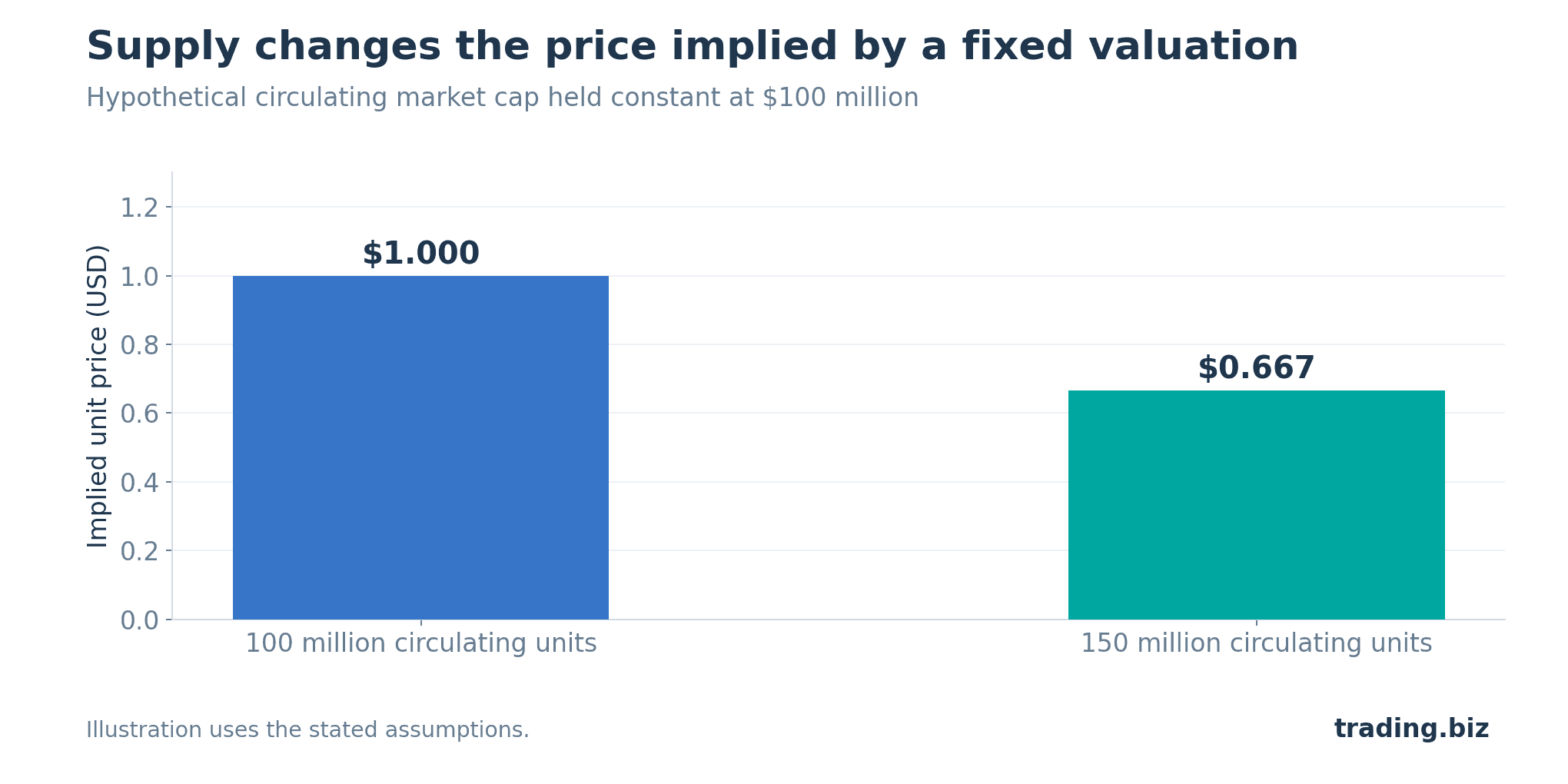
Figure 1. At a fixed hypothetical circulating valuation of $100 million, increasing circulating supply from 100 million to 150 million units changes the implied price from $1 to approximately $0.667. The fixed-valuation assumption isolates the supply calculation.
Check security separately from valuation. Review the consensus design, validator or mining concentration, upgrade controls, contract audits and incident response. An audit covers a defined scope and version. It cannot guarantee that every future upgrade or connected protocol is safe.
Finally, examine executable liquidity. A displayed market cap does not show how much you can sell near the quoted price. Inspect order-book depth, venue concentration and withdrawals for the position size you are considering.
Large-cap coins: Bitcoin and Ethereum
Bitcoin's investment case commonly begins with its monetary design, transfer network and issuance limit. Bitcoin's halving documentation describes the 21 million supply limit and the scheduled reduction of new issuance. Demand for the asset still determines what buyers will pay for that supply.
The research task is to test the demand thesis. Consider who needs to hold or transfer BTC, the custody route they use and the conditions under which they might sell. A fixed supply limit does not establish a minimum market price.
Also distinguish the network from your access method. Holding native BTC in a wallet, keeping a balance with an exchange and buying an exchange-traded product introduce different custody, fee and legal arrangements. Record which exposure your valuation argument actually concerns.
Ethereum supports application execution, with ETH used for network fees and staking. Ethereum's ETH guide describes those functions. Research should connect application demand, settlement activity, network economics and the token's role under the current rules.
ETH supply reflects issuance and fee burning. The balance can change with network conditions, as explained in the issuance documentation. Avoid assuming a permanently falling supply merely because some fees are burned.
Scaling creates another question. Activity can move through layer-two systems with their own fees and operating arrangements. Examine how that activity generates demand for Ethereum settlement and ETH, while accounting for the additional systems a user relies on.
For both assets, compare the thesis with valuation and your holding period. A strong five-year network argument cannot tell you whether next month's price move will be positive. Keep the operating evidence and the entry decision as separate research records.
Altcoins and sectors: what to check
Other assets need sector-specific questions. A payments network, an oracle and a governance token do not earn demand in the same way. Copying the BTC supply argument across them can miss the central economic mechanism.
| Sector or example | Evidence to examine | Main question for the token |
|---|---|---|
| Smart-contract networks, including Solana | Paid activity, reliability, fees and issuance | How does usage create sustainable token demand? |
| Oracles, including Chainlink | Services purchased, payment design and security arrangements | How does service demand connect to LINK? |
| DeFi applications | Fees, incentives, collateral and governance controls | What rights or cash flows does the token actually have? |
| Stablecoins | Reserves, redemption terms, issuer and chain | What preserves the peg and permits redemption? |
| Emerging gaming or infrastructure projects | Paying customers, retention and unlock schedule | Can usage persist after promotional rewards decline? |
For Solana, the official fee documentation explains transaction fees paid in SOL. Study those mechanics alongside issuance, staking participation and the quality of the activity producing the fees. A large transaction count can include activity with limited economic value.
Chainlink's documented Payment Abstraction can accept supported payment forms and convert them into LINK through decentralised exchange infrastructure. That mechanism gives the demand analysis something specific to test: service payments, conversion activity and the use of resulting tokens under the current arrangements.
For Chainlink, the LINK documentation describes service payments and network-security roles. Inspect the current payment and reward arrangements before assuming every new integration creates an immediate equivalent purchase of LINK in the market.
DeFi tokens need an explicit rights check. A governance vote, a fee discount and a legally enforceable claim on cash flow are different features. Read the current contracts, governance decisions and token terms before modelling token-holder revenue.
Stablecoins fit a different objective from volatile growth assets. Circle's transparency page provides reserve and assurance information for USDC, among other disclosures. Assess redemption eligibility and the custody route alongside those reports. A reserve disclosure does not make every secondary-market holder a direct bank depositor.
For emerging projects, request evidence beyond partnership logos. A named paying customer, repeat usage and a documented token requirement are more useful than an announcement without measurable activity. Check whether upcoming investor unlocks are large relative to the available trading depth.
Best crypto to invest for different risk levels
For someone who needs the money for rent, tax or a near-term purchase, a crypto allocation can be zero. A requirement to preserve a specific cash amount on a specific date conflicts with a position that can fall sharply or become difficult to access.
A reader beginning research can study BTC and ETH before adding smaller assets. Their different monetary and application models give you two distinct sets of evidence to examine. Start with a position small enough that operational mistakes and price losses do not disrupt essential plans.
A more speculative allocation might examine an additional sector only after documenting its demand mechanism and dilution. Calling an altcoin the next big cryptocurrency adds no evidence. State what would have to happen, by when, and which observation would undermine the idea.
Even a stablecoin allocation needs a purpose and a risk analysis. Currency exposure, issuer terms, blockchain transfers and exchange custody remain relevant. An advertised yield adds another service or counterparty whose economics need examination.
Your research can produce a watchlist without producing an immediate purchase. If the valuation requires an adoption assumption you cannot support, wait for better evidence or a different price. There is no requirement to own one asset from every sector.
Position sizing, diversification and exit rules
Set the portfolio-level exposure before choosing the number of coins. Suppose a hypothetical $20,000 portfolio allocates $1,000 to crypto, or 5%. A 70% fall in that sleeve costs $700, equal to 3.5% of the initial portfolio, before any losses elsewhere.
Within that sleeve, a $300 speculative token position can lose the full $300, or 1.5% of the initial portfolio. These are loss scenarios, not recommended allocation percentages. Leverage or borrowing can create additional consequences beyond a fully paid spot holding.
Diversification needs different risk sources. Five tokens using the same bridge, custodian or collateral system can share one failure path. BTC, ETH and smaller tokens can also fall together during a broad sell-off. Count operational dependencies as well as tickers.
Write an exit rule tied to the thesis. Examples include a broken security assumption, adoption falling below the level used in your valuation, an unexpected supply change or a portfolio allocation exceeding your chosen limit. A price stop can support execution discipline, with gaps and slippage still possible.
Plan how the sale reaches spendable cash. Verify the exchange, permitted local-currency route, transfer fees and tax records. An asset that looks liquid against a stablecoin still needs another step if your liability is a bank payment.
Keep a dated research note for each holding. Record the source documents, price, circulating supply, next material unlock and the next evidence review. Revisit it after a significant protocol change or incident even when the price has remained stable.
Terms used in a crypto research note
These definitions help compare assets with very different unit prices and supply schedules. Use the same date and currency when putting valuations side by side.
| Term | Meaning |
|---|---|
| Market capitalization | Price multiplied by circulating supply |
| Fully diluted valuation | Price multiplied by the supply measure used for full dilution |
| Tokenomics | Rules and incentives governing a token's supply, use and distribution |
| Unlock | Release of previously restricted tokens under a vesting arrangement |
| Liquidity | Ability to transact a specified size at acceptable prices |
| Position sizing | Setting exposure relative to capital and potential loss |
FAQ
What crypto should I buy now for a long-term holding?
Begin with the demand, supply and security case you can explain and verify. BTC and ETH offer different starting points for research. Check current valuation and your loss capacity before turning a thesis into a position.
Does a low token price mean more upside?
Price per unit needs the circulating supply and future dilution. A $0.01 token with one trillion units has a $10 billion circulating valuation. Compare valuation and demand assumptions before calling it cheap.
Is a top 5 crypto to buy now list enough research?
It can identify names to investigate. It cannot establish current rights, unlocks, custody arrangements or suitability. Build a dated evidence record for each asset that survives the initial screen.
What should I do before the first purchase?
Write the reason for ownership, maximum cash exposure, evidence that would invalidate the thesis and the route back to cash. Test the chosen custody and transfer process with a small amount before increasing the position.
Find Your Perfect Broker: Explore Our List Now!
Choose the best with our expert-selected options
Find Your Perfect Broker: Explore Our List Now!
Choose the best with our expert-selected options
Discover top binary options brokers tailored to your region. Browse our curated lists by country: