Updated:November 11, 2026

11 min

Revisiting the history of Bitcoin
Revisiting the history of Bitcoin starts with one point. It was built to run with nobody in charge: no central management, no bank supervision, no government sign-off. Cryptography and peer-to-peer software do that work instead. A developer using the alias Satoshi Nakamoto presented Bitcoin to the public in 2009, and to this day nobody knows whether that name covered one person or a group.

Pejman Zwin
Author
Updated October 23, 2026
Revisiting the history of Bitcoin starts with one point. It was built to run with nobody in charge: no central management, no bank supervision, no government sign-off. Cryptography and peer-to-peer software do that work instead. A developer using the alias Satoshi Nakamoto presented Bitcoin to the public in 2009, and to this day nobody knows whether that name covered one person or a group.
It went on to become the best known cryptocurrency in the world. Thousands of others followed, and most of them borrowed the same basic design: a shared ledger, a fixed set of rules and no issuer to appeal to.
How it came about is a better story than most people expect. It did not grab me at first. When I heard about cryptocurrency in 2013 my reaction was short: that is nerd money.
In 2016 I looked again and dug in properly. Bitcoin turned out to be far more interesting than I had assumed. It is not only money. Blockchain is not a currency system either, it is a platform built on trust. There is a trading side to it as well, and different market phases call for different methods, shorting Bitcoin among them.
Crypto is everywhere now. Plenty of people have still never asked why Bitcoin was built in the first place, and that is the part worth going back to.
What is the history of Bitcoin?
The birth of Bitcoin sits where money, politics and central control over cash meet. The 2008 crash was the trigger. An anonymous entity calling itself Satoshi Nakamoto set out to break the centralization of money.
Nakamoto's premise was that a financial system should be transparent and open to everyone. People have always needed a way to pay for goods and services. The earliest version was the bartering system, livestock traded for grain. It worked, but it gave no consistent way to establish worth.
Gold fixed that. It became the intermediary that made trade workable without a direct swap. Precious metals are hard to produce and limited in supply, which is a virtue and a ceiling at the same time. Government-issued fiat currencies such as the US dollar and the euro eventually took the place of gold and silver.
Fiat brought its own problems: debasement and inflation, because printing more paper is easy. One theme runs through the whole story of payments. People pick whatever is fastest and simplest to complete.

Some economists and historians rate the arrival of cryptocurrency above the invention of gold money. Bill Gates called Bitcoin a technological tour de force. The 2008 debut started a revolution, but it stood on decades of earlier work.
The story of crypto begins with the story of the internet. A currency of this kind cannot exist without a worldwide network of connected machines, and it took thirty years of that network before anyone could build one.
Plenty of people name David Chaum as the first pioneer here. He described untraceable digital money in a research paper in 1983, while still a graduate student at Berkeley.
He built many of the cryptographic protocols that later sat underneath cryptocurrencies. The nickname stuck: the Godfather of Anonymous Communication.
His argument was about privacy. In an online society privacy is essential, and it cannot be left to governments or faceless corporations to hand out. Building and spreading working cryptography was the only reliable answer he saw.
Chaum's thinking shaped Bitcoin years later. At the time it was simply too early. DigiCash, the company he founded in 1989 to make the idea real, went bankrupt, and he walked away from the attempt.
In the late 1980s almost nobody wanted to do business online. Technical gaps and legal uncertainty kept banks and merchants out of it. That shifted in the early 1990s, when online stores began listing products on the World Wide Web and taking credit cards, and the first e-commerce transaction went through.
The dot-com boom of the mid-1990s brought the first digital currencies that actually functioned. E-gold, founded in 1996 and backed by gold, was among the first of them. PayPal followed in 1998, launched by Elon Musk, Peter Thiel and others, and that was the real breakthrough.
PayPal moved money between people online, across borders, without a bank branch in the middle. It replaced cheques and money orders with something that cleared in seconds.
Google Wallets, Apple Pay and the rest arrived later, and PayPal is still widely used. Even so, another decade passed before cryptocurrency became a working concept rather than a paper one.
Bitcoin was not the first cryptocurrency proposed. It was the first one that worked. It also popularised the record-keeping technology underneath it, the blockchain, which turned out to matter more than the coin itself.
Bitcoin's own history begins on Halloween 2008. Satoshi Nakamoto released a whitepaper on October 31 that year, setting out a new kind of currency. Eight pages, free to download, and the start of everything that followed.
Bitcoin launched during the 2008 global financial crisis, and the timing was almost certainly deliberate. Public trust in governments and large banks was collapsing. That opened room for a different answer.
Nakamoto's design cut out the long chain of financial intermediaries. Money could move instantly and anonymously, with no middleman fee and no government veto. Who Satoshi Nakamoto actually was is still unknown.
The mystery runs deeper than the name. Nakamoto has never touched the wallet holding over one million Bitcoins. Before vanishing, Satoshi named Gavin Andersen, a programmer who worked on the first version of Bitcoin, as successor. The final words in that email were plain: I have moved on to other things, Bitcoin is in good hands with Gavin and everyone.
The smallest transferable unit of Bitcoin is now called a Satoshi, in his honour. The network went live on January 3, 2009, with the Genesis Block. From that moment cryptocurrency stopped being an idea.
Turning that vision into a reliable, anonymous, decentralized payment system took years. Bitcoin had no monetary value at the start. Anyone could download the software for free and earn coins through mining, the process known as Proof-of-Work.
May 22, 2010 is the date everyone remembers. Somebody spent Bitcoin on a real purchase for the first time, and the purchase was a pizza. The day is now called Bitcoin Pizza Day, and it counted because it showed the currency could actually pay for something.
Miners worked out that their coins were worth money and started selling them on exchanges such as Mt. Gox, CEX.IO (commenced operations in 2013) and Tradehill. Over five days beginning on July 12th of 2009, the market value rose tenfold, from under a penny to 8 cents.
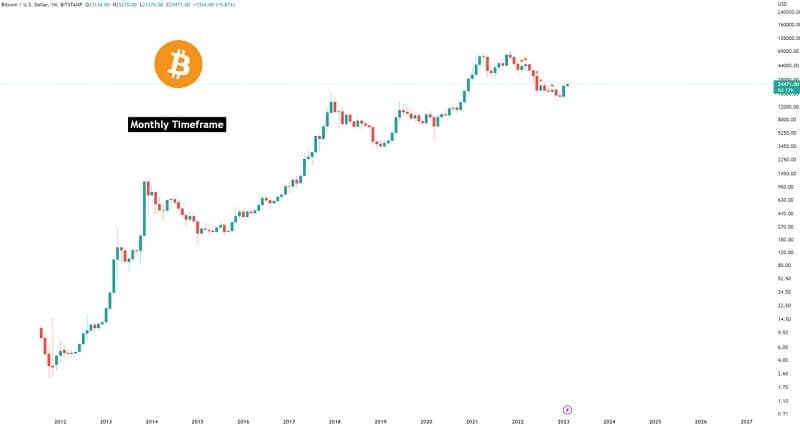
By November 2010 the market cap reached $1 million and the price hit 50 cents a coin. The first mobile transaction happened in December 2010. Price history from the Bitstamp exchange has been charted on TradingView since August 2011.
Usage jumped when the Silk Road website launched in January 2011. That internet black market took Bitcoin precisely because it was anonymous, and buyers spent it on drugs and other illegal goods. Grim as it reads, this is what gave Bitcoin its first real use case.
The digital rights organization Electronic Frontier Foundation put the category simply. A censorship-resistant digital currency is one that can move anonymously from one person to another, with no gatekeeper able to stop the transfer.
WikiLeaks began accepting Bitcoin after the US government pushed Visa, MasterCard and other processors into blocking donations. Bitcoin quickly became the rail for payments that had nowhere else to go. In February 2011 it traded at one dollar, reaching parity with the US dollar.
In early February 2014 Mt. Gox, then one of the largest exchanges and based in Japan, suspended withdrawals and blamed technical difficulties. By the end of that month it had reported 744,000 Bitcoins stolen and filed for bankruptcy.
Mt. Gox had been shedding users for months before the filing, because withdrawals were already hard to get out. Bitcoin went through a rough stretch after that, up and down.
In 2017 Bitcoin came close to $20,000, then broke down to around $6,800. That drop was brutal for holders. Many sold everything and left the market for good.
Others saw the same peak and read it as an invitation. I started my own cryptocurrency journey in December 2020, the month Bitcoin passed its previous high of $19,800.
The run carried on for almost a year and topped out at an all-time high of $69,000 in 2021. I put in $30,000 during that stretch and took out $120,000. Then the market turned bearish and the price fell back, to around $24,400 at the time this article was first written.
After that peak the price spent long stretches consolidating inside a range. Analysts split into two camps every time it happens. One calls the bottom, the other calls more downside, and neither camp has a better record than the other. That is the honest lesson of the whole timeline.
What the timeline is worth to a trader
Put the numbers next to each other and the pattern is hard to miss. Under a penny to 8 cents in five days. One dollar in February 2011. Almost $20,000 in 2017, then $6,800. An all-time high of $69,000 in 2021, then most of it handed back. Every one of those moves ran the same way: a fast climb, a crowd arriving late, then a drawdown deep enough to clear out whoever bought the top.

Mt. Gox supplies the other half of the lesson, and it is the half people skip. The exchange held the coins. The exchange lost 744,000 of them. The users had no claim on anything. Price risk and custody risk are two different problems, and a good answer to one does nothing about the other. Where you hold a position matters as much as when you open it, so our broker reviews are worth reading before you choose a venue.
If you want more on the king of cryptocurrency, my Bitcoin Roadmap article goes further into it. There are two routes to trading it: CFDs through a broker such as BDSwiss, or spot on an exchange such as Binance. Read our broker ratings before you pick either one.
The practical takeaway is short. Size a crypto position so that a drawdown of two thirds does not end the account, because 2017 and 2021 both delivered exactly that. Keep coins you are not actively trading off the platform that custodies them. And compare regulated brokers before you open an account, because the venue decides what happens to your balance on the day something breaks.
FAQ
What is the history of Bitcoin in short?
It runs from David Chaum's 1983 paper on untraceable digital cash, through E-gold and PayPal in the 1990s, to the whitepaper Satoshi Nakamoto published on October 31, 2008. The network itself started on January 3, 2009 with the Genesis Block.
How does that history read in 2026?
As the same cycle repeating. Under a penny to 8 cents in five days, one dollar in February 2011, close to $20,000 in 2017, an all-time high of $69,000 in 2021. Each peak was followed by a fall deep enough to clear out the late buyers.
Why does the history matter for traders?
Because it shows where the money actually went. Mt. Gox lost 744,000 Bitcoins and its users had no claim on any of them. That was custody risk rather than price risk, and it cost more people more money than any single crash on the chart.
What are the common mistakes?
Buying after a headline instead of before one. Leaving long-term coins on an exchange. Reading a personal result, my own $30,000 turning into $120,000, as a repeatable model rather than one run inside one cycle. And sizing a position as though a two thirds drawdown cannot happen.
How do I apply it in practice?
Pick the route first. CFDs through a regulated broker give you leverage and no coin custody. A spot exchange gives you the asset and the responsibility that comes with it. Then size the trade so the worst drawdown on this timeline would not close your account.
Find Your Perfect Broker: Explore Our List Now!
Choose the best with our expert-selected options
Find Your Perfect Broker: Explore Our List Now!
Choose the best with our expert-selected options
Discover top binary options brokers tailored to your region. Browse our curated lists by country: