You can inspect the market at 07:30 and 19:00, but your job keeps you away from the screen between them. A strategy requiring a decision after every five-minute candle asks for attention you cannot supply. Changing the app will not create those missing hours.
The main types of trading become easier to compare when you attach them to a working day. Start with the holding period, required decisions and instrument. Then calculate the money at risk and the cost of completing each trade.
How trading styles are classified
Holding period is one classification. A scalper may seek a move lasting seconds or minutes. A day trader plans to finish the position within the trading session. A swing trader can hold across several sessions, while position trading can follow a longer thesis over months.
Execution is another classification. A person can submit orders manually, a program can apply rules, or a service can copy another account. Algorithmic trading can operate at an intraday or multi-session horizon. Copying a trader does not tell you how long that trader holds positions.
The market is a third dimension. The types of trading in stock market discussions may involve fully paid shares, options or other permitted products. Types of forex trading can include delivered currency, futures or leveraged rolling contracts. The legal structure determines margin, settlement and costs.
Asking how many types of trading exist therefore needs a classification first. Four familiar holding-period labels are useful, but they cannot describe every combination of instrument and execution method. Write those three fields separately in a trading plan.
Scalping and day trading
Scalping seeks comparatively small moves and requires frequent execution decisions. A six-pip gross target with an assumed 1.5-pip round-trip cost leaves 4.5 pips before considering other effects. The same cost represents a much smaller share of a 100-pip target.
A scalper must also distinguish chart prices from executable prices. A bid chart can show the level you wanted while the ask remains above your buy limit. Record the order trigger, available quantity and actual fill before judging a small chart move profitable.
Day trading covers a wider range of intraday holding periods. One approach may take a single opening-range trade; another may generate many entries. Both can aim to close within the session, while making very different demands on attention and costs.
For a hypothetical share trade, a $1,000 position that moves 0.5% generates $5 before charges. An assumed $2 total cost consumes 40% of that gross gain. Lower apparent time exposure does not make the economics automatically attractive.
Session boundaries need a definition. An exchange can have regular and extended hours; a currency venue can quote through several regional sessions. Write the last permitted entry and required exit time, including the timezone. An overnight position left by an unfilled exit no longer matches the original intraday plan.
FINRA's guidance on frequent intraday trading explains the importance of account type, settlement, margin and costs for US securities. Those rules belong to that jurisdiction and product. Read the relevant local account terms before copying a capital requirement from a foreign trading guide.
Swing and position trading
Swing trading commonly aims to capture a move across several sessions. A daily chart can define the setup while a shorter interval helps identify an entry. Less frequent decisions can fit around work, provided alerts and order handling match the times you are available.
The position continues to carry risk while you are away. A stock bought at $50 with a stop at $48 may open at $46 after an announcement. A stop's trigger is distinct from its execution price, as the SEC's stop-order bulletin explains for securities.
Position trading usually follows a longer price or economic thesis. The planned exit might depend on a weekly trend condition, a business development or a change in policy expectations. The holding-period label should follow the written thesis and exit, instead of becoming a reason to retain a failed short-term trade.
Costs accumulate differently over that horizon. A hypothetical leveraged position charged $2 each night costs $40 over 20 chargeable nights if the rate stays unchanged. A fully paid shareholding has different carrying costs and cash demands. Compare contracts before comparing charts.
Longer horizons also change the information you need. An hourly setup may be invalidated before a scheduled earnings report; a position trade may be intended to include it. Record that decision explicitly. Holding through an event should be part of the tested plan.
Algorithmic trading and copy trading
Algorithmic trading applies programmed rules to decisions such as signals, sizing and order submission. It can reduce repeated manual work, but an incorrect symbol mapping or quantity formula can repeat its error across many orders. The program needs monitoring and limits as well as a backtest.
For example, a rule might enter only after a completed hourly close above a premarked level. Specify what happens after a lost connection, rejected order or restart. If the program sees an existing position on reconnect, it needs a defined action before submitting another entry.
Copy trading follows activity from a leader or signal service according to the platform's allocation rules. Your results can differ because of joining time, fees, minimum order sizes and execution. The copied account's holding period still determines whether exposure remains open overnight.
Assess both arrangements through the decisions they delegate. A robot that only sends an alert leaves the order decision to you. A fully automated copier can change exposure while you are asleep. Their supervision requirements should be written beside the available controls.
Automation also adds a fixed-cost question. A hypothetical $20 monthly hosting bill represents 2% of a $1,000 test account each month before trading charges. Scale, uptime and the strategy's turnover all affect whether that cost makes sense.
Comparison table: time, capital, stress and costs
Use the holding period to identify likely demands, then verify them for the proposed rules. The examples below describe common research arrangements; individual strategies can differ substantially within the same label.
| Style | Typical decision pattern | Costs and risk to examine |
|---|
| Scalping | Repeated decisions over short intervals | Spread, commission, latency and frequent errors |
| Day trading | Decisions within a defined session | Round-trip costs and an executable end-of-session exit |
| Swing trading | Reviews around multi-session setups | Gaps, overnight financing and scheduled events |
| Position trading | Longer thesis with planned review points | Carrying cost, concentration and thesis deterioration |
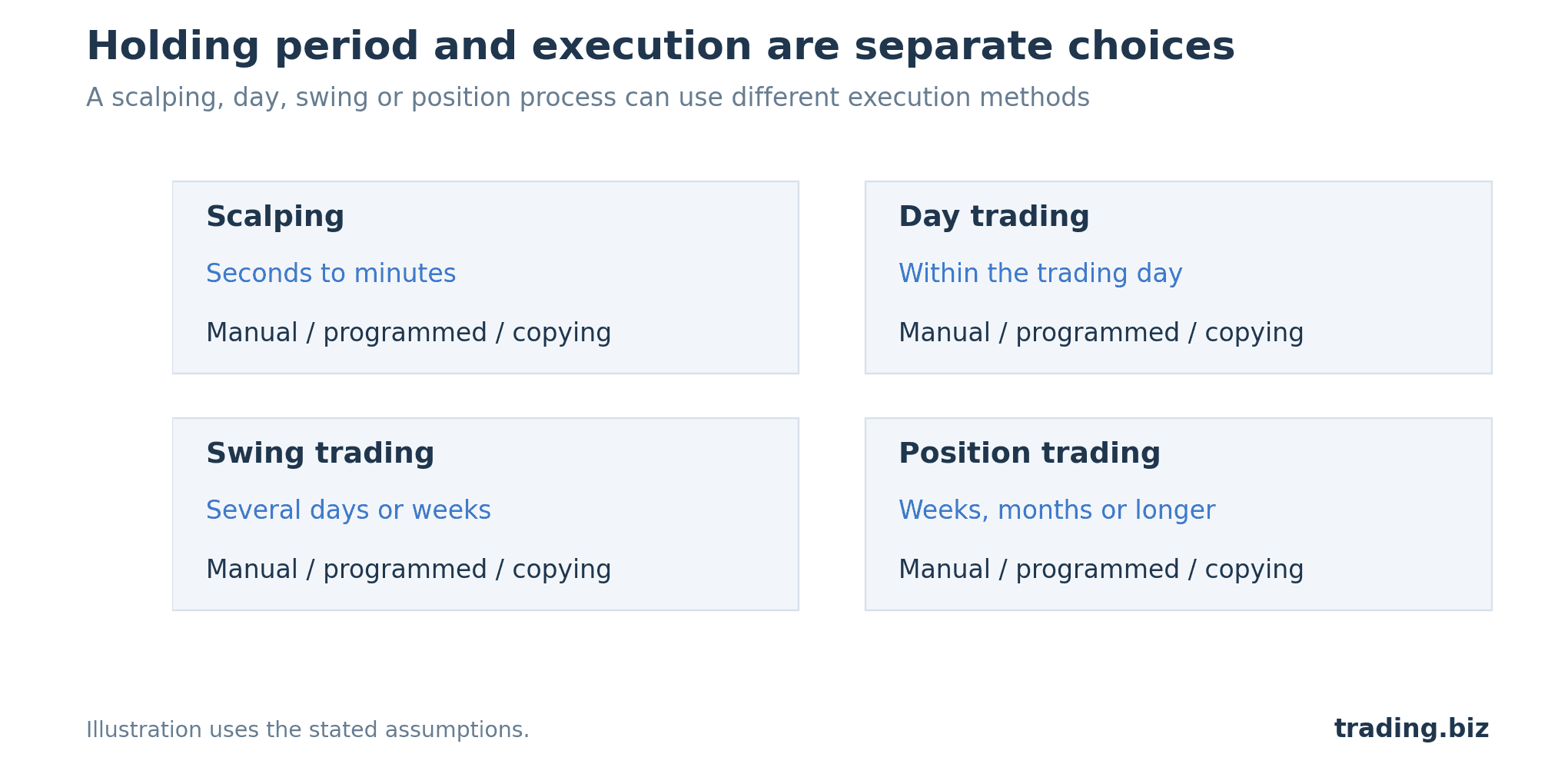
Figure 1. Four holding-period styles sit alongside a separate execution choice: manual decisions, programmed rules or copying. The labels describe how a process operates, without ranking returns.
Trading capital must support both the exposure and the operating costs. A broker's advertised minimum deposit tells you little about whether the planned quantity fits your loss budget. At $1 per pip, a 30-pip stop represents $30 of price risk regardless of how small a deposit the platform accepts.
Stress also needs an observable definition. Count decisions, interruptions and the size of open fluctuations. One person may manage two daily reviews reliably while repeatedly missing intraday exits. Another may prefer a fixed morning session to holding through overnight announcements.
The phrase 4 types of traders can serve as a starting map, but your actual process is more specific: instrument, session, signal, exit, quantity and order handling. Two people using the same label can make opposite choices in all six fields.
How to choose a trading style that fits your life
Begin with a week of actual availability. Mark the hours when you can review positions without interruptions and the events you would be unable to monitor. If the strategy requires attention outside that schedule, change the rules or the intended horizon before funding it.
Next, run one complete cash calculation. Suppose the account is $2,000 and the research risk limit is $10 per trade. A $2 entry-to-stop distance permits five shares before costs. A wider $5 distance permits two shares. The size must follow the loss limit across different types of trading.
Then test one setup and one exit. Keep all qualifying signals, including those skipped because you were unavailable. A historical strategy that assumes perfect attendance can overstate what your working routine would have captured.
For types of trading strategies in forex, include the account's swap, margin and event conditions. A short intraday test cannot establish the carrying cost of holding the same exposure for three weeks. Recalculate the complete intended holding period.
Which type of trading is most profitable cannot be answered from the label. Compare a defined implementation after costs, with its drawdown and required capital. A high gross return created by taking more exposure does not establish a more efficient method.
Keep an explicit review date. After a trial, compare adherence, net costs, missed decisions and adverse scenarios. Choose the process you can execute consistently under your actual constraints, then continue testing its underlying economics.
Include the operational end of a trade in that review. If your plan closes a stock position before the exchange ends its regular session, test what happens when trading is halted or an order is only partly filled. A style described as intraday can still leave an overnight position after an execution problem. Keep a contingency, a contact route and enough account capacity for that scenario.
Terms used when comparing trading styles
These terms help keep the comparisons consistent. Attach a market and an order rule to each definition before applying it to a real account.
| Term | Meaning |
|---|
| Time horizon | Intended interval over which a trade's thesis develops |
| Turnover | Frequency and size of transactions relative to capital |
| Carrying cost | Expense or credit associated with holding exposure |
| Execution method | How trading decisions become submitted orders |
| Trading capital | Funds committed to exposure, collateral and operations |
FAQ
Which type of trading is best for beginners?
Choose a process you can observe and calculate completely. A defined market, one setup and a manageable review schedule make errors easier to identify. The label alone cannot establish suitability or profitability.
Can a swing trader use an algorithm?
Yes. Holding period and automation describe separate dimensions. The program still needs rules for entry, exit, sizing, interruptions and monitoring over the intended holding period.
Can I switch styles during a losing trade?
A longer holding period changes the original plan's costs and risk. Close or review the position under its assigned rules, then test a proposed new method separately before using it for another entry.
What should a first trial produce?
Produce a complete record of signals, actual or simulated orders, costs and missed decisions. Review that record against your calendar before increasing the capital or adding a second style.



 Rahul NambiampurathTrading.Biz