Updated:November 25, 2026

9 min

Beginner guide: crypto mining explained, payback and scams
A mining machine can produce coins while losing money after electricity, fees and hardware costs. Learn what miners actually do, build a payback estimate and separate real computing work from cloud contracts and mobile-app promises.

Vadim Egortsev
Author
A 3 kW machine running continuously uses 72 kWh every day. At $0.20 per kWh, electricity alone costs $14.40. A dashboard showing $12 of daily mining revenue would already describe an operating loss.
That calculation comes before the hardware purchase. For crypto mining explained in practical terms, start with the work the machine performs and follow each cost to the money you can actually keep.
How mining works: blocks, hashrate and rewards
In proof-of-work mining, machines repeatedly calculate hashes while trying to produce a block satisfying the network's current target. The successful block can collect the protocol's block subsidy and included transaction fees, provided the network accepts it under its rules.
A hash is the output of a cryptographic calculation. Hashrate measures how many such attempts equipment can perform per second. A higher share of the relevant network's computing power generally increases the expected share of mining rewards, with actual results depending on chance and the payout arrangement.
Bitcoin's mining explanation describes specialised hardware, competitive participation and the role of mining in securing the network. Mining does not permit an operator to invent valid transactions or spend someone else's coins. Other nodes still check the block's rules.
Network difficulty adjusts the required work as participation changes. If more competing hashrate joins while your machine stays unchanged, the expected coins earned by that machine can fall. A profitability estimate needs the network assumptions and the date on which they were measured.
Bitcoin's subsidy also follows a halving schedule, described on its halving page. Transaction fees are a separate reward component. A future reduction in subsidy should not be replaced in your budget by an assumed matching rise in the coin price.
Mining crypto at home: ASICs, GPUs and electricity
An ASIC is hardware designed for a particular computing task. Bitcoin mining uses specialised ASIC equipment. A GPU can perform more general parallel computing, and some proof-of-work networks can use GPU mining, depending on their algorithms and competitive hardware.
The supported algorithm determines what a crypto mining machine can mine. A Bitcoin ASIC cannot simply switch to any coin with an attractive advertised return. Check the exact algorithm, firmware support and realistic pool options before treating another coin as a fallback.
Ethereum Mainnet no longer uses proof-of-work mining. The Merge documentation records its September 2022 transition to proof of stake. Old tutorials describing direct ETH mining with a graphics card are unsuitable for the current Ethereum network.
For home mining, obtain the actual power draw and local tariff, including time-based pricing where applicable. Add cooling, internet, repairs and pool charges. A cheap energy headline can exclude taxes or apply only during certain hours.
Continuous high-power equipment also needs a suitable electrical installation. Have the load and installation assessed by a qualified local professional. Check ventilation, noise and the property's rules before expecting an ordinary room to host a machine around the clock.
A 3 kW miner releases substantial heat into the space. That can create additional cooling costs in summer. If you plan to use the heat in winter, value only the heating you genuinely displace and model the months when that benefit disappears.
Estimating payback and break-even
Build the estimate in two layers. Operating cash flow covers revenue minus running costs. Capital recovery asks whether that remaining cash can repay the delivered equipment, installation and other initial spending within its useful life.
Use this hypothetical example: a $2,400 installed machine consumes 3 kW, earns $12 gross per day and pays a 2% pool fee. The pool charge is $0.24, leaving $11.76 before electricity. Ignore other costs temporarily to isolate the energy calculation.
| Electricity tariff | Daily electricity cost | Cash after energy and pool fee | Simple hardware payback |
|---|---|---|---|
| $0.08/kWh | $5.76 | $6.00 | 400 days |
| $0.12/kWh | $8.64 | $3.12 | About 769 days |
| $0.20/kWh | $14.40 | Minus $2.64 | No positive payback |
These are scenario calculations, not current mining revenue or hardware quotes. They assume uninterrupted operation, unchanged revenue and no repairs, tax or cooling expense. Actual capital recovery can take longer or fail entirely.
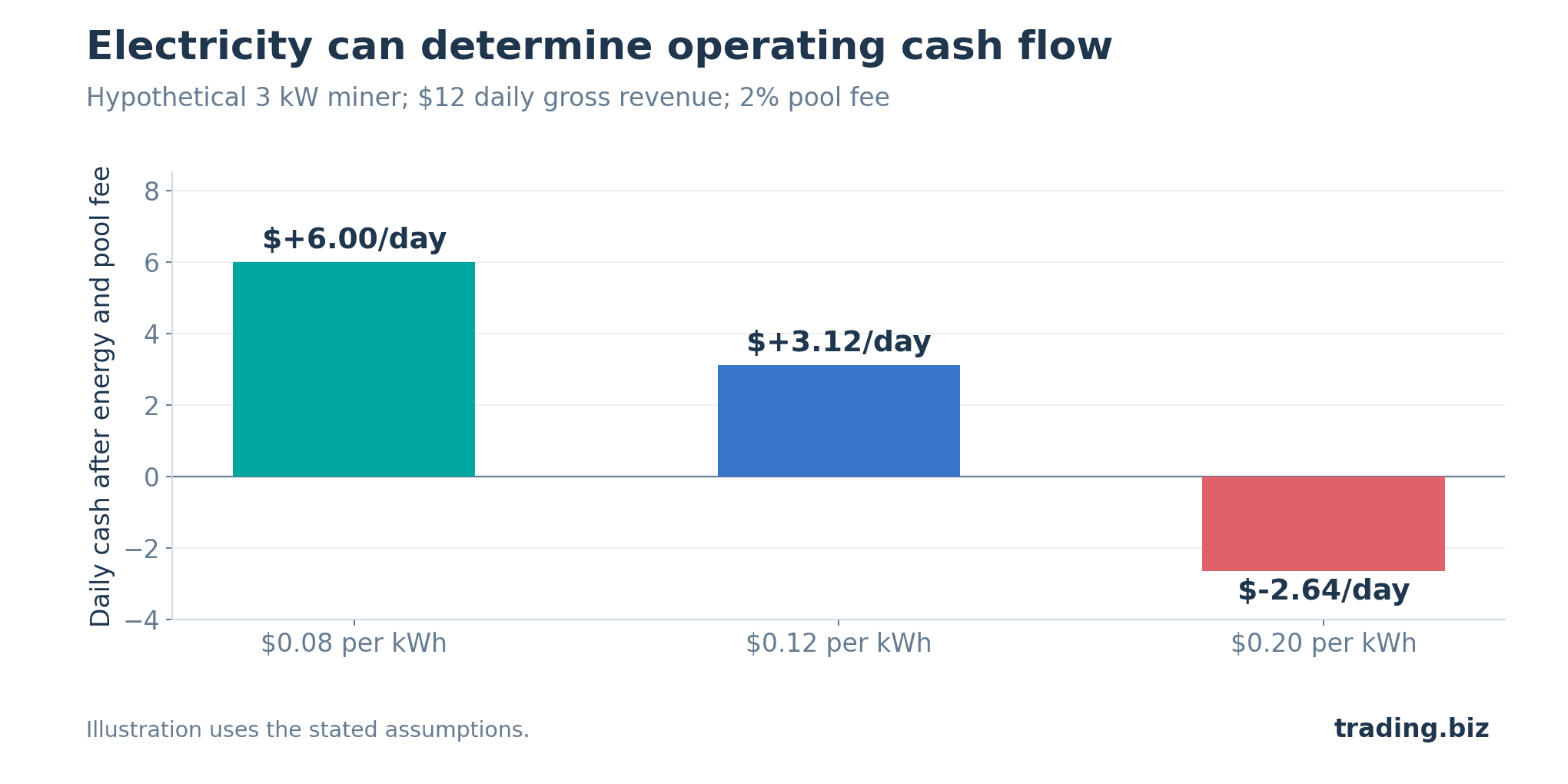
Figure 1. A hypothetical 3 kW miner earning $12 gross daily and paying a 2% pool fee leaves $6.00, $3.12 or minus $2.64 per day at electricity tariffs of $0.08, $0.12 or $0.20 per kWh. Other costs are excluded.
The simplified break-even tariff is $11.76 divided by 72 kWh, approximately $0.1633 per kWh. At that tariff, nothing remains to repay the $2,400 machine. Any additional running cost lowers the break-even electricity price.
Stress the revenue assumption too. At $9 gross daily, the same 2% pool fee leaves $8.82. With $0.12/kWh electricity, the remaining cash is only $0.18 a day before other costs. The energy bill stays payable while the coin price and difficulty move.
Include downtime explicitly. A five-day repair can remove revenue while adding shipping and parts costs. Record the warranty's actual coverage and expected repair route. A spreadsheet that assumes 365 flawless operating days gives an incomplete picture of a used machine.
Hardware resale value belongs in a separate scenario. An assumed $600 sale after two years can improve an estimate, while an obsolete or damaged machine may attract much less. Keep the model's cash generation visible without relying on that resale figure. Used-equipment demand often changes alongside the same coin-price and efficiency conditions that affect your mining income.
Cloud mining: how it works and typical scams
Cloud mining sells contractual access to remotely operated computing capacity or a related payout arrangement. The customer relies on the operator's equipment, reporting, fees and ability to honour the contract. The word cloud does not verify that the promised capacity exists.
Read the hash allocation, term, maintenance charge, payout formula, withdrawal threshold and early-termination conditions. Some contracts become uneconomic when revenue falls below their running charges. A fixed upfront payment can remain spent even after useful payouts stop.
The joint SEC and CFTC warning on fraudulent crypto websites describes schemes claiming to use mining farms while promising high guaranteed returns. It also highlights demands for additional payments to release supposed profits. Our Moon Bitcoins review examines a service advertised as free Bitcoin mining and checks its withdrawal claims.
A live dashboard is weak evidence by itself. Ask how the operation, company and contract can be independently checked. A photograph of a data centre does not show that your payment purchased a particular machine or enforceable share of output.
Referral rewards can create another warning sign when recruiting deposits becomes the main explanation for returns. If the operator cannot reconcile promised payouts with hashrate, network conditions and costs, do not substitute testimonials for the missing economics.
If withdrawal suddenly requires another deposit described as tax, verification or account activation, stop sending money and preserve the records. Verify any genuine tax obligation independently through the relevant authority. Paying another wallet address does not establish that a government received a tax payment.
Mining with Android: what is real and what is a gimmick
An Android phone can display pool results or remotely administer separate mining equipment. That interface does not mean the phone generated the displayed Bitcoin. The actual computing work may happen on an ASIC in another location.
Direct Bitcoin mining on a typical phone has an extremely small share of competing network hashrate. Running the processor harder adds heat, battery wear and power consumption without making it comparable to dedicated hardware. A mobile earning screen needs a clear explanation of what creates the reward.
Some apps distribute promotional tokens, points or a share of a hosted service. Identify which of those arrangements applies. A button labelled start mining can describe an account activity with no proof-of-work contribution from the device.
Be cautious when a crypto mining on mobile app requests a recovery phrase, broad account access or a deposit to release earnings. A mining monitor needs no authority to restore your unrelated wallet. Obtain software through a verified route and inspect the permissions before connecting an account.
Mining with Android can be useful as a monitoring topic. It should not be presented as an easy phone-based route to industrial Bitcoin mining returns.
Mining pools, taxes and legal status
A pool combines participants' work and distributes payouts under a stated scheme. This can make payments more regular than solo mining, where a small operator may wait a very long time for a block. Pool participation still has fees and rules.
Compare the payout method, fee, minimum withdrawal, rejected-share handling and operator history. A rejected or stale share can reduce effective paid work even when the machine's local hashrate looks normal. Reconcile local statistics with the pool's accepted contribution.
Legal status depends on the country, location, electricity arrangements and business activity. A ban in one jurisdiction cannot answer why crypto mining is illegal somewhere else. Check local rules, the property agreement, energy contract and any registration or environmental requirements before installing equipment.
Tax also depends on the facts. HMRC's cryptoasset receipt guidance discusses mining receipts and distinguishes trading activity from other taxable income. Later disposal can create a separate calculation. Other countries can use different rules.
Keep hardware invoices, electricity records, pool statements, receipt dates and local-currency valuations. Track coin sales separately from coin production. Revenue earned in tokens and cash available to pay the next electricity bill are different entries in the business records.
Mining terms used in the calculation
These definitions connect the network process to an operator's accounts. Keep the units beside each number when comparing two machines or contracts.
| Term | Meaning |
|---|---|
| Hashrate | Number of relevant hashing attempts per second |
| ASIC | Hardware specialised for a defined computing task |
| Difficulty | Protocol measure affecting the work needed for a valid block |
| Block subsidy | Newly issued coins permitted in a valid block |
| Mining pool | Arrangement combining work and distributing payouts |
| kWh | Energy used by a 1 kW load over one hour |
FAQ
How does crypto mining work without guaranteeing a payout every day?
Machines compete probabilistically to produce valid blocks. Pools can distribute payments using their chosen scheme. The network does not promise each machine a fixed daily cash income.
Is the cheapest used miner always the best starting point?
Power efficiency, condition, repair access and the supported algorithm affect its economics. Calculate cash flow at your tariff and stressed revenue before comparing the purchase price.
Can cloud mining remove electricity risk?
The contract can pass energy or maintenance costs to you directly or through its payout formula. Read the termination and fee provisions before assuming an upfront payment fixes the entire cost.
What number should I calculate before buying equipment?
Estimate daily cash after your electricity tariff, pool fee and other running costs. Repeat it with lower revenue and downtime, then check whether enough remains to recover the delivered hardware cost.
Find Your Perfect Broker: Explore Our List Now!
Choose the best with our expert-selected options

Find Your Perfect Broker: Explore Our List Now!
Choose the best with our expert-selected options
Discover top binary options brokers tailored to your region. Browse our curated lists by country: