Updated:November 25, 2026

9 min

0
How P2P crypto trading works: buying USDT with INR, PKR or NGN
P2P escrow can hold the seller's crypto while a bank payment is made. It cannot guarantee the payment's origin or prevent every later dispute. Follow a controlled USDT purchase workflow, check local access and calculate arbitrage after all costs.

Vitalii Bednarskyi
Author

The seller sends a screenshot saying the payment failed. Your banking app shows a completed transfer. The USDT is still locked in the order. At that point, the order record, payment reference and platform dispute process matter more than a promise in a private message.
P2P crypto trading connects counterparties who exchange crypto against an agreed payment method. Understanding the custody and payment sequence helps you recognise when to proceed and when to stop.
How P2P crypto trading and escrow work
On a typical custodial P2P crypto exchange, the platform locks the seller's crypto for an active order. The buyer sends the agreed fiat payment through the permitted banking or payment channel. The seller verifies receipt and authorises release under the platform's process.
The fiat payment usually travels outside the crypto platform. Escrow therefore protects a defined crypto balance during the order. It does not independently verify every bank transaction, guarantee the payer's identity or remove the possibility of a legal freeze.
Check that the order is actually covered by the platform's escrow and dispute rules. A social-media advert followed by a direct transfer to a wallet can have a completely different arrangement. The presence of the word escrow in a chat message establishes nothing by itself.
USDT also has asset and network risks. A P2P purchase creates exposure to the stablecoin issuer, supported chain and custody route. A dollar peg is a target arrangement; it does not make USDT equivalent to an insured bank deposit in your local currency.
Buying USDT for INR, PKR and NGN step by step
First check whether the provider, product and payment route are permitted and available for your country. Complete the platform's identity checks and use an account in your own verified name. Do not change your stated residence to access a restricted market.
Country checks need current sources. For India, the Finance Ministry's September 2026 FIU notice explains registration and AML obligations for VDA service providers serving India, including offshore operators. FIU registration has a defined compliance scope and does not guarantee an investment or every payment route.
Pakistan's position changed in 2026. SBP Circular Letter 10 of 14 April 2026 replaced its 2018 instructions with a framework for bank accounts involving PVARA-regulated providers. NOC-stage accounts have limited purposes; transactional services require the relevant licence and compliance conditions. An old blanket description based only on 2018 is incomplete.
For Nigeria, check the SEC's live operator directory. It distinguishes regulatory-incubation categories and lists Busha and Quidax under ARIP. That listing alone does not confirm that a specific NGN P2P feature is currently offered or authorised for your intended use.
| Currency | Check before opening an order | Payment detail to verify |
|---|---|---|
| INR | Provider's current Indian compliance status and supported route | Named recipient and permitted bank or UPI account |
| PKR | PVARA status and the service allowed under that status | Supported bank route and licensed-provider conditions |
| NGN | Current SEC status and actual product availability | Permitted naira payment method and matching account name |
Second, select USDT, the fiat currency, transaction amount and an available payment method. Compare the final quantity you receive. A lower advertised price can come with a minimum order larger than your intended purchase.
Third, review the counterparty's terms and open the order. Confirm that the displayed asset is locked, the price and quantity are fixed under that order, and the payment deadline is clear. Save the order reference before leaving for the banking app.
Fourth, pay only the verified recipient shown in the active order, using the permitted account and exact amount. Keep the bank reference and timestamp. Never follow a new recipient sent through Telegram or WhatsApp without resolving the discrepancy inside the platform's official process.
Fifth, mark payment completed only after you have actually sent it. Wait for release into the correct platform balance. If the order expires or the seller disputes payment after you have paid, use the official appeal route and preserve the evidence; casually cancelling can complicate recovery.
For a hypothetical purchase at ₹88 per USDT, 100 USDT costs ₹8,800 before any other charge. That is an arithmetic example, not a current INR quote. Apply the same amount-times-price calculation to a supported PKR or NGN offer and confirm the final order total before paying.
Choosing a counterparty: ratings, limits and payment methods
A completion rate needs its sample size and period. A profile with 99% across 1,000 orders provides a different history from one completed order. Inspect recent activity, complaints and whether the advertised payment method matches the terms.
Ratings still have limits. An established account can be compromised, and historical smooth transfers do not verify the source of the next payment. Keep the same name and recipient checks for a highly rated merchant.
Check minimum and maximum order sizes before committing. If you want 100 USDT and the advert starts at 500 USDT, another advert may fit. Splitting payments or changing the amount outside the platform can create mismatches with the escrowed order.
Payment methods differ in speed, reversibility and dispute procedures. Read both the platform's rules and your bank's relevant terms. A transfer appearing in a bank balance does not automatically remove every later recall, fraud investigation or account restriction.
Keep communication inside the order. A counterparty asking to finish privately removes useful platform records and can bypass controls. The best P2P crypto trading platform for your case needs lawful local access, a usable dispute route and the payment method you can verify.
P2P arbitrage: spreads between buy and sell offers
P2P arbitrage attempts to capture a price difference between purchase and resale routes. The spread becomes available only if both legs can execute at the required size and under permitted payment conditions.
Suppose you buy 1,000 USDT at ₹88 and can sell the same quantity at ₹88.60. The apparent gross difference is ₹600. If platform, payment and transfer costs total ₹250, the remaining amount is ₹350 before tax, delays and losses from disputes.
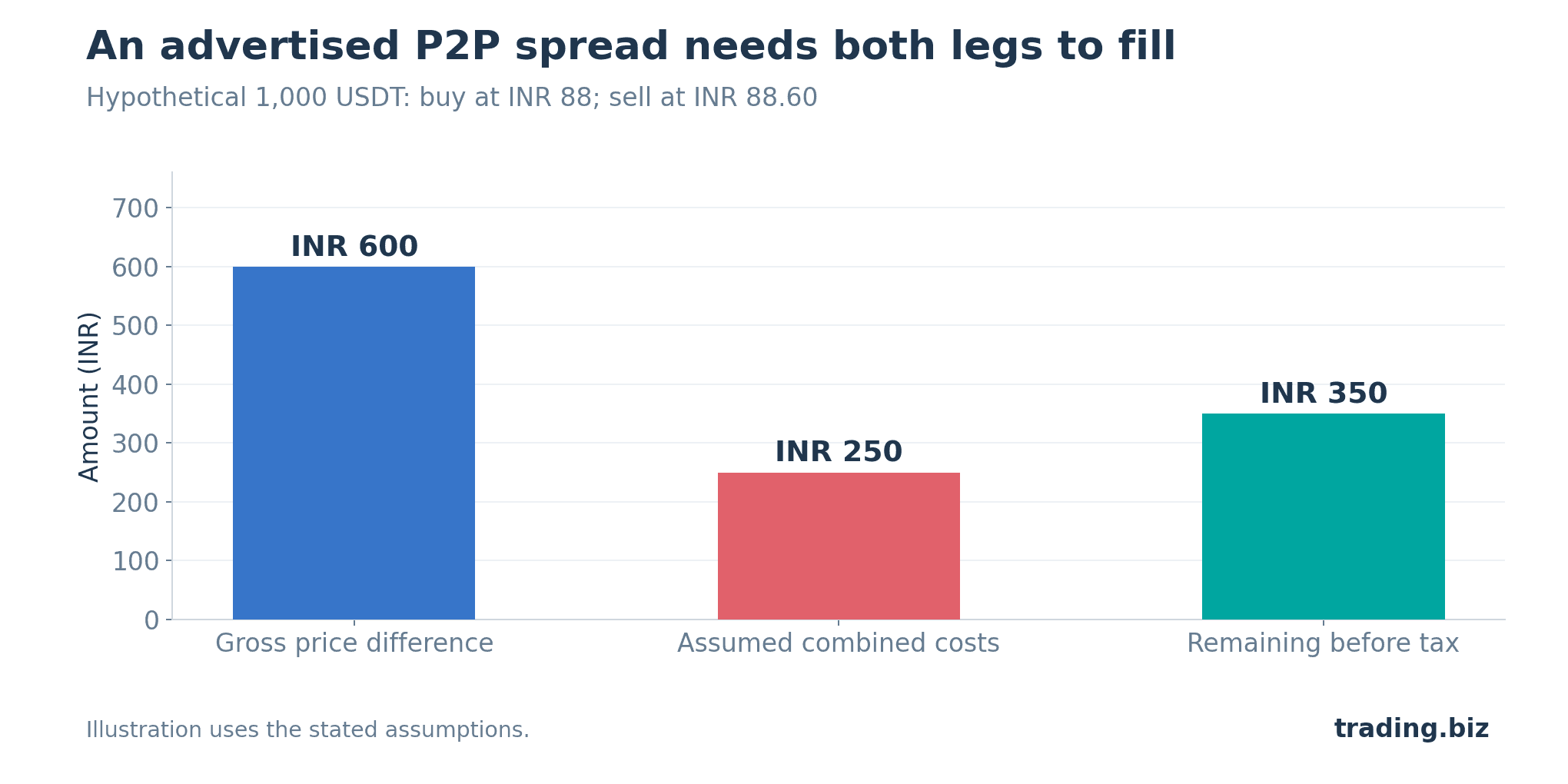
Figure 1. A hypothetical 1,000-USDT purchase at ₹88 and resale at ₹88.60 produces a ₹600 gross difference. Assumed combined costs of ₹250 leave ₹350 before tax and operational losses. Neither quote is a live offer.
The two quotes may have different limits or bank requirements. An advert showing ₹88.60 for only 100 USDT cannot support the full 1,000-USDT resale calculation. Check executable quantity, timing and the amount each bank can process under its rules.
Delays can erase the margin. If the available resale price falls to ₹88.20 before you complete the second leg, the gross difference becomes ₹200. With the same ₹250 costs, the result is a ₹50 loss before tax.
Also calculate the capital tied up. ₹350 on ₹88,000 is about 0.40% for that completed cycle. Repeating it daily is an assumption requiring sufficient offers, working bank access and no unresolved disputes. A frozen transfer can immobilise much more than one cycle's expected profit.
Fraud patterns: chargebacks, fake receipts and third-party payers
Fake receipts are a direct pressure tactic. A buyer can send an edited bank screenshot or an SMS resembling a payment notification. When selling, open your own banking app independently and check the actual transaction, amount and sender before authorising release.
Binance P2P's scam guidance describes fake payment evidence, chargebacks and third-party payments. The guidance is useful for understanding those mechanisms even when comparing another platform's particular procedures.
Third-party payers break the verified-name chain. Someone else's payment can involve a stolen account, an unrelated victim or a later dispute. Stop and use the platform's appeal procedure when the sender does not match. Coordinate any refund through the documented platform and bank process instead of sending money to a new account supplied in chat.
A buyer can also claim an overpayment and request a separate return before the original payment is resolved. Verify the bank record and seek official assistance. Keeping the crypto locked during a dispute preserves the platform's ability to examine that side of the transaction.
Impersonation adds another route. A supposed support agent can contact you privately and demand release, a password or a recovery phrase. Enter support through the verified app or website. An escrow dispute does not require giving a stranger the keys to another wallet.
Safety checklist and tax notes
Use the following checks at the points where they affect the order. These checks address payment, identity and order-record errors.
-
Verify the provider's status, product availability and bank route before selecting an advert.
-
Match the recipient and sender names to the verified order and permitted payment details.
-
Keep the exact amount, order reference, timestamps and bank evidence together.
-
Confirm funds independently before releasing crypto when selling.
-
Use the official dispute route if payment, identity or release does not match the order.
Tax and reporting rules depend on your residence and activity. Buying, selling, earning a spread and operating a recurring merchant business can involve different obligations. Check current withholding and reporting requirements before treating the entire price difference as spendable income.
For each cycle, record acquisition cost, sale proceeds, platform and bank fees, asset quantity and local-currency values. Keep the P2P order IDs linked to the bank references. Use lawful, accurate payment descriptions and records; hiding the nature of a transfer does not resolve a compliance issue.
Terms used in a P2P order
These definitions describe the transaction's separate components. Check how the chosen platform implements each one before paying.
| Term | Meaning |
|---|---|
| Escrow | Arrangement holding specified assets pending order conditions |
| Counterparty | Person or entity on the other side of the trade |
| Chargeback | Payment reversal process available under certain payment methods |
| Third-party payer | Sender whose identity differs from the verified counterparty |
| Arbitrage spread | Difference between an intended purchase and resale price |
FAQ
Is P2P crypto trading legal in India?
Assess the current provider, activity, payment route and reporting obligations. The FIU framework covers specified VDA service-provider duties. It does not provide a blanket assurance for every P2P transaction or bank transfer.
Can escrow guarantee that my bank account will never be restricted?
No. It holds the relevant crypto under the platform's process. Banks and authorities can separately examine fiat payments and their source. Preserve the transaction records and follow lawful payment requirements.
Should I release USDT after receiving a screenshot?
Check your own payment account independently. If the funds, sender or amount do not match, keep the order within the dispute process. A screenshot alone cannot establish receipt.
What should I do after paying if the seller stops responding?
Keep the order evidence and bank reference, then open the platform's official appeal. Follow its instructions for a paid order and avoid making a second payment to a newly supplied account.
Find Your Perfect Broker: Explore Our List Now!
Choose the best with our expert-selected options
Find Your Perfect Broker: Explore Our List Now!
Choose the best with our expert-selected options
Discover top binary options brokers tailored to your region. Browse our curated lists by country: