You stake 100 tokens and receive six more over a year. If the token price drops from $10 to $7, the larger balance is worth $742 before fees. The starting value was $1,000.
That simple example belongs beside every advertised staking yield. Crypto staking combines a token-denominated reward with exposure to the token, the network and the service used to participate.
What staking is and where staking rewards come from
Staking commits assets to a proof-of-stake network's security process, directly or through a supported participation arrangement. Validators perform protocol duties, and eligible participants receive rewards according to the network's rules.
Rewards can include newly issued tokens and a share of transaction-related revenue. Their composition differs across networks. Solana's staking explanation, for example, links the reward rate to inflation, total stake, validator uptime and commission.
New issuance increases the supply held by participants. A 7% token reward in a network with expanding supply deserves a dilution analysis alongside the percentage shown in the app. Your share of the network and the token's purchasing power can move differently.
An exchange's Earn menu may group staking, lending and promotional products together. Ask which underlying activity generates the return. A token loan to a counterparty introduces a different cash-flow source and credit exposure from protocol validation.
To answer what is staking crypto for a particular product, identify the network, the validator or operator, the asset you deposit and the asset you can withdraw. If the provider cannot explain those four items, the advertised percentage is insufficient.
Proof of stake basics: validators, delegation and slashing
A validator proposes or attests to blocks according to the protocol. Correct participation can earn rewards. Missed duties, downtime and prohibited behaviour can have different consequences, so read the network-specific rules.
Ethereum's rewards and penalties documentation distinguishes ordinary penalties from slashing for specified serious validator offences. Running conflicting validator instances can create a problem even when the operator intended only to improve availability.
Delegation allows a token holder to assign stake to an operator where the protocol supports that model. The operator performs validation and commonly takes a commission from rewards. Native delegation, a custodial exchange balance and participation in a smart-contract pool have different control arrangements.
Slashing is not identical across proof-of-stake networks. Some implement it differently or do not have the same mechanism active. Check whether a provider passes validator penalties to customers, absorbs them under limited terms or offers no protection.
For a hypothetical 6-token gross reward and a 10% commission on rewards, the operator's share is 0.6 tokens. You retain 5.4 before transaction costs and tax. Verify whether the displayed yield already deducts that commission to avoid subtracting it twice.
Staking on exchanges
Exchange staking can simplify participation through one account interface. The provider handles the underlying operational process, while you rely on its custody, reporting and withdrawal arrangements. Service availability can vary with the legal entity and your location.
Read whether the displayed reward is an estimate, a promotional rate or a fixed contractual offer. Check its duration, covered balance and payment asset. A high introductory percentage on the first $100 has a different effect on a $10,000 allocation.
Withdrawal language deserves equal attention. Instant access may depend on a provider's liquidity buffer or an early-exit service. The underlying network can have queues even when the app normally offers a fast internal redemption.
Check how the exchange calculates its fee. A percentage of rewards, an embedded yield reduction and a withdrawal charge produce different statements. Save the terms and reconcile the first reward payment against the amount and period actually eligible.
Searches for the best crypto staking platforms should therefore compare custody, supported networks, transparent commission and exit procedures. A single highest APY crypto staking result cannot establish which arrangement you can legally access or recover from during an outage.
Staking in your own wallet and liquid staking
With supported native wallet delegation, you can retain control of the wallet keys while assigning stake through the protocol. Keep enough unstaked native currency for transaction fees. A balance fully committed to staking can leave the next administrative transaction inconvenient to fund.
Choose a validator using measured uptime, commission terms and the network's available performance records. Consider concentration and operational history. A zero-commission advertisement can change later, so check the rules for updating it and for moving your delegation.
Liquid staking commonly issues a receipt token representing an economic claim on pooled staked assets. You may be able to sell that token while the underlying stake remains committed. The market sale price can differ from the redemption value or the value suggested by the underlying balance.
That receipt adds its own contracts, operator arrangements and liquidity. Depositing it into another lending or trading protocol adds another dependency. Map each layer before treating the resulting position as equivalent to holding the original token in a wallet.
| Participation route | Control and work | Additional exposure to inspect |
|---|
| Solo validation | You manage validator operations | Downtime, key handling and protocol penalties |
| Native delegation | You select an operator through supported wallet tools | Validator performance, commission and exit timing |
| Exchange staking | Provider manages participation and custody | Custody, terms and withdrawal restrictions |
| Liquid staking | Pooled stake with a transferable receipt | Contracts, receipt-token pricing and redemption |
Yield versus risk: lockups, slashing and price drops
Start the calculation in tokens, then translate it into your spending currency. Suppose 100 tokens cost $10 each, the gross annual reward is six tokens and the provider takes 10% of rewards. You end with 105.4 tokens before other costs.
At an unchanged $10 price, that is $1,054. At $7, it is $737.80, a 26.22% decline from the initial $1,000. The rewards reduced the loss slightly. They did not determine the direction of the token price.
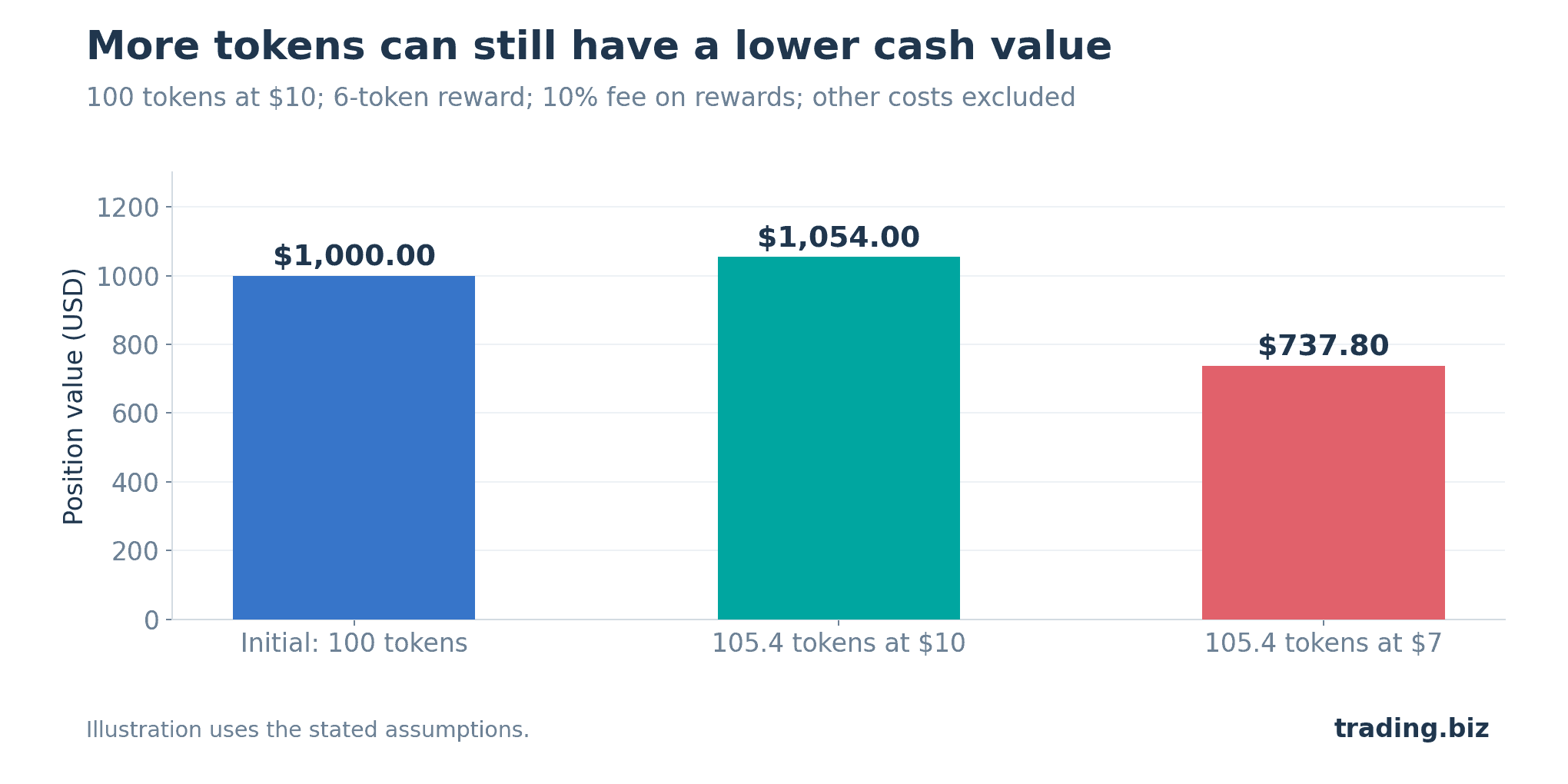
Figure 1. A hypothetical 100-token stake earns six tokens gross, with a 10% fee on rewards. The resulting 105.4 tokens are worth $1,054 at $10 each or $737.80 at $7, before other costs and tax.
A crypto staking calculator also needs the holding period, compounding assumption, commission and fixed transaction costs. APR describes an annual rate without the same compounding assumption as APY. A 6% APR compounded monthly would produce about 6.17% APY if the rate stayed unchanged and every reward could be reinvested immediately.
Actual rewards and reinvestment timing can vary. A fixed $5 transaction cost consumes half of a $10 reward and a much smaller portion of a $500 reward. Position size affects whether frequent compounding is economical.
Lockups and exit queues can stop you selling on your preferred day. Ethereum's withdrawal guide explains that withdrawal behaviour depends on validator type and exit processes. Legacy and compounding validator arrangements have different balance-handling rules; avoid assuming every balance above 32 ETH is automatically withdrawn.
Slashing, provider failure and contract exploits affect the asset balance itself. A liquid receipt trading below its expected redemption value creates another possible loss. Assess these alongside price exposure when asking whether staking crypto is worth it.
Write down the exit route in two stages: ending the staking commitment and converting the resulting asset into the currency you need. A completed protocol withdrawal still leaves a sale, possible network transfer and exchange access to arrange. Emergency cash should not depend on all those steps working on the same afternoon.
Commission changes also deserve a trigger. At a six-token gross reward, increasing the operator share from 10% to 20% reduces your net reward from 5.4 to 4.8 tokens, before other costs. Check whether moving the delegation involves a waiting period or foregone rewards before reacting to the new rate.
Tax treatment of staking rewards
Tax rules depend on residence, activity and the legal character of the arrangement. Receiving rewards and later disposing of tokens can create separate recordkeeping and tax events. A reward paid in tokens can matter even when you never withdraw cash.
For US cash-method taxpayers, IRS Revenue Ruling 2023-14 addresses inclusion of staking rewards at fair market value when the taxpayer gains dominion and control. That US treatment should not be applied automatically to readers elsewhere.
In the UK, HMRC's guidance on receiving cryptoassets discusses income treatment for staking and other activities, with later disposal considered separately. The facts can affect the applicable category.
Keep the receipt date, token quantity, local-currency valuation method, provider fee and subsequent disposal record. For liquid staking, ask how the receipt-token transaction is treated before entering it. Preserve the transaction hashes so a provider's later reporting change does not erase your evidence.
Terms behind a staking percentage
These definitions help compare offers using the same assumptions. Record whether a displayed number is gross or net before putting two rates side by side.
| Term | Meaning |
|---|
| Validator | Operator performing a proof-of-stake protocol's duties |
| Delegation | Assignment of stake to an operator under supported rules |
| Slashing | Protocol penalty for specified validator violations |
| APY | Annualised yield incorporating a stated compounding assumption |
| Exit queue | Waiting process before committed stake can leave validation |
| Liquid staking token | Transferable token representing an interest in staked assets |
FAQ
Is staking crypto safe if I keep my own keys?
Key control removes some custody dependence. Validator performance, protocol rules, price changes and any contracts used remain relevant. Native delegation and liquid staking have different dependencies.
Can Bitcoin earn native proof-of-stake rewards?
Bitcoin uses proof of work. A service advertising BTC staking or yield needs a separate explanation of its mechanism, such as lending, wrapping or another protocol. Check where the BTC actually goes.
Why can the displayed yield change?
Participation, issuance, activity, validator performance and provider terms can alter rewards. Record the rate's date and assumptions, then compare them with the next actual reward period.
What should I test before staking a larger amount?
Use a small eligible amount to verify the reward record and withdrawal process. Check any waiting period, fee and tax record while the operational exposure is still limited.



 Rahul NambiampurathTrading.Biz