Updated:November 11, 2026

5 min

Crypto Tax in the UK
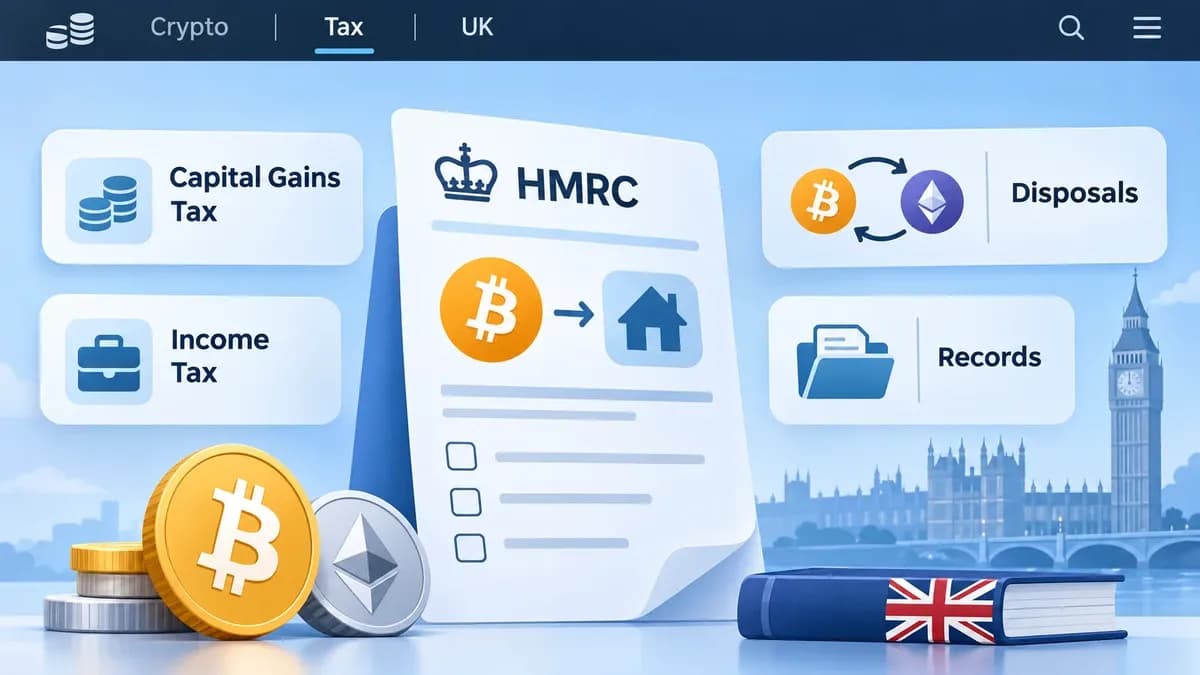
HMRC does not treat cryptocurrency as money. It treats it as property, which means disposals are subject to capital gains tax, and in some circumstances income tax applies instead. Updated September 2026.

Pejman Zwin
Author
Updated October 23, 2026
HMRC does not treat cryptocurrency as money. It treats it as property, which means disposals are subject to capital gains tax, and in some circumstances income tax applies instead. Updated September 2026.
Important: tax thresholds, allowances and rates change with each Budget. The rules below describe how the system works. Always confirm current figures on gov.uk or with a qualified accountant before filing.
The key points
-
HMRC treats crypto assets as property, not as currency
-
Disposals trigger capital gains tax, including selling, exchanging one token for another, and spending crypto on goods
-
Income tax applies instead where crypto is received as earnings rather than held as an investment
-
An annual exempt amount applies to total capital gains, and it has been reduced substantially in recent years
-
Capital gains rates differ from income tax rates and depend on your income band
-
Reporting is done through Self Assessment, or through HMRC's real-time capital gains service
-
Records of every transaction must be kept, exchanges do not file on your behalf
Why crypto is taxed as property
HMRC does not recognise crypto assets as a form of money or currency. Even though exchange tokens such as Bitcoin function as a payment method in practice, the tax treatment follows asset rules rather than currency rules.
This has a consequence people frequently miss. Swapping one cryptocurrency for another is a disposal for tax purposes, even though no pounds were involved and nothing was withdrawn to a bank account. The gain is calculated in sterling at the time of the swap.
Spending crypto on goods or services is also a disposal. Buying something with Bitcoin creates a taxable event on the difference between what you paid for that Bitcoin and its value at the moment you spent it.
Capital gains or income tax
Capital gains tax applies to profit made on disposal of an investment. Income tax applies where crypto represents earnings rather than an investment return.
-
Mining rewards: generally treated as income
-
Crypto received as salary or compensation: income tax and national insurance both apply
-
A business operating in crypto rather than fiat: business tax rules apply
-
Trading at a level and frequency amounting to a trade: may be assessed as income rather than capital gains
-
Buying and holding as an investment, then selling: capital gains tax
The boundary between investing and trading is a question of facts, including frequency, organisation and intention. HMRC assesses it case by case, and most individual investors fall on the capital gains side. If your activity is high volume and systematic, take advice rather than assuming.
How much you pay
The capital gains rate you pay depends on which income tax band you fall into once the gain is added to your other income. Higher earners pay a higher rate on the same gain.
Capital gains rates are not the same as income tax rates, and the two sets of thresholds should not be confused. A gain can also push you across a band boundary, meaning part of it is taxed at one rate and part at another.
An annual exempt amount applies to total gains across all assets, not per asset and not per transaction. Gains below that threshold in a tax year are not taxed.
That allowance has been cut significantly across recent Budgets. Any article quoting a figure of over ten thousand pounds is describing a threshold that no longer applies, so check the current amount before planning around it.
How to report and pay
-
Register for Self Assessment if you are not already registered
-
Keep detailed records of every transaction throughout the tax year, including dates, sterling values and fees
-
Include crypto gains in the Self Assessment return, or use HMRC's real-time capital gains reporting service
-
File and pay by the Self Assessment deadline of 31 January following the end of the tax year
-
Keep supporting records after filing, HMRC can enquire into a return after submission
Record keeping is the part most people underestimate. Exchanges do not report to HMRC on your behalf, and reconstructing years of transactions retrospectively, particularly across multiple platforms and wallets, is considerably harder than logging them as you go.
If your position is at all complex, use an accountant. The cost of professional advice is usually far lower than the cost of an incorrect return.
This article is general information, not tax advice. For platform comparisons see our crypto brokers section and related trading guides.
UK crypto tax: frequently asked questions
Does HMRC treat crypto as currency?
No. Crypto assets are treated as property, so disposals fall under capital gains tax rules rather than currency rules.
Is swapping one coin for another taxable?
Yes. Exchanging one cryptocurrency for another is a disposal, even though no pounds are involved and nothing is withdrawn.
Is spending crypto taxable?
Yes. Using crypto to buy goods or services creates a taxable event on the difference between your acquisition cost and the value at the time of spending.
Tax on cryptocurrency in the UK
When does income tax apply instead?
Where crypto is earned rather than invested: mining rewards, payment as salary, or a business operating in crypto. Salary payments also attract national insurance.
What is the annual exempt amount?
A yearly allowance covering total capital gains across all assets. It has been reduced substantially in recent Budgets, so check the current figure on gov.uk.
How do I report crypto gains?
Through Self Assessment, or HMRC's real-time capital gains service. Keep full records, exchanges do not report on your behalf.

Cryptocurrency in the UK
Find Your Perfect Broker: Explore Our List Now!
Choose the best with our expert-selected options
Find Your Perfect Broker: Explore Our List Now!
Choose the best with our expert-selected options
Discover top binary options brokers tailored to your region. Browse our curated lists by country: