Updated:November 25, 2026

8 min

0
How to read an order book: bids, asks, depth and spoofing
Buying four units can use several ask levels even when the screen shows one best price. Follow a small order book through the spread, average fill and remaining liquidity before treating a visible wall as support.

Semelyuk Alexandra
Author

The best ask shows two units at $100. You submit a market order to buy four. Two units fill at $100 and another two at $100.10, giving a $100.05 average before fees. The first price was available for only half your quantity.
An order book makes that quantity constraint visible. It also shows only the orders published by that venue at that moment. Use it alongside the order rules and completed trades, especially when the displayed liquidity changes quickly.
What is an order book
An order book lists resting buy and sell interest by price under a venue's rules. Buy orders form the bid side; sell orders form the ask side. An aggregated display groups quantities at each price, while more detailed feeds can provide additional order-level information.
Coinbase's explanation of an order book describes bids, asks and available market depth. The precise display and data coverage depend on the exchange or service. A book for one BTC pair represents that venue and instrument.
It does not disclose every future decision. Participants can add, modify or cancel orders, subject to the rules. Hidden or reserve quantities may also exist where supported. A screenshot is a snapshot of published interest, without a promise that the same quantity will remain when your order arrives.
Keep the trade feed separate. A resting order expresses willingness to transact under its conditions. A completed trade records that a transaction occurred. A large visible offer that disappears may have traded, been cancelled or changed; inspect the available evidence before choosing an explanation.
Bid vs ask: the spread and the best prices
The best bid is the highest published buying price and the best ask is the lowest published selling price in the relevant book. If they are $99.90 and $100.00, the bid-ask spread is $0.10. The midpoint is $99.95.
A marketable buy generally consumes available asks. A marketable sell generally consumes available bids. The actual match follows the venue's priority and order-handling rules. Price-time priority is common, but the rules for a specific market should be checked.
The spread is not the same as the total cost of a trade. Commission, market impact, slippage against a stated benchmark and the eventual exit can all affect the result. A narrow best-price spread with little depth may still be expensive for a large quantity.
Read the quantity unit. A crypto book may display base-asset units, quote-currency value or contracts. Ten contracts can represent a very different exposure from ten coins. The contract specification resolves that difference.
Market depth and liquidity
Market depth shows quantities available across price levels. In the hypothetical ask book below, buying four units uses two levels if the displayed orders remain available. All prices and quantities are illustrative.
| Ask price | Available quantity | Cumulative quantity |
|---|---|---|
| $100.00 | 2 units | 2 units |
| $100.10 | 3 units | 5 units |
| $100.20 | 6 units | 11 units |
The four-unit purchase costs $400.20 before fees. Buying all 11 displayed units would cost $1,101.50, averaging approximately $100.1364. A larger order reaches farther into the book and changes the average price.
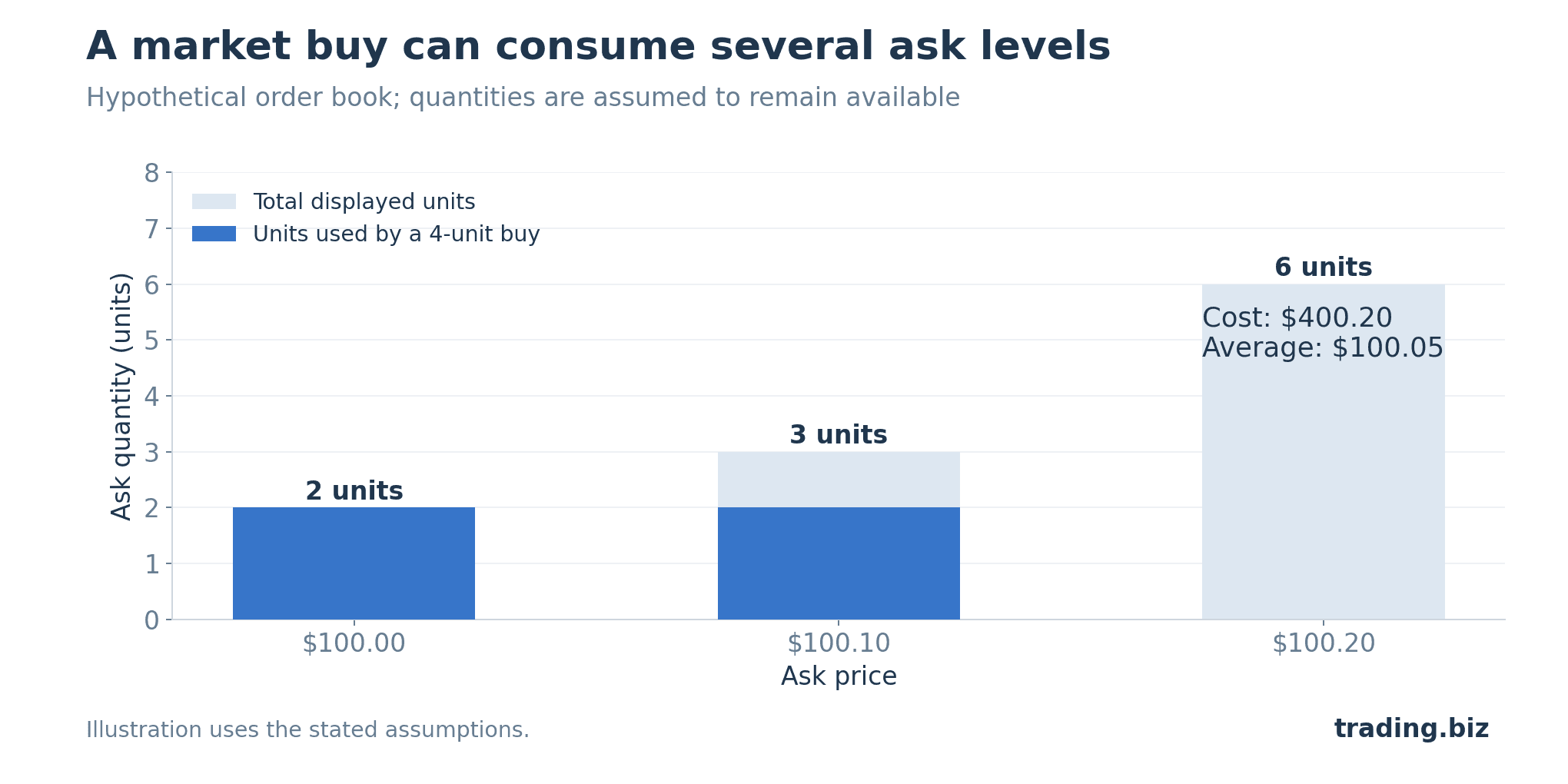
Figure 1. A hypothetical ask book offers 2, 3 and 6 units at $100.00, $100.10 and $100.20. A four-unit market buy uses two levels if those quantities remain available.
A depth chart presents cumulative quantities graphically. Its slope and steps can help show where displayed size concentrates. Zoom, price aggregation and the selected quantity unit can change its appearance without any change in the underlying orders.
Liquidity also includes how the book responds after trading. A large order may consume visible size and be followed by new quotes. One snapshot cannot establish replenishment speed or the price impact of a repeated sequence of orders.
Reading the order book on a crypto exchange
Confirm the pair and product first. BTC/USDT spot and a BTC perpetual contract can sit on adjacent screens while using different settlement, leverage and quantity conventions. Record the market name with any screenshot used for analysis.
Set a price grouping suited to the question. Grouping quotes into $10 bands can hide a $1 difference relevant to a small target. A finer view can reveal more detail while increasing the number of updates you need to interpret.
Compare the intended quantity with cumulative depth on the side you will consume. For a buy, use asks; for a sell, use bids. Include the order's maximum price where one exists. Stop the calculation at that price and record any unfilled quantity.
Then compare the actual fill with the snapshot and its timestamp. A displayed quote may have changed before your order reached the matching engine. Save acknowledgements and fills if you intend to measure that difference.
An order book TradingView display also depends on the connected venue and data service. Level 2 data can be a separate entitlement. A chart subscription or a forex broker quote feed does not automatically provide a consolidated book for every market.
Spoofing and fake walls
A fake wall is a trader's description of large displayed interest suspected of being misleading. Its size alone cannot establish the order owner's intent. Legitimate participants can cancel or resize orders when price or risk changes.
Spoofing concerns deceptive order behaviour, with legal definitions depending on the market and jurisdiction. For analysis, preserve the sequence: when the size appeared, how it changed, whether trades occurred and what the surrounding market did. A single before-and-after image leaves many of those details unknown.
An apparent buy wall can also be consumed by genuine selling. If your plan assumes a visible 100-unit bid must hold the price, specify what happens when that bid trades or vanishes. The position needs a loss condition independent of the wall remaining visible.
Order book trading therefore needs evidence beyond colour and size. Compare repeated observations and executable outcomes. A bright block on a heatmap can help identify a question; it cannot supply the account's risk budget.
Order types and how they interact with the book
A market order prioritises execution at available prices under the venue's rules. A limit order sets a worst acceptable price, while leaving the possibility of no fill or a partial fill. The SEC's order guidance explains the price and execution distinction for securities orders.
A buy limit at $100.10 in the example could immediately consume the available asks at $100.00 and $100.10, up to its quantity. A limit order can therefore act as a taker when it crosses the spread. Its label does not guarantee a maker fee.
A post-only instruction, where supported, can prevent immediate taking by cancelling or adjusting a marketable order according to the venue's rules. Immediate-or-cancel and fill-or-kill instructions have different treatment of unfilled quantities. Read their exact definitions before using them in a multi-leg process.
Queue position matters for a resting order. A chart touching your limit price does not prove that enough opposing quantity traded ahead of and through your order. Use actual fills or an explicit queue assumption in a historical simulation.
Price grouping can also exaggerate a wall's persistence. An aggregated $100 band might contain many separate orders that appear and disappear while its rounded total stays similar. Save the grouping increment with the image and compare the trade feed before attributing the behaviour to one participant.
For a practical cost check, compare a four-unit market buy with a four-unit limit at $100.00 in the example. The market order can complete at the stated weighted price; the limit can initially fill only two units. The remaining two units carry a different opportunity and timing risk. Assess the intended completed position when comparing market versus limit order choices.
Terms used in an order book
These definitions describe different parts of the display and transaction. Keep the quantity unit and venue visible when comparing two screens.
| Term | Meaning |
|---|---|
| Best bid | Highest published buying price in the relevant book |
| Best ask | Lowest published selling price in the relevant book |
| Depth | Available quantities across price levels |
| Marketable limit | Limit order priced to execute against available opposite orders |
| Queue position | An order's priority among competing interest under the venue's rules |
FAQ
How do I read an order book for a large purchase?
Compare your quantity with cumulative asks and calculate the weighted average price. Include fees and an allowed price limit. Recheck available depth before submitting the order.
Does a large bid guarantee support?
The bid can trade, change or disappear. Treat it as an observation within a defined plan, with its own invalidation and position size.
Is a limit order always cheaper than a market order?
Its cost depends on execution, fees and whether it fills. A marketable limit can take liquidity, while a passive order may remain unfilled. Compare the complete intended transaction.
What should I record during practice?
Save the venue, pair, timestamp, quantity unit, visible depth and submitted order. Compare the resulting fills with those observations before increasing trade size.
Find Your Perfect Broker: Explore Our List Now!
Choose the best with our expert-selected options
Find Your Perfect Broker: Explore Our List Now!
Choose the best with our expert-selected options
Discover top binary options brokers tailored to your region. Browse our curated lists by country: