Updated:November 25, 2026

9 min

0
CFD trading explained: leverage, costs and how CFDs differ
Fifty share CFDs bought at $100 create $5,000 of exposure. At an assumed 20% margin, a $10 fall uses half the initial $1,000 collateral before costs. Follow the contract, charges and close-out calculation.

Joel Lim
Author

You deposit $1,000 and open a position linked to $5,000 of shares. The shares fall 10%. Your price loss is $500, before charges, because the contract follows the full exposure. The amount posted as margin did not reduce the quantity's sensitivity.
CFD trading explained through one account is easier to follow than a leverage slogan. Start with the instrument, contract units and executable prices. Then add margin, financing and the provider's close-out rules.
CFD meaning: define CFD trading in plain words
CFD stands for contract for difference. It is a derivative agreement settling a price difference according to the contract's terms. The underlying reference can be a share, currency pair, index or another permitted market. The exact product and its availability depend on the provider and jurisdiction.
For a simple share CFD quoted per share, a long position's price profit or loss is quantity multiplied by exit price minus entry price. Fifty units bought at $100 and sold at $104 produce $200 before costs. Selling those units at $90 produces a $500 price loss.
A short position reverses the price direction of that calculation. Selling 50 units at $100 and buying them back at $104 loses $200 before costs. The instrument's contract size and settlement currency must be checked before applying the formula to an index or commodity symbol.
CFD meaning in trading also includes the claim you hold. A share CFD gives contractual price exposure; it does not make you the owner of the referenced shares. Dividends may produce cash adjustments under the agreement, while voting and other shareholder rights differ from owning the underlying security.
How leverage, margin and overnight financing work
Margin is collateral required to support the exposure. With $5,000 of exposure and an assumed 20% initial margin rate, the requirement is $1,000. That corresponds to five times the collateral in market exposure. This example rate is an arithmetic assumption, not a quotation for a specific broker.
The same 50-unit position changes by $50 for each $1 move in the share reference. A lower required margin can release collateral, but it leaves that price sensitivity unchanged. Increasing the quantity after receiving more leverage changes both exposure and potential losses.
Account equity includes the effect of open profit and loss and applicable charges. Used margin supports the open positions. A provider can reduce or close exposure when the account no longer meets its requirements. Multiple positions must be evaluated together under the account's close-out policy.
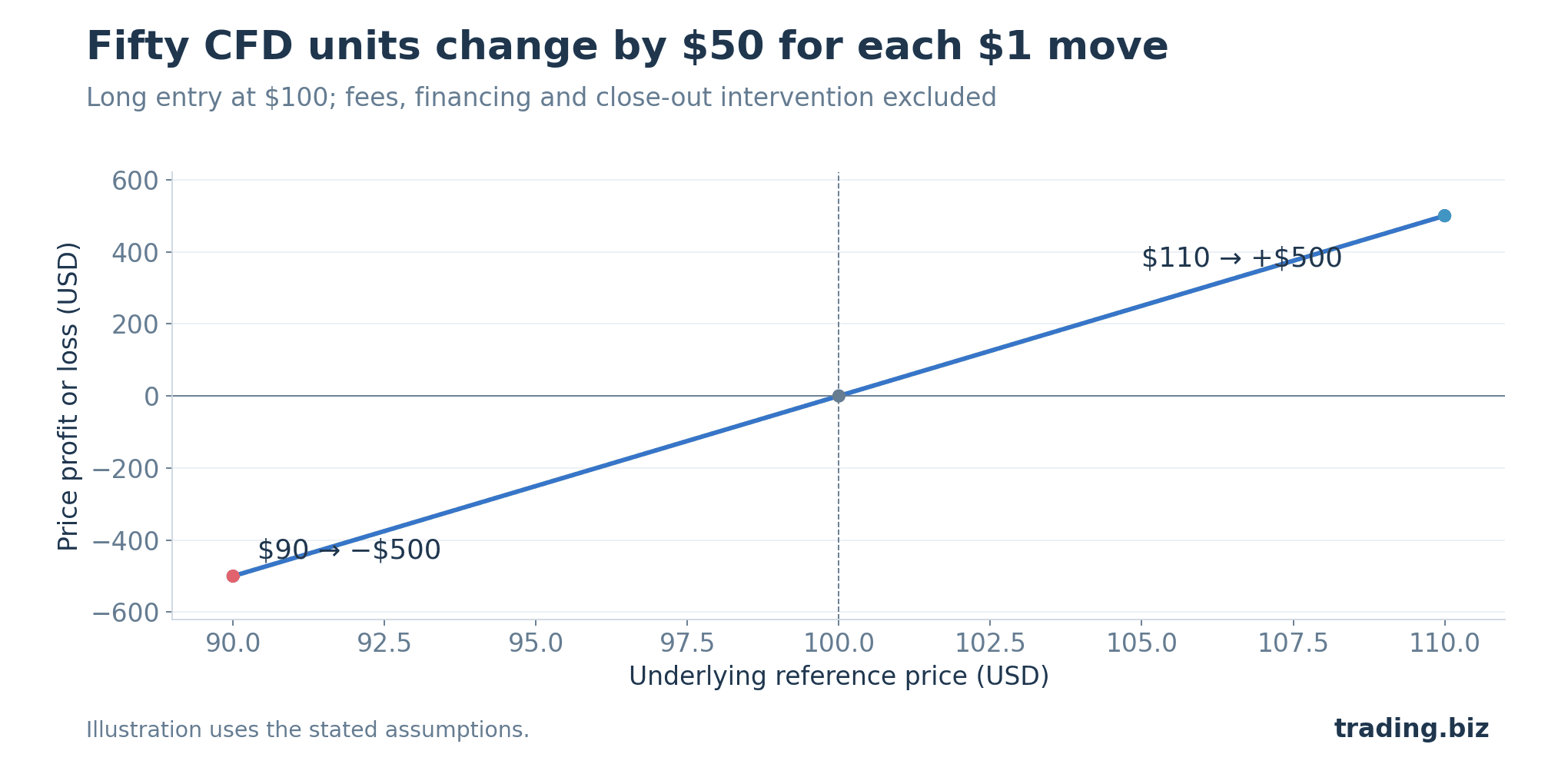
Figure 1. For the hypothetical 50-unit long CFD opened at $100, each $1 price move changes profit or loss by $50. Fees, financing and close-out intervention are excluded from the line.
Overnight financing can depend on the instrument, direction, reference rate, markup and day-count convention. Some contracts also have multi-day adjustments around settlement dates or holidays. Read the schedule for the actual symbol and holding period.
For a simplified calculation, assume constant $5,000 notional, an 8% annual charge, seven chargeable days and a 365-day basis. Financing is $5,000 × 8% × 7 / 365, or approximately $7.67. A provider using changing daily notional or another convention produces a different amount.
What is CFD broker: role, execution models and payment
A CFD trading broker supplies the account, product terms, pricing interface and order-handling arrangement. Identify the legal entity named in your agreement. A familiar brand can operate through several entities with different permissions and client protections.
The provider may hedge some client exposure externally, internalise it or use a mixture of arrangements. Read the execution and conflicts policies. A label such as ECN or direct market access, by itself, does not establish the legal counterparty or the complete treatment of your order.
The FCA's CFD guidance is one example of a regulator explaining the responsibilities of firms serving retail customers. Its rules apply within their defined scope. An offshore account using the same brand requires its own assessment of permissions, protections and complaint routes.
Fund the account through the payment details verified inside the provider's official process. Check the beneficiary, permitted payment method, account currency and conversion charge. A request to send money to a salesperson's personal account needs independent verification before any payment.
The CFD trading platform is the interface through which you submit instructions. Learn the quantity field, order type, trigger reference and session status in a demo before relying on the ticket. A correctly drawn chart level cannot correct an extra zero entered into volume.
CFD fees: spread, commission and swap
Calculate the complete round trip using a consistent price basis. A long normally opens at the available ask and closes at the bid, subject to the product's rules. If those are your actual entry and exit prices, their difference already includes the relevant spread effect. Adding that spread again would double-count it.
Return to the 50 units bought at an actual $100 entry and sold at an actual $104 exit. Assume a $5 commission each way and the simplified $7.67 financing charge. The $200 price profit becomes $182.33 before any other adjustments or tax.
The following figures belong to that hypothetical trade. They show the calculation structure; the provider's current schedule supplies the real rates and any minimum charges.
| Component | Example | Effect on the result |
|---|---|---|
| Price result | 50 × ($104 minus $100) | +$200.00 |
| Opening commission | Assumed $5 | −$5.00 |
| Closing commission | Assumed $5 | −$5.00 |
| Financing | Stated seven-day calculation | −$7.67 |
| Net before other items | Sum of the above | +$182.33 |
Currency conversion can add another cost when account and settlement currencies differ. A dividend adjustment, borrow charge or contract expiry can also affect the ledger. Check both the dealing ticket and transaction history so the realised result can be reconciled.
Swap is often used for an overnight funding adjustment in retail forex discussions. Providers use different terminology and formulas across contracts. A swap-free account can have other charges or holding restrictions, so inspect the complete fee schedule before assuming a multi-day position has no carrying cost.
CFD vs forex vs binary options
Forex names the currency market. CFD names a contract structure that can reference a currency pair or another underlying. A forex product may be delivered currency, a rolling leveraged contract, a future or another arrangement. Read the contract before comparing costs or regulatory treatment.
Binary options use a different payoff structure, commonly a fixed payout determined by whether a defined condition is met at expiry. For a hypothetical $10 stake paying $8 profit on a win and losing $10 on a loss, the break-even win rate is 10 / 18, or about 55.56%, before other costs.
That fixed-payout calculation cannot be transferred to a CFD. A CFD's result varies with quantity, price movement and costs until the position closes or the agreement's close-out process acts. The exit mechanism and holding period therefore belong in the comparison.
The table compares broad mechanics. Product availability and legal restrictions must still be checked for the exact account and residence.
| Product description | What determines the result | What to establish first |
|---|---|---|
| Fully paid shares | Price, distributions and ownership costs | Ownership, custody and dealing terms |
| CFD | Contract quantity, price difference and adjustments | Margin, financing and close-out rules |
| Forex product | Terms of the specific currency contract | Delivery or derivative structure and costs |
| Binary option | Defined expiry condition and payout schedule | Legality, payout and loss mechanics |
CFD vs stock comparisons should also include corporate actions and trading hours. A cash shareholding and a leveraged share derivative can reference the same company while placing different demands on collateral and overnight risk.
Risks and regulation of CFDs
Under its retail CFD framework, the FCA requires leverage limits, account-level margin close-out and negative balance protection within the rules' scope. Its guidance also warns that opting for professional status can remove retail protections. Check the classification offered in the actual agreement before accepting it.
For the framework's 50% margin close-out concept, consider an account with a constant $1,000 margin requirement and no other positions. Equity of $500 reaches that hypothetical threshold. It corresponds to a $500 decline from $1,000 starting equity before charges. In the 50-unit example, a $10 underlying decline produces that $500 price loss, while the share reference falls 10%.
Negative balance protection concerns the covered account under the applicable rules. It does not preserve the original deposit or make every stop fill at its trigger. A personal stop, the provider's margin close-out and an account-balance protection are distinct mechanisms with distinct conditions.
Rules differ by product as well. The FCA Handbook's cryptoasset-derivative restrictions need to be checked separately when a provider advertises crypto-linked exposure. Permission for one derivative or client category cannot establish permission for another.
Market gaps, changing margin requirements and provider risk can affect even a small position. Three positions with separate symbols may share the same market driver. Test the combined adverse move in cash and compare it with both your planned loss budget and collateral capacity.
Finally, read the provider-specific risk warning and its calculation period. A percentage of losing retail accounts describes the provider's stated sample. It cannot be converted into the probability that your next trade will win or lose.
Before switching symbols, repeat the sensitivity calculation from the contract specification. One share CFD unit, one index contract and one metal lot can represent very different quantities. Write the account-currency effect of one quoted point and multiply it by the proposed stop distance. Then include the volume step, minimum charge and expected holding cost before deciding which quantity fits the loss budget.
Terms used in CFD trading
These definitions connect the order ticket with the account statement. Keep the provider's contract specification beside them when changing from shares to currencies, indices or metals.
| Term | Meaning |
|---|---|
| Notional exposure | Market value represented by the contract quantity |
| Initial margin | Collateral required to establish the exposure |
| Account equity | Account value after open results and applicable adjustments |
| Financing | Charge or credit associated with carrying a position |
| Close-out | Reduction or closure under the provider's risk rules |
FAQ
What does CFD stand for in trading?
Contract for difference. The agreement specifies how a referenced price difference is settled. Check quantity, contract units and currency before calculating the cash result.
Can I lose my entire CFD deposit?
Yes, losses and charges can consume the account's funds. Any protection against a negative balance depends on the applicable rules and agreement. Size the position using an explicit loss scenario before opening it.
Is a lower spread always cheaper?
Compare spread and commission together, then add financing and other relevant adjustments over the intended holding period. Use actual executable entry and exit prices consistently so no cost is counted twice.
What should I check before a first CFD order?
Calculate the cash effect of a $1 move, the planned exit loss, required margin and expected carrying cost. Match those figures to the ticket's quantity and contract specification before submitting the trade.
Find Your Perfect Broker: Explore Our List Now!
Choose the best with our expert-selected options
Find Your Perfect Broker: Explore Our List Now!
Choose the best with our expert-selected options
Discover top binary options brokers tailored to your region. Browse our curated lists by country: