You finish a chapter on breakouts and open a chart. Price has already moved. The book gave you a pattern, but you still need to specify when the signal existed, which order you would submit and how much a failed entry could cost.
That gap shapes this reading list. The best trading books leave you with questions you can turn into observations, calculations or tests. Buying five at once can postpone that work just as easily as it can support it.
How we picked these trading books
We grouped these books by the problem they help investigate: market mechanics, chart definitions, decision-making, historical experience and systematic research. Author and title details were checked against publisher catalogues. The exercises below are our suggested ways to apply the material.
The list includes older books because a chapter about order incentives or position sizing can remain useful after its software examples age. Check the publication and edition before buying. A reprint date does not establish that platform instructions, regulations or transaction costs have been updated.
There is no return ranking here. A popular author's trading record, a publisher's description and the educational value of a chapter are different forms of evidence. Use the publisher page to establish what the book contains; test a proposed trading method against current data and costs.
Start with the task in the second column. The reading sequence is deliberately flexible: someone who repeatedly submits the wrong order type needs different material from someone already writing and validating code.
| Book and author | Best starting task | Work to produce |
|---|
| Technical Analysis of the Financial Markets, John J. Murphy | Learn chart vocabulary | One precisely defined chart pattern |
| The Art and Science of Technical Analysis, Adam Grimes | Connect structure and setups | Entry, invalidation and failure examples |
| Trading in the Zone, Mark Douglas | Examine decisions under uncertainty | A process-adherence journal |
| Market Wizards, Jack D. Schwager | Compare practitioners' methods | Notes separating shared principles from personal style |
| Reminiscences of a Stock Operator, Edwin Lefèvre | Read trading history critically | A distinction between narrative and testable rule |
| Trading and Exchanges, Larry Harris | Understand orders and market structure | A complete round-trip execution calculation |
| Algorithmic Trading, Ernest P. Chan | Build a research process | A cost-aware test with a later holdout period |
| Day Trading and Swing Trading the Currency Market, Kathy Lien | Study forex context | An event and rate-exposure worksheet |
| Mastering Bitcoin, Andreas M. Antonopoulos and David A. Harding | Understand Bitcoin transactions | A documented custody and transaction workflow |
Books for beginner traders
John J. Murphy's Technical Analysis of the Financial Markets offers a broad introduction to technical tools and chart interpretation. It can help a beginner understand what a trendline, moving average or momentum indicator is meant to describe. The breadth makes it a reference you can revisit by topic.
Pick one concept from a chapter and make its definition explicit. For support, write whether your level uses a single low, a price zone or repeated closes. Mark 20 examples with future bars hidden. Keep the failures as well as the charts that later rallied.
Jack D. Schwager's Market Wizards takes a different route through interviews with traders. Read it to compare how practitioners frame decisions and risk. An interview provides context and recollection; it does not supply a complete algorithm you can execute after one chapter.
After two interviews, make separate notes for the instrument, holding period, loss control and information used. If those details differ, resist blending the two approaches into a single imaginary method. The comparison is useful precisely because successful practitioners can operate very differently.
Reminiscences of a Stock Operator is Edwin Lefèvre's fictionalised trading narrative associated with Jesse Livermore. Read it as historical literature about speculation. A memorable scene can prompt a good research question, but it cannot establish a current fill price, legal rule or expected return.
Books for beginner traders should also help identify missing foundations. If you cannot yet distinguish cash paid for shares from margin posted for a derivative, pause the search for an entry pattern and work through the contract mechanics. One correctly calculated loss is more useful than ten unexplained chart labels.
Technical analysis and price action books
Adam Grimes's The Art and Science of Technical Analysis connects market structure, price action and trading strategies. It suits readers who want to move from recognising a picture to examining a repeatable setup and its limitations.
Use a chapter to draft an entry rule with a confirmation time, order type and failure condition. For a breakout, specify whether a completed close beyond resistance is required. If the level becomes known only after two later candles, the test must retain that delay.
Murphy can provide the vocabulary while Grimes prompts more detailed questions about structure and evidence. Keep those purposes visible in your notes. Reading both does not remove the need to define your data source, trading session or transaction costs.
For price action trading books generally, inspect the sample charts. Ask whether levels were visible before the illustrated entry and whether failed cases appear. A historical screenshot with a perfect arrow provides less execution information than a rule that tells you exactly when the order could have existed.
Books for intraday trading need an additional execution layer. A two-pip spread has a very different effect on a six-pip target than on a 150-pip target. Write the spread, commission and slippage assumptions next to the setup before testing it on a one-minute chart.
Trading psychology and discipline books
Mark Douglas's Trading in the Zone focuses on trading decisions and uncertainty. Use its themes to examine how you respond to a planned loss or a missed move. Avoid treating confidence as evidence that the underlying strategy works.
An exercise can start with 20 trades and two separate labels: whether the rule was followed and whether the trade won. A winning rule violation remains a violation. A correctly executed losing trade remains part of the method's outcome distribution.
Trading psychology books are most useful when they change an observable action. Examples include setting a quantity ceiling, writing a maximum entry price or defining the condition for a pause. “Be patient” needs a corresponding action, such as waiting for a completed hourly close.
Return to the same chapter after reviewing your journal. If the repeated issue is duplicate orders caused by the interface, practise the order workflow. A psychological explanation should not conceal a mechanical problem you can reproduce and fix.
Books for experienced traders: systems, risk and market structure
Larry Harris's Trading and Exchanges: Market Microstructure for Practitioners examines how markets and their participants operate. It is a strong next step when you need to understand orders, spreads, liquidity and incentives behind an execution result.
Take a 100-share purchase and write out the quoted bid and ask, the submitted order, commissions and exit. Then change only one input, such as available depth. That exercise links a market-structure concept to the cash result instead of leaving it as terminology.
Ernest P. Chan's Algorithmic Trading: Winning Strategies and Their Rationale discusses systematic strategies and implementation. Use it alongside a research log that records every parameter version and the data available at each decision time.
Keep an untouched later period for evaluation. A strategy chosen from 200 parameter combinations has already benefited from extensive selection. A convincing historical curve needs an examination of costs, data leakage, survivorship and sensitivity to reasonable parameter changes.
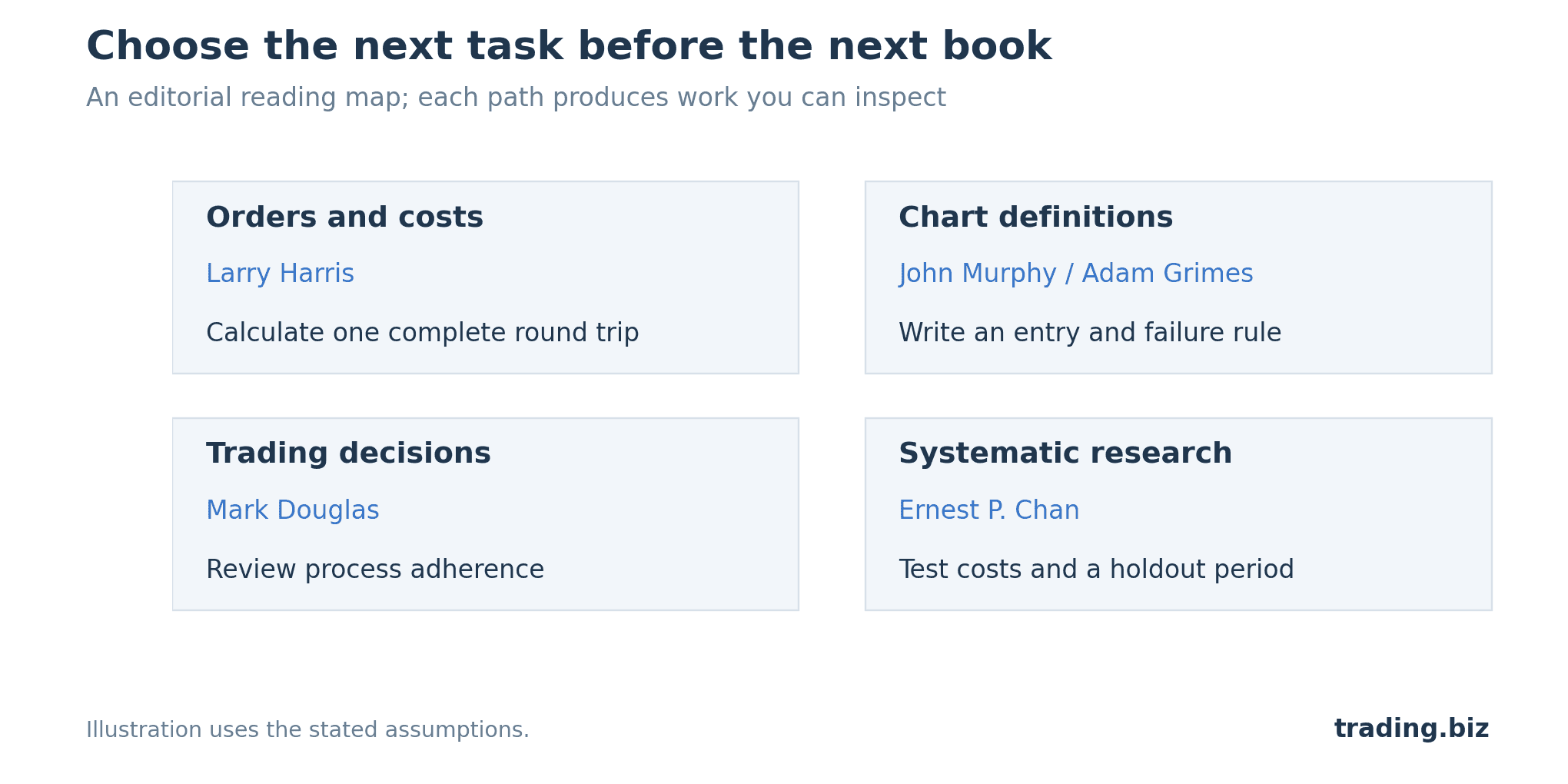
Figure 1. An editorial reading map links four study tasks with a piece of work to produce. The paths describe learning activities and make no claim about trading performance.
The best books on trading can therefore lead to quite different outputs: a market-structure worksheet, a chart definition or executable research code. Choose the output your current process lacks. Adding another strategy before you can measure the existing one often creates more untracked decisions.
Books on crypto and forex specifically
Kathy Lien's Day Trading and Swing Trading the Currency Market belongs among forex trading books that connect currency trading with economic context and trading approaches. Verify the edition's contents on the Wiley catalogue. Use a chapter to identify the currencies, event exposure and holding costs of a proposed trade.
For example, a EUR/USD position held across a central bank decision requires an event date, stop mechanism and financing assumption. A long GBP/USD position can add exposure to the same dollar move. The exercise should show the combined portfolio sensitivity.
Mastering Bitcoin, third edition, by Andreas M. Antonopoulos and David A. Harding, covers Bitcoin's technical foundations. It helps a trader understand transactions and custody, which affect the ability to move and safeguard an asset. It is a technical reference with a different purpose from a directional trading manual.
Use it to document a transaction workflow: address verification, fee selection, confirmation and recovery material. Work in an appropriate test environment before committing valuable assets. A chart strategy cannot resolve a mistaken address or missing backup.
When assessing crypto trading books, check how they distinguish spot assets, perpetual futures and custody. An old exchange screenshot can become obsolete quickly. Recheck platform rules against current official documentation before following any operational instruction.
Terms used in a reading and research plan
Keep these definitions beside your notes when a book proposes a method. They help separate learning the idea from evaluating its implementation.
| Term | Meaning |
|---|
| Setup | A defined set of conditions preceding a possible trade |
| Execution cost | Spread, fees and price effects associated with trading |
| Holdout period | Later data kept out of strategy selection |
| Data leakage | Use of information unavailable at the decision time |
| Process adherence | Whether an actual decision followed its assigned rules |
FAQ
Which trading book should I read first?
Choose by the missing task. Murphy can introduce chart vocabulary; Harris addresses market mechanics in greater depth. Start with one chapter and produce a worked example before ordering another book.
Are the best day trading books useful for swing traders?
Risk and order concepts can transfer, but holding periods change costs and event exposure. Recalculate overnight financing and gaps when adapting an intraday example to several sessions.
Should I copy a strategy exactly as printed?
First establish the rules, data and market conditions behind it. Reproduce the calculation, then test current costs and a later period. Keep any adaptation under a separate version so the comparison remains clear.
How do I make a reading list manageable?
Pick one mechanics book and one book matched to your current task. Schedule a review after two chapters. Continue when you can show the calculation, chart definition or journal change those chapters produced.



 Rahul NambiampurathTrading.Biz