One trader is credited with a famous currency position. Another built a quantitative firm with teams, data and execution infrastructure. Put both names into a ranking by personal wealth and most of the useful information disappears.
The best traders in the world become worth studying when you connect a documented method with the decisions it requires. A memorable profit figure gives you much less to work with than a clear account of risk, timing and what changed the trader's mind.
Best trader in world: how success is measured
Start with the unit being compared. A manager's fund return belongs to a vehicle, strategy, share class and period. Personal net worth can include ownership of a management company and assets outside trading. A contest result covers the account and dates governed by that competition's rules.
Returns also need their cost basis. Gross and net figures can differ because of fees and other expenses. A 30% gain with a 50% drawdown describes a different risk path from a 15% gain with a 10% drawdown. Those hypothetical figures illustrate why one return column is insufficient.
Searches for top 10 traders in the world or richest traders in the world often mix these measures. Build a comparison with the period, capital base, cash-flow treatment, leverage, drawdown and evidence source. Leave an unverified field blank instead of filling it with a recycled estimate.
The names below form a study list organised by approach. The practical exercises are our interpretations of what a reader can investigate. They do not reproduce the traders' private systems or imply that their historical results are available to copy.
Cash flows deserve particular care. Suppose an account begins at $10,000, receives another $5,000 and ends at $16,000. The $6,000 increase in balance cannot be called a 60% trading gain: $5,000 came from the deposit. A proper return calculation also needs the timing of that cash flow.
Use the same discipline when reading a profile. Find the original record behind a result and establish whether it covers an individual account, a fund or an estimate of business ownership. A short biography can establish a name and career milestone while leaving the return calculation unresolved.
Legendary macro traders: Soros, Druckenmiller, Jones
George Soros: examine the feedback loop
Soros describes reflexivity in his own account of financial markets: participants' beliefs can influence prices and, under some conditions, the underlying situation those prices reflect. The framework asks you to examine a feedback process as it develops.
For a study exercise, separate observation, interpretation and a condition that would weaken the interpretation. Rising collateral values might support more borrowing, which can support further buying. Then ask what happens if financing becomes more expensive. This produces a sequence you can investigate with data.
Do not turn that sequence into an automatic short simply because the word bubble appears. An expanding feedback process can persist longer than a trader's capital or financing arrangement can support. The entry and loss budget still require separate rules.
Stanley Druckenmiller: connect the thesis to the instrument
Druckenmiller's chapter in The New Market Wizards addresses top-down investing. Use that material to examine how a broad economic view becomes a particular position. A view on falling inflation can be expressed through several assets with different sensitivities.
Suppose you expect lower short-term rates. A currency pair, a government bond and a growth stock will not respond identically, because each carries other exposures. Write what must happen for your chosen instrument to benefit. Then list the observable developments that would invalidate the trade.
Concentration also needs a cash calculation. Three positions linked to the same policy view can form one large economic bet. Count their combined adverse scenario before treating three symbols as three independent ideas.
Paul Tudor Jones: study the decision process around risk
Tudor's own history dates the firm's founding by Paul Tudor Jones to 1980. Its current description includes discretionary and quantitative strategies across asset classes. A founder's public profile and a modern firm's full activity should be read with that distinction in mind.
For a useful exercise, write a maximum acceptable loss before drafting the market thesis. If a $10,000 test allocation can lose $100 on a view, calculate the quantity for several plausible stop distances. A wider chart stop must reduce quantity if the cash budget stays unchanged.
That exercise is our application of risk budgeting. It is not a claim about Jones's private sizing formula. Public interviews can help you ask better questions; they rarely reveal every operational constraint of a professional portfolio.
Stock and trend traders: Livermore, Minervini
Jesse Livermore: read the history with its limitations
Edwin Lefèvre's Reminiscences of a Stock Operator is a fictionalised biography associated with Livermore. Its narrative is a reason to investigate speculation, crowd behaviour and decision-making. It should be read with its historical and literary form in view.
Choose one idea, such as waiting for a price condition, and translate it into a modern definition. State the observable condition, confirmation time and order you could actually submit. An engaging scene does not determine today's spread, position limits or execution venue.
Keep the failures in the history as visible as the celebrated trades. Selecting only a successful episode creates a misleading teaching sample before a chart is even opened.
Mark Minervini: turn a stock selection idea into rules
Minervini's own educational site identifies his SEPA approach and stock-screening tools. That establishes the terminology he uses to describe his work. Performance claims require their own records, period and verification standard.
When studying a stock setup, write the liquidity requirement, trend condition, entry trigger and exit. Suppose the proposed entry is $50 with a stop at $48. A $100 price-risk budget permits 50 shares before costs. An entry at $51 changes that quantity to about 33 shares for the same stop and budget.
The calculation shows why copying a chart image cannot reproduce a trade. Your entry, liquidity and account size determine the exposure you actually take.
Ed Seykota and Richard Dennis: investigate systematic trend decisions
Seykota and Dennis appear among the practitioners interviewed in Market Wizards. Their material is useful for studying rule-based trading questions: when to enter, how much to hold and when a trend position ends.
For an exercise, choose a fully specified trend rule and evaluate all qualifying signals over a defined period. Record the losing trades and inactive stretches as carefully as the large trends. A strategy that depends on occasional extended moves can be distorted by removing either part of that record.
Treat any rule reconstructed from an interview as your implementation. Public recollection does not establish every parameter, contract roll, portfolio constraint or cost used in the original operation.
Quant and systematic traders: Simons and Renaissance
Jim Simons: examine the research organisation
The Simons Foundation's account of his career describes Monometrics beginning in 1978 and being renamed Renaissance Technologies in 1982. His work connects mathematics, research and the development of a quantitative investment firm.
The lesson available to an independent researcher starts with experimental discipline. If you test 100 signals and select the strongest historical curve, the selection process has already used information. Keep a later period untouched and record the entire set of tests you considered.
Institutional resources also matter. Data quality, execution, financing and teams can contribute to an operation's result. A retail indicator carrying a famous firm's name provides no evidence that it uses the firm's research or can reproduce its performance.
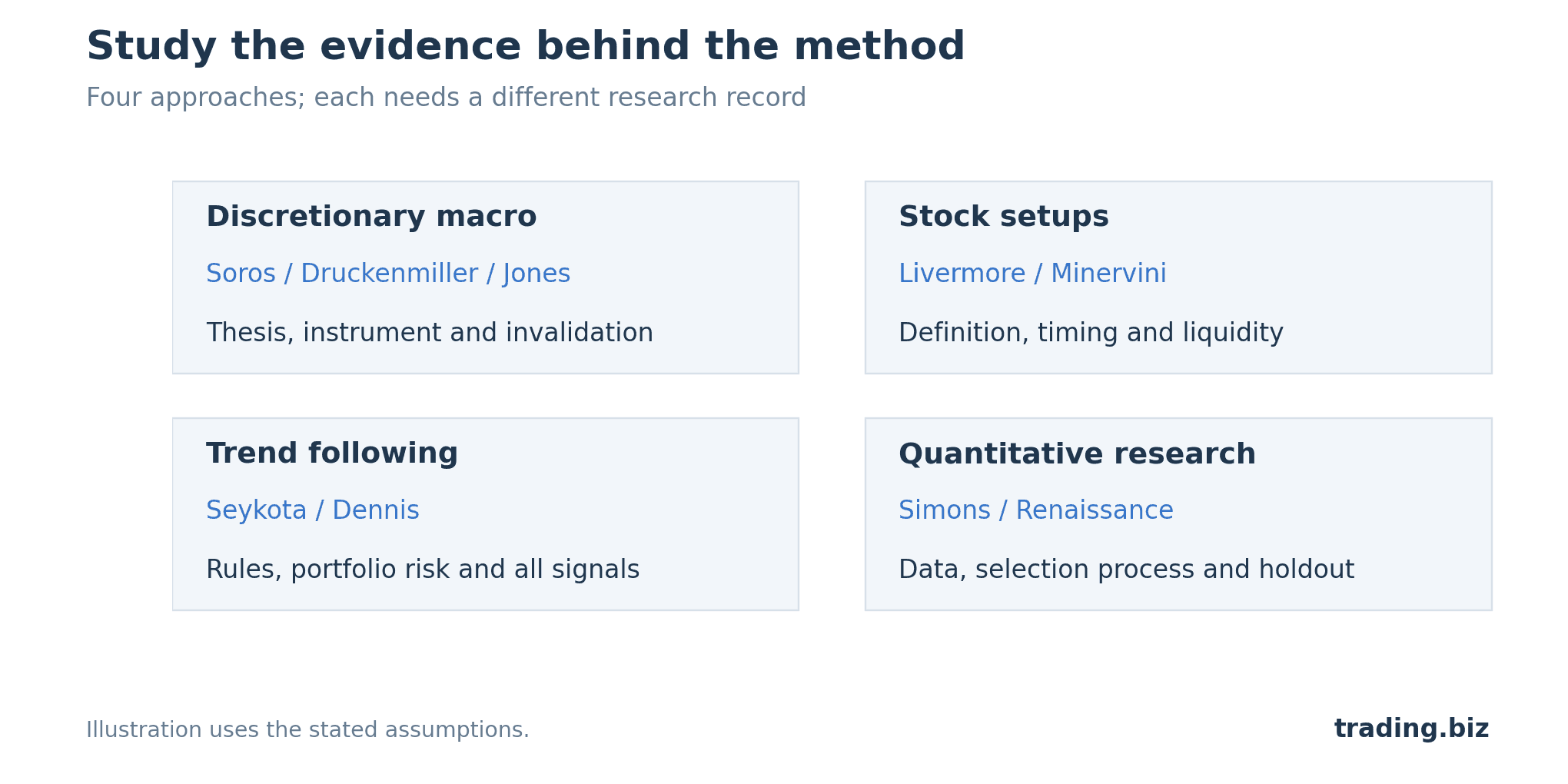
Figure 1. Four study approaches require different evidence: a macro thesis, a defined stock setup, a trend rule and a reproducible quantitative test. The diagram is an editorial comparison.
Trader names worth studying and where to find their work
Bruce Kovner adds another discretionary macro perspective through his Market Wizards interview. Study the connection between a market idea and the point where exposure must be reduced. Keep the interview's circumstances attached to each note instead of turning a sentence into a universal rule.
For newer names such as Jack Kellogg, apply the same evidence standard you use for older famous traders. Identify the complete interview, an attributable statement or the original competition record before repeating a number. A social-media screenshot can omit cash flows, losing periods and open positions.
The world's top forex traders, best stock traders in the world and best day traders in the world are overlapping search labels with different implied time horizons. Specify the instrument and holding period you want to investigate. An equity swing trader's process cannot automatically answer an intraday currency-execution problem.
Use the comparison below to choose a first reading task. The final column identifies a limit on what the source can establish, which matters before adapting any method to your own account.
| Study area | Names to investigate | Evidence to seek | Limit to retain |
|---|
| Discretionary macro | Soros, Druckenmiller, Jones, Kovner | Attributable writing and complete interviews | Public material omits private portfolio details |
| Stock speculation | Livermore, Minervini, Kellogg | Historical context and original records | A narrative or screenshot is incomplete evidence |
| Trend following | Seykota, Dennis | Definitions of rules and portfolio risk | Your reconstruction needs independent testing |
| Quantitative research | Simons | Documented history and research principles | Firm results do not reveal a transferable model |
Search phrases such as top 10 richest forex traders in the world can be especially misleading when they recast multi-asset managers as pure forex traders. Check what the person actually traded in the period being discussed. Wealth estimates also need a date and a stated method.
What to take from top traders: risk, patience and process
Extract one decision you can observe. For risk, calculate the loss at a specified exit. For patience, identify the condition that keeps you out of the market. For research, preserve the strategy version and the time at which each input became available.
Consider a hypothetical $1,000 account with a $10 planned loss per trade. Three correlated positions can put roughly $30 at risk under their stated stops before execution effects. The presence of three different entry narratives does not reduce that common exposure.
Then write the condition for changing your mind. A macro view may weaken after a policy decision; a stock setup may fail at a price level; a systematic model may reach a predefined review threshold. Make the condition visible before the trade is judged by its result.
You can also study what a public account leaves unexplained. Missing drawdown, costs or position sizes are questions for further investigation. Admiration is a poor substitute for those fields when you are deciding how much capital a proposed method can put at risk.
Terms used in performance comparisons
Use these definitions when comparing records from different sources. Keep the account, period and calculation attached to every reported percentage.
| Term | Meaning |
|---|
| Net return | Return after the expenses specified by the record |
| Drawdown | Decline from a previous account or strategy peak |
| Survivorship bias | Distortion from examining surviving successes alone |
| Track record | Documented results for a defined account and period |
| Holdout test | Evaluation on data excluded from selecting a method |
FAQ
Who are the best traders in the world?
The answer depends on the measure and available evidence. This study list covers several approaches without assigning a single ordinal rank. Compare records only after aligning periods, costs and risk definitions.
Can a beginner copy a famous trader's strategy?
Public material can provide an idea to investigate. The beginner still needs explicit rules, an achievable order and a risk budget. Test the implementation on its own evidence before committing money.
Which trader should I study first?
Choose someone whose instrument and decision horizon match the task you are learning. Read one complete source, write one testable rule and record the information still missing before moving to the next name.



 Rahul NambiampurathTrading.Biz