Updated:November 11, 2026

8 min

ALMA and Moving Average trading strategy explained
The ALMA, or Arnaud Legoux Moving Average, tells you which way a trend is running. This article covers what the indicator does, how the number is built, and how the ALMA and Moving Average trading strategy works at the chart, including the exact crossover that produces an entry.

Saqib Iqbal
Author
Updated October 23, 2026
The ALMA, or Arnaud Legoux Moving Average, tells you which way a trend is running. This article covers what the indicator does, how the number is built, and how the ALMA and Moving Average trading strategy works at the chart, including the exact crossover that produces an entry.
What is ALMA?
ALMA is a refined moving average. Plenty of traders build strategies around it, and the reason is worth understanding before you place an order.
Arnaud Legoux developed the indicator in 2009 as a modification of the standard MA. His goal was to cut the lag that every moving average carries. ALMA usually produces more reliable signals than other MAs, and it does that by smoothing out small price swings.
Put differently, it makes up and down trends easier to see. So why is ALMA better than a plain MA? A moving average assumes the most recent price matters more than the prints before it.
What it does not account for is the extra uncertainty attached to that recent price. ALMA gives the newest print slightly less weight and returns a smoother line. The picture you get is more honest.
How to calculate ALMA
ALMA uses two calculation methods: a Gaussian filter offset and standard deviation. Three parameters control what comes out.
Window: how much price data is examined. The default is nine intervals. Change the number to tune the indicator to your timeframe.
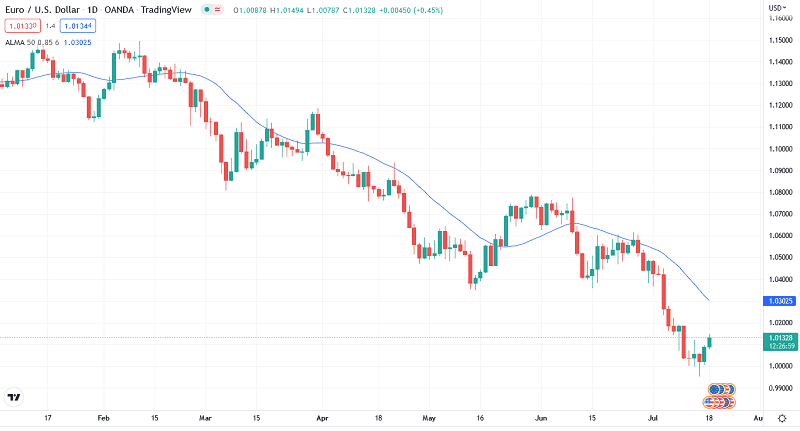
ALMA on the chart
Offset: where the Gaussian filter sits on the line. The default is 0.85. Set it to 1.0 and the indicator tracks price almost perfectly. Push it toward 0 and lag grows sharply.
Sigma: the standard deviation of the combination line. It sharpens that line. The default value is 6.0.
ALMA performs best on longer timeframes, four hours and above. It reads the tendency of the price trend to tell you whether the market is bullish or bearish. If the ALMA line sits above the candle, the trend is bearish. If it sits below the current price, the trend is bullish.
How to use ALMA
You now know what the indicator is and how the value is built. Next comes the part that matters at the chart.

How ALMA is calculated
The indicator works in several ways. Combine it with other technical tools and you get a fuller picture. Here is how to use ALMA effectively.
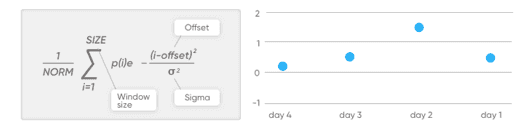
The default value of Sigma
The good old support and resistance
Start with the obvious use. ALMA helps you read support and resistance levels. When the gap between price and the ALMA line widens or narrows, breakouts and retracements from the trend become tradable.
Trading with MA
When used alongside MAs, the indicator can help find entry signals. We’ll talk about ALMA with MA in detail later.
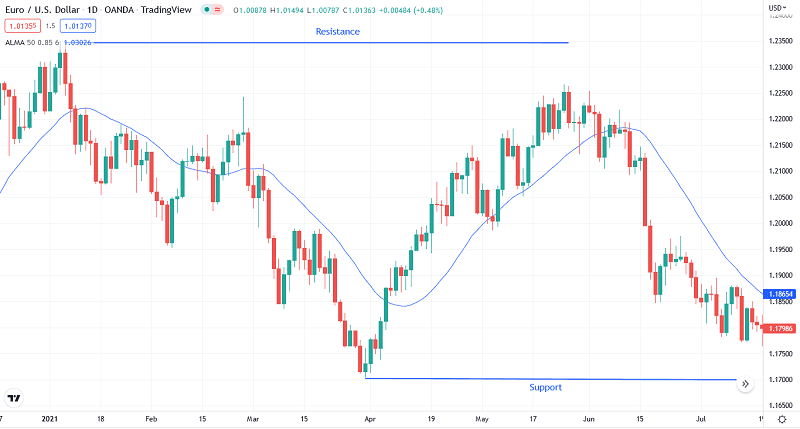
The gap between price and ALMA widens
Finding momentum with the RSI
Another option pairs ALMA with the relative strength index (RSI), which measures momentum. If the RSI shows an asset overbought while ALMA sits above price, the chart is giving you a strong sell signal.
Flip it around and the same logic holds. An oversold RSI with ALMA below price is a powerful buy signal. Indicators like the RSI can be customised on the IQ Cent platform, so the setup can follow your strategy rather than the other way round.
ALMA trading strategy with MA
There are several ways to run ALMA together with a moving average.
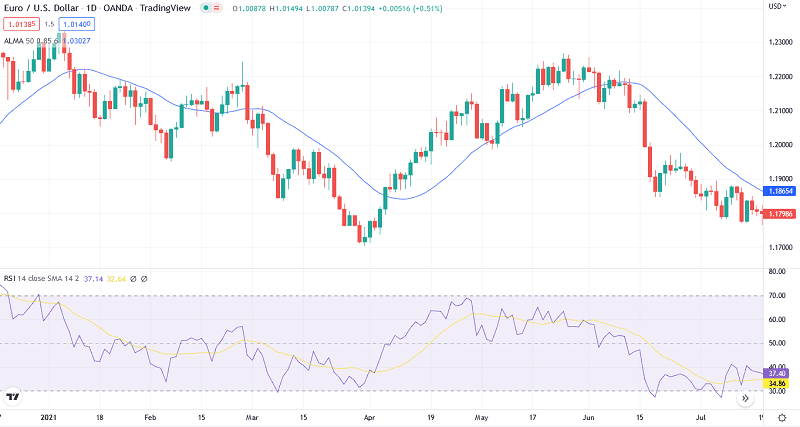
RSI indicates
ALMA and MA crossover
The setup pairs a longer-period ALMA with a shorter-period MA. The reverse works too, a shorter ALMA against a longer MA. For this example we use a 200-period ALMA and a 50-period MA.
On longer timeframes price is less affected by short-term noise, which makes the reading better for long-term sentiment. The timeframe here is D1. Shorten or lengthen it to match how you trade.
ALMA and MA trading strategy
One caution before you set it up. Day trading is volatile and hard even for experienced traders, so a 15-minute ALMA against a 50-minute MA gives you far more noise than signal. Stay with the daily pairing.
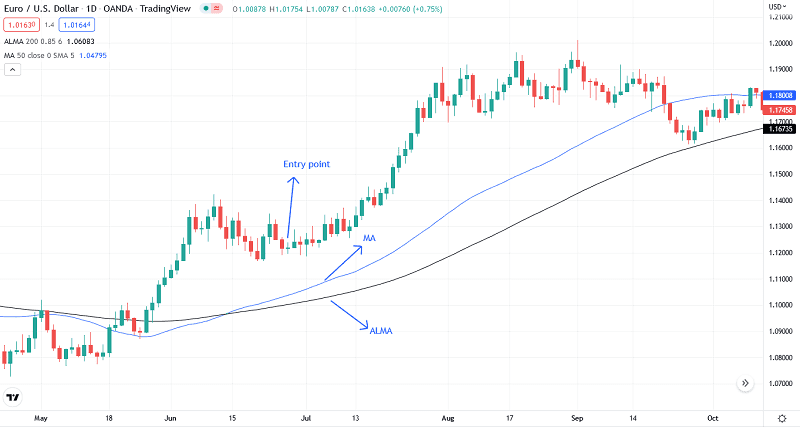
Look at the chart above. The 200-day ALMA sits well below the 50-day moving average. That gap says the market has averaged a stronger performance over the last 50 days than over the previous 200.
When the 50-day moving average crosses up through the 200-day ALMA, the market is rebounding and a bull run is close. That is a bullish crossover, so long positions are on the table. When the ALMA climbs above the MA instead, you are looking at a downtrend.
In the second chart the 50-day MA falls hard and meets the 200-day ALMA. Average performance over the last 50 days has slipped below the 200-day average. Once the ALMA line cuts above the 50-day moving average and the gap keeps widening, the downtrend is confirmed.
A worked example on the daily chart
Set it up step by step. Load a 200-period ALMA with the defaults, window 9, offset 0.85, sigma 6.0. Add a 50-period moving average to the same daily chart.
Now wait. The signal is neither line on its own. It is the moment they cross. While the 50-day MA runs above the 200-day ALMA, the trend is up and you hold. The entry is the candle that closes after the cross, not the wick that touches it.
Confirmation costs nothing. Check the RSI on the same chart: an oversold reading with ALMA below price turns a decent long into a strong one. Exit on the opposite cross, when ALMA climbs back above the 50-day MA.
15-minute ALMA and a 50-minute MA
One sanity check before you start. Crossovers on D1 with these periods are rare by design. If your setup fires every few days, the periods are too short and you are trading noise.
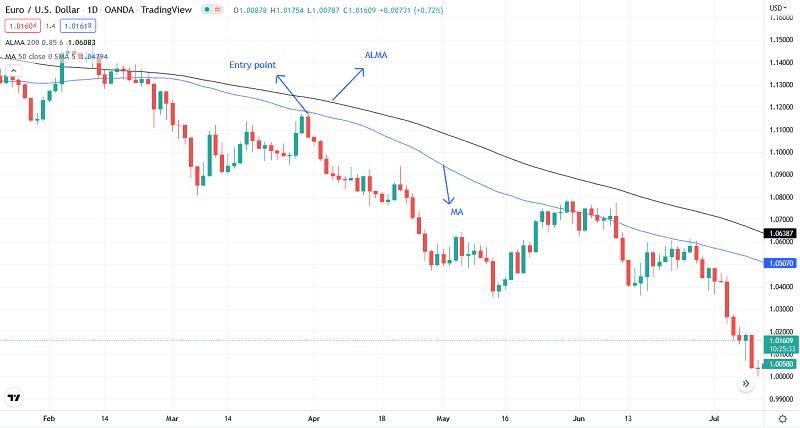
ALMA with MA bearish crossover
Key takeaways
Here are some of the important points you need to remember when trading ALMA with MA:
Using short-term ALMA (5, 10, 12, 20, and 26 periods) will result in early detection of a trend, but with the potential for many false signals.
Using long-term settings (30, 50, 100, and 200 periods) will result in recognizing a trend later when it is more established but with less potential because you are jumping in later. However, you should receive fewer false signals and have a greater win rate.
You can also combine ALMA and MA with momentum indicators like the RSI or MACD for further signal confirmation.
What are the limitations of ALMA?
ALMA is useful, not magic. It carries real shortcomings, and knowing them keeps you out of avoidable trouble.

What are some limitations of the ALMA?
ALMA softens the weaknesses of a traditional moving average, but it still works from past data. It projects a trend from what has already happened and cannot see what is coming. The calculation is price-based, so pair it with a volume indicator: that second class of data tells you whether the move has anything behind it.
Bottom line
ALMA fixes the lag of a plain moving average without losing what makes moving averages useful. It still lags, and it still cannot see news. Paired with a 50-period MA on a daily chart and confirmed by RSI or MACD, it works as a trend filter rather than a signal machine.
Test it on a demo account first. Settings that look clean on one instrument fall apart on another. Then check what execution costs you: on a strategy that trades a few times a year, slippage on entry hurts more than spread, so compare brokers on both. Our broker reviews are grouped by country.
FAQ
What is the ALMA and Moving Average trading strategy?
It pairs the Arnaud Legoux Moving Average with a standard moving average of a different period and trades the crossover between them. The common pairing is a 200-period ALMA against a 50-period MA on a daily chart.
How does the strategy work in 2026?
The mechanics have not changed. A 50-day MA crossing up through the 200-day ALMA reads as bullish, and the reverse reads as bearish. Entries are taken on the close after the cross, not on the touch.
Why does ALMA matter for traders?
A plain moving average lags because it weights the latest price heavily and ignores how uncertain that price is. ALMA reduces that weight and smooths small swings, so the line turns later on noise and earlier on genuine trend changes.
What are the common mistakes?
Using short periods such as 5, 10 or 12 and getting buried in false signals. Trading ALMA alone, without RSI, MACD or a volume indicator. Reading the indicator on a 15-minute chart when it was built for four hours and above.
How do I apply it in practice?
Start on a demo account with the defaults: window 9, offset 0.85, sigma 6.0. Run a 200-period ALMA and a 50-period MA on D1. Wait for a crossover, confirm with RSI, and exit on the opposite cross.
Find Your Perfect Broker: Explore Our List Now!
Choose the best with our expert-selected options
Find Your Perfect Broker: Explore Our List Now!
Choose the best with our expert-selected options
Discover top binary options brokers tailored to your region. Browse our curated lists by country: