Updated:November 25, 2026

8 min

Why slippage in trading happens and how to reduce it
A buy planned at $100 that fills at $100.20 has 20 basis points of adverse slippage against that benchmark. Measure buys and sells with a consistent sign before comparing execution or changing order types.

Vadim Egortsev
Author

You click buy while the screen shows $100. The fill arrives at $100.20. On ten units, that difference costs $2 against the chosen $100 benchmark, before commission. If the displayed price was already stale, several parts of the trading process may have contributed.
Slippage in trading needs a reference price and timestamp. Without them, a complaint about a bad fill can mix market movement, spread, delayed submission and the actual execution result into one unexplained number.
Slippage meaning: positive and negative slippage
Slippage compares an execution price with a defined reference. Negative slippage usually means an adverse difference; positive slippage usually means price improvement. For a buy, paying more is adverse. For a sell, receiving less is adverse.
Use a cash-cost convention to avoid reversing the sign. For a buy, adverse execution cost is quantity × (fill minus reference). For a sell, it is quantity × (reference minus fill). A negative answer under this convention represents an improvement.
Suppose ten units are bought at $100.20 against a $100 reference. Adverse cost is $2 and slippage percentage is 0.20%, or 20 basis points. Selling ten units at $99.80 against the same reference also has a $2 adverse cost.
The benchmark matters. A signal-time midpoint, the ask visible at submission and the quote at venue arrival measure different intervals. Record the chosen definition before comparing brokers or sessions.
Why slippage happens: volatility, liquidity and latency
Volatility can change the available price between decision and execution. Liquidity determines how much quantity is available at each level. Latency describes elapsed time through the device, network, provider and order system. Several effects can occur within one trade.
In a hypothetical book, two units are offered at $100 and three at $100.10. A four-unit buy fills at a $100.05 average if those quotes remain available. The order consumes multiple levels even without a connection failure.
A larger order can therefore experience a different average fill from a smaller one. Comparing a one-unit test with a 100-unit live order needs an assessment of available depth. Execution speed alone cannot create quantity at the best price.
The spread must also be treated consistently. If you benchmark a buy against a midpoint, part of the measured difference reflects paying the ask. If you benchmark against the available ask, the measure starts after that quoted spread component. Avoid counting the same cost twice.
Slippage during news and market gaps
An event can cause quotes to change rapidly and available size to fall. A stop order may become marketable after its trigger, while the next available execution price lies farther away. The SEC's stop-order bulletin explains that a securities stop's trigger does not guarantee its execution price.
Suppose a long position has a sell stop at $98 and the market opens at $95. A fill at $95 creates $3 of adverse stop slippage per unit against the trigger. The account loss also includes the distance from the actual entry to the trigger and applicable costs.
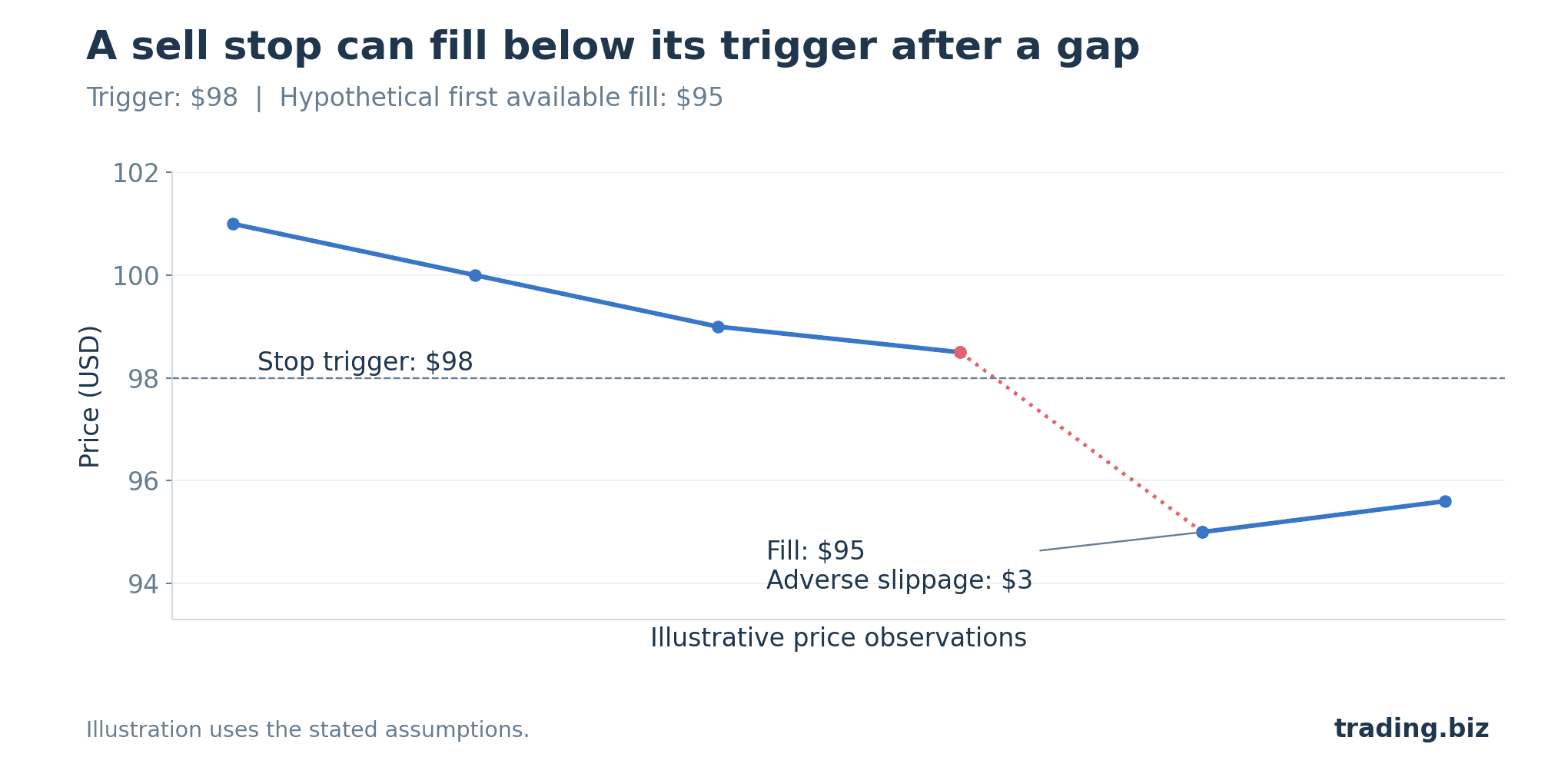
Figure 1. A hypothetical sell stop triggered at $98 fills at $95 after a gap. The $3 difference is adverse slippage against the stop level; the full trade loss depends on its entry and quantity.
Slippage in forex trading can also reflect a different trigger reference from the chart you are viewing. Slippage in crypto trading may involve a thin exchange book or an on-chain swap's route and price-impact settings. Use the rules of the actual product.
How to reduce slippage: limit orders, timing and VPS
A limit order constrains the worst acceptable execution price. It also creates a no-fill or partial-fill possibility. A stop-limit can avoid selling below its limit while leaving the position open through a continued fall. That remaining exposure belongs in the plan.
Match order size to available liquidity and the intended window. Splitting a large order can reduce the amount submitted at once, but later pieces may face different prices and additional fees. Evaluate the completed transaction instead of assuming splitting always improves it.
Choose timing that matches the tested assumptions. If a strategy's small target becomes uneconomic under event spreads, a defined exclusion window may help the research. Save skipped opportunities so the revised result includes what the filter removed.
MetaTrader's virtual-hosting documentation describes locating automated trading closer to a broker's server. A VPS can reduce some connection delays and improve availability. It cannot guarantee a price through a gap or supply missing market depth.
A guaranteed stop, if the provider offers one for the instrument, has separate terms and costs. Verify its trigger, premium and exclusions. A standard stop, limit order and guaranteed stop each resolve a different part of the execution problem.
Choosing a broker with good execution
Read the legal entity's execution policy and the instrument's specification. Identify the order types, trigger prices, available sessions and treatment of rejected instructions. A marketing claim about milliseconds cannot replace those details.
Compare equivalent samples. The same pair, similar quantity, session and event conditions provide a more meaningful comparison than two unrelated trades. Record improvements as well as adverse fills so the result does not selectively count only disappointments.
Calculate total cost. One account may have a lower spread and a higher commission; another may produce different stop fills. Include fees, financing where relevant and the cost of failed or partial orders before judging the complete round trip.
Use a small trial to learn the workflow and collect evidence. A demo is useful for order handling, while its simulated fills cannot prove the live liquidity available to your actual quantity.
Measuring slippage in your own trades
Create a record with the signal time, reference quote, submission time, acknowledgement, fill, side and quantity. Use the same reference-price convention throughout a comparison. Preserve raw order records before aggregating them.
The following examples use the adverse-cost convention. A minus sign means an improvement against the chosen benchmark, with commission excluded.
| Side and quantity | Reference | Fill | Execution cost |
|---|---|---|---|
| Buy 10 units | $100.00 | $100.20 | +$2.00 |
| Sell 10 units | $100.00 | $99.80 | +$2.00 |
| Buy 10 units | $100.00 | $99.90 | −$1.00 |
| Sell 10 units | $100.00 | $100.10 | −$1.00 |
Review the distribution as well as the average. A median near zero can coexist with a few expensive event fills. Keep sample count, size distribution and the worst observations visible when judging whether a method fits its loss budget.
Separate a measured execution difference from an allegation of misconduct. If a fill appears inconsistent with the agreement, retain the order ID, timestamps and relevant quote data. Ask the provider to explain its reference, trigger and execution sequence.
Use a weighted calculation when one order has several fills. Suppose a ten-unit buy receives four units at $100.10 and six at $100.30. The average is $100.22. Against a $100 reference, the order's adverse execution cost is $2.20 before fees. Averaging the two displayed prices without their quantities would give the wrong result.
A cancelled or rejected order needs a separate record. It has no fill price, so assigning zero slippage would make a provider with many missed executions look artificially favourable. Track fill rate and the cost of any later replacement beside the slippage of completed orders.
Review the benchmark's data source as well. A quote captured from another exchange, contract month or delayed feed can produce a misleading difference. Match the symbol, currency, session and timestamp before asking whether a fill was unusual. Keep the original reference observation so a later price correction cannot silently change the comparison.
Terms used in execution analysis
These terms identify different stages and costs. Put the relevant timestamp beside each one so a later comparison measures the same interval.
| Term | Meaning |
|---|---|
| Reference price | Benchmark selected before assessing the fill |
| Basis point | One hundredth of a percentage point |
| Latency | Time elapsed through part of the trading process |
| Price improvement | A fill better than the chosen benchmark |
| Market impact | Price effect associated with transacting a quantity |
FAQ
How do I avoid slippage in trading completely?
No general method guarantees both the intended price and execution in every market. A limit can constrain price while leaving an order unfilled. Choose the trade-off the plan can support.
Does a VPS guarantee better fills?
It can improve parts of connectivity and availability. Compare actual fills for equivalent trades. Market depth, changing quotes and order rules remain relevant.
Should I use an absolute slippage number?
An absolute value removes the distinction between improvement and adverse execution. Keep a signed measure and a cash total, then examine both the average and the tail of the sample.
What should I measure next session?
Pick one benchmark and save it before submission. Reconcile every fill and rejection against that record before changing the order type or increasing quantity.
Find Your Perfect Broker: Explore Our List Now!
Choose the best with our expert-selected options

Find Your Perfect Broker: Explore Our List Now!
Choose the best with our expert-selected options
Discover top binary options brokers tailored to your region. Browse our curated lists by country: