Updated:November 11, 2026

5 min

Pi Network and PiCoin Explained
Pi Network lets users mine a cryptocurrency by tapping a button in a mobile app once a day. Understanding what that mining actually is, and what it is not, matters more than the mechanics. Updated September 2026.

Pejman Zwin
Author

Updated October 23, 2026
Pi Network lets users mine a cryptocurrency by tapping a button in a mobile app once a day. Understanding what that mining actually is, and what it is not, matters more than the mechanics. Updated September 2026.
Pi Network and PiCoin Explained
Pi Network at a glance
-
Launched: March 14, 2019, Pi Day, by a group of Stanford graduates
-
Named after: the mathematical constant pi
-
Consensus: Stellar Consensus Protocol, not proof of work
-
Mining: through a mobile app, requiring a daily check-in rather than computation
-
Roles: Pioneers, Contributors, Ambassadors and Nodes
-
Reward schedule: halves as the user base grows by multiples of ten
-
Enclosed mainnet: December 2021, with no external transfers permitted
-
Open mainnet: followed considerably later, after an extended enclosed period
-
Requirement: KYC verification to migrate balances to mainnet
What mobile mining actually means
This is the point that needs clarifying first, because the terminology is misleading.
Bitcoin mining means performing computational work to validate transactions, which consumes electricity and requires hardware. Pi Network uses the Stellar Consensus Protocol instead, where trust relationships between participants replace computational work.
So tapping the app does not compute anything. It records that you are an active participant, and your reward accrues from that participation. Your phone performs no validation work and consumes no meaningful power.
That is not a criticism of the design: SCP is a legitimate consensus mechanism used by the Stellar network. It is a correction to the word mining, which implies something that is not happening here.
How the consensus works
The Stellar Consensus Protocol organises participants into small groups, typically three to five, and builds a network of trust relationships between them.
Rather than the participant with the most computing power validating transactions, validation depends on overlapping circles of participants who trust each other. This removes the energy cost and the hardware advantage that concentrates proof of work mining among large operators.
The four roles
-
Pioneers: users who mine through the mobile app and complete KYC verification
-
Contributors: users who add people they know and trust to their security circle
-
Ambassadors: users who invite new participants to the network
-
Nodes: Pioneers who run the SCP algorithm on a computer, performing the actual validation
Nodes are the only role performing technical work. The other three build the trust graph the consensus depends on, which is why the network prioritised user growth in its early phases.
What technology does the Pi network employ?
KYC verification requires personal information and is mandatory for migrating a balance to the mainnet. Unverified balances do not transfer.
The halving schedule
The initial mining reward was substantial and has been cut repeatedly as the user base expanded.
Unlike Bitcoin, where halving occurs on a fixed block schedule, Pi halves when the number of participants grows by a factor of ten. Passing one million users cut the rate, passing ten million cut it again.
The practical effect is that early participants accumulated far more than later ones for identical effort, which is a common structure in referral-driven networks and worth understanding before evaluating what a balance represents.
The roadmap and mainnet
-
Phase 1, March 2019: network launch, user acquisition and mobile mining
-
Phase 2: testnet for nodes, first version of the node software
-
Phase 3, December 2021: enclosed mainnet and KYC service
The December 2021 launch requires a clarification the source did not make. It was an enclosed mainnet: the blockchain ran, but external connectivity was blocked, meaning balances could not be transferred off the network or traded on external exchanges.
That enclosed period lasted considerably longer than initially indicated, and open mainnet followed later. Anyone assessing the project should confirm the current network status and transfer rules directly from the project rather than from articles written during the enclosed phase.
What to check before investing time or money
-
Confirm the current mainnet status and whether transfers are permitted
-
Understand that completing KYC means handing personal data to the project
-
Check what your balance can actually be used for today, not what is planned
-
Treat any quoted price or valuation with caution, thin markets produce unreliable figures
-
Remember the effort is free, but the personal data required for KYC is not nothing
-
Compare regulated venues in our [[crypto brokers|/crypto-brokers]] section for established assets
See related material on evaluating crypto projects in our trading guides.
Pi Network: frequently asked questions
Is Pi Network mining real mining?
Not in the Bitcoin sense. Your phone performs no computation. Tapping the app records participation, and rewards accrue from that rather than from validation work.
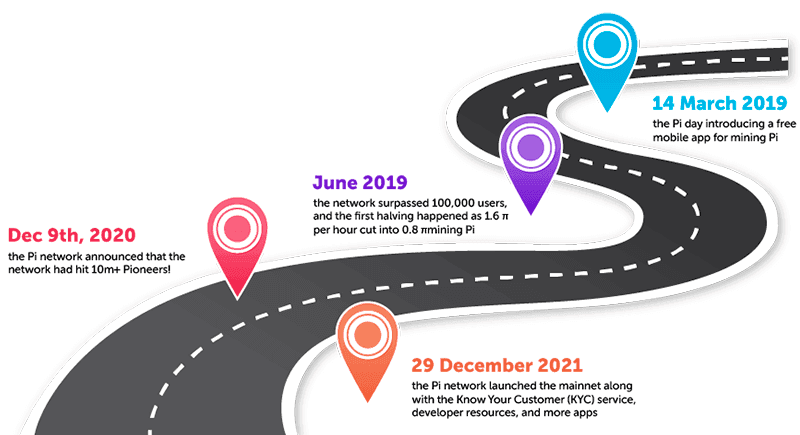
What is Picoin’s roadmap, and what has happened so far?
What consensus does Pi use?
The Stellar Consensus Protocol, which builds validation on overlapping trust relationships between participants rather than on computational power.
When did the mainnet launch?
An enclosed mainnet launched in December 2021, with external transfers blocked. Open mainnet followed considerably later.
How to mine Picoin?
Do I need KYC?
Yes, to migrate a balance to the mainnet. Unverified balances do not transfer, and verification requires submitting personal information.
How does the halving work?
Rewards halve as the user base grows by multiples of ten, rather than on a fixed block schedule. Early participants accumulated far more for the same effort.
What are the four roles?
Pioneers who mine via the app, Contributors who build security circles, Ambassadors who invite users, and Nodes who run the validation software.
Find Your Perfect Broker: Explore Our List Now!
Choose the best with our expert-selected options

Find Your Perfect Broker: Explore Our List Now!
Choose the best with our expert-selected options
Discover top binary options brokers tailored to your region. Browse our curated lists by country: