Updated:November 11, 2026

14 min

Understanding leveraged trading in 2026: pros and cons
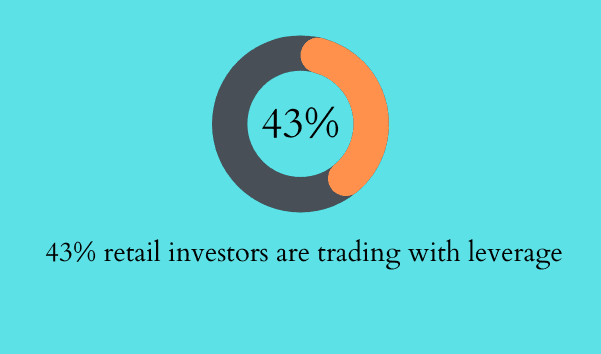
Understanding leveraged trading starts with one uncomfortable fact. The same tool that lets $30 control a $3,000 position also empties accounts. Leverage is the reason most people come to forex at all. A Yahoo poll put the share of retail investors trading with leverage at 43 percent. This guide covers the pros and cons, the ratios brokers offer, how margin fits in, and a worked example.

Saqib Iqbal
Author
Updated October 23, 2026
Understanding leveraged trading starts with one uncomfortable fact. The same tool that lets $30 control a $3,000 position also empties accounts. Leverage is the reason most people come to forex at all. A Yahoo poll put the share of retail investors trading with leverage at 43 percent. This guide covers the pros and cons, the ratios brokers offer, how margin fits in, and a worked example.
Leverage swings both ways, and that is the whole story. At 1:20 with a stop in place it is a capital efficiency tool. At 1:2,000 without one it is a countdown. If you are starting out, read the cons section before the pros section.
What is leverage in trading?
Think of leverage as borrowed buying power. The broker puts up most of the position value, you put up the rest, and you carry the profit or loss on the whole thing. That is what it is all about. Open an account with a broker such as SimpleFX and the leverage setting sits right there in the account type.
Every broker sets its own ratios, and what you are offered depends on where you live and which account you hold. The ratio is what turns a small balance into a tradable position size. Get it wrong and nothing else in your plan matters much.
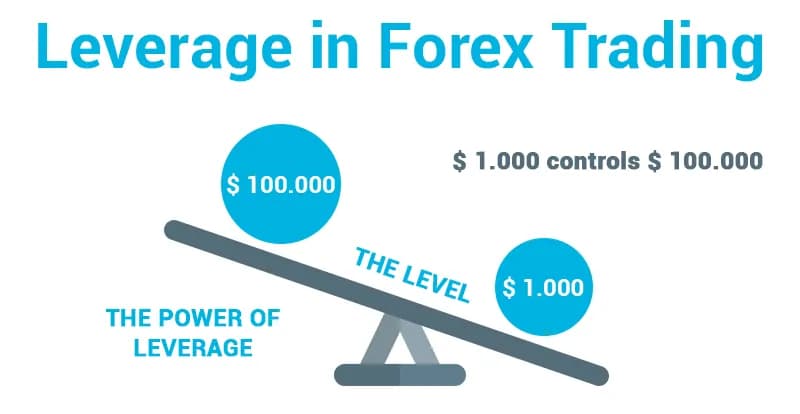
Here is the arithmetic. Say you want to buy 3,000 units of EUR/USD. Without leverage that ties up $3,000 of your own money, and for most retail accounts the idea stops there.
With leverage of 1:100, the same position needs $30 of margin. That is the appeal in one line. The position is a hundred times larger than the cash behind it, and so is the value of every pip it moves, in both directions.
What are leverage ratios?
Brokers publish their ratios openly, usually on a dedicated leverage page or in the account comparison table. Check it before you deposit rather than after. The figure can also differ from one instrument to the next, so read the table instead of the headline number. Our list of brokers sets those terms out side by side.
How much you get depends on the regulator. The UK's FCA caps retail leverage at 1:30. Offshore brokers advertise ratios like 1:2,000 and 1:3,000, and those are the numbers that appear in ads aimed at beginners.
43% retail investors are trading with laverage
At 1:3,000, five dollars controls a position worth $15,000. That is the lure. It pulls you towards trading with capital you do not actually have.
Leverage in forex trading
It is a lure with two edges. Leverage does not change how often you are right. It changes the size of being wrong. A move of half a percent against a 1:100 position wipes out half the margin behind it.
Run the numbers on a real trade. You go long EUR/USD at 1.3700 with 1:100 and a stop at 1.3650. That is a 50 pip stop, decided before you click anything.
Your balance is $1,000. Lot size is one mini lot, which is 10,000 units, so each pip is worth roughly $1. The margin required is $137.
Most brokers show that margin figure in the order ticket, so you rarely have to work it out yourself. If price moves 100 pips your way, the trade returns 1 x 100 = $100. That is 10 percent of the account from a single position.
Reverse the move and you are down $100 just as quickly. The lesson is not that leverage is good or bad. It is that the higher the ratio, the smaller the price move that decides your account.
The same trade at three ratios
Keep the trade identical and change only the ratio. Balance $1,000, one mini lot of EUR/USD at 1.3700, each pip worth about $1.
At 1:30 the margin is roughly $457, leaving about $543 free. A 100 pip move against you costs $100 and the position survives comfortably.
At 1:100 the margin is $137 and free margin is $863. Same $100 loss, more room, more temptation to open a second position.
Commodity Futures Trading Commission
At 1:1,000 the margin is about $14. Ten positions of that size tie up $137, and a 100 pip adverse move across them costs $1,000. The whole balance.
Notice what did not change. The loss per pip is identical in all three rows. Leverage changed how many positions you could open, and that is where the account goes.
I do not use much leverage myself. In practice I sit at 1:20 or 1:30. That is enough to keep position sizing flexible without turning a bad week into a blown account.
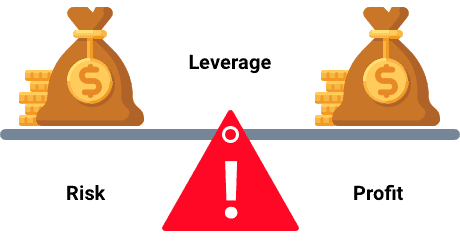
Risks of forex leverage
How does leverage trading work?
Leveraged trading confuses people because the word sounds technical. The mechanics are plain. You borrow buying power, the broker holds part of your balance as security, and profit or loss is counted on the full position size.
The funds come from your broker. Firms like Plus500 and FxPro extend that buying power and you place the trades. It magnifies what a given balance can control. Positions that would be out of reach on cash alone become routine.
Will leveraged trading earn you a cool $100 a day? Not on its own. This is not gambling and it is not a salary. Without a risk rule attached, a higher ratio simply gets you to zero faster.
For instance, I never risk more than 1 or 2 percent of the balance on a single trade. That rule fixes the position size first, and the leverage ratio follows from it. Doing it the other way round is how accounts disappear.
How to use leverage in day trading
Day trading and leverage look like a natural pair. Trade often, magnify each result, bank the difference at the close. In practice that pairing ruins more intraday accounts than any other habit.
Day trading and leverage seem like a perfect pair
Day trading means opening one or several positions inside a session. Leverage magnifies both sides of every one of them. Here is the counterintuitive part: intraday is where you want the lower ratio, not the higher one.
Intraday price action is noisy. A trend running your way can reverse on a single headline, and at high leverage that reversal reaches your stop before you have finished reading the news.
A workable setting is 1:30 or 1:50, with risk held at 1 to 2 percent of the balance per trade. Lose five trades in a row on those numbers and you are down under 10 percent. That is a bad week rather than a dead account.
What is margin trading leverage?
Leverage and margin are two sides of one mechanism. A Yahoo survey put margin use at 23 percent of US stock accounts. If you trade with leverage, margin is the part that decides when the broker closes you out.
Brokers do not lend out of generosity. They need security. To let you hold a $5,000 or $10,000 position, the broker locks a slice of your balance until the position closes.
At 1:100, ten dollars of locked balance supports $1,000 of position. Those ten dollars are your margin. It is a good-faith deposit rather than a fee, and it returns to your free balance when the trade closes.
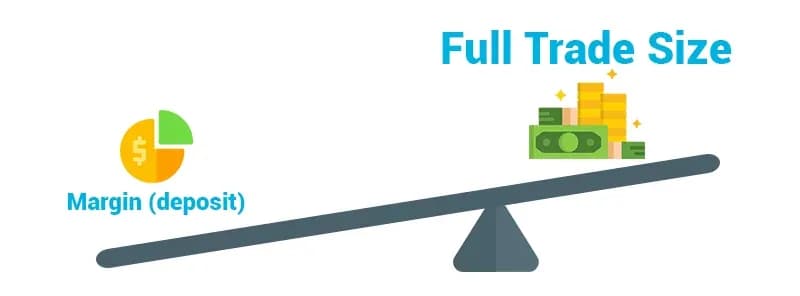
Forex margin
You cannot open a leveraged position without free margin in the account. The higher the ratio, the smaller the requirement. At 1:100, as in the example above, the margin comes to 1 percent.
Read that 1 percent as a share of the position, not of your account. A $5,000 position needs $50 held aside. Whatever is left is your free margin, and free margin is the buffer between an open trade and a margin call.
How to trade on leverage: pros
Applied carefully, leverage does several useful things. Here are the ones that show up in a real account.
You only need a small amount
Leverage frees up capital. You commit a fraction of equity to hold a position instead of its full value, which leaves the rest of the balance available for other trades or as a buffer. On a small account that is the difference between trading one pair and trading three.
A tool for quiet markets
Volatility is not constant. Some weeks a major pair travels 200 pips, other weeks it drifts inside 40. On the quiet weeks an unleveraged position returns too little to bother with. Leverage makes a modest move worth taking.
More positions across the week
The forex market runs around the clock from Monday morning in Sydney to Friday evening in New York. That is 24 hours a day, five days a week. It never sleeps during the week and it is shut at the weekend.
That schedule hands you a lot of entries, and leverage lets you take more of them without tying the whole balance up in one trade. Spreading risk over several small positions beats concentrating it in one large one.
Short and long
In forex you can buy or sell a pair with equal ease. Read the direction, take the position, and leverage applies the same way on either side. There is no structural penalty for going short here.
IQ Cent does not publish leverage terms on its website, so anything you read elsewhere about its ratios is second-hand. Wherever you end up trading, confirm the ratio in the account terms before funding, and cross-check it against our broker reviews.
Quick returns over a short holding period
Leverage compresses the time needed to produce a given return. Higher ratios such as 1:1,000 turn a small intraday move into a meaningful number. That only works alongside a hard risk rule. Without one it works in reverse, at the same speed.
How to trade on leverage: cons
Every advantage above has a matching cost. Leverage has one side, applied to whichever direction the price happens to take.
Multiplies losses during high volatility
High volatility is where a high ratio does its damage. Around a rate decision or a jobs number, a major pair can travel further in ten minutes than in the previous three days. At 1:2,000 a move like that clears the account before your stop fills at the price you wanted.
The danger of a margin call
Your broker holds margin against every open position. As losses build, the equity backing those positions falls, and at some point it stops covering the requirement.
That moment is the margin call. It does not mean your balance has hit zero. It means equity has dropped below the margin the broker requires, and unless you add funds or cut exposure, positions get closed automatically at whatever price is available. Lower leverage keeps that threshold well away from ordinary price movement.
What are some pro tips for leveraged trading?
A large ratio on offer is not an instruction to use it. Buying power you do not need is just extra rope. Set leverage from your trading plan, not from the maximum the broker allows.
There is a reason 43 percent of retail investors trade with leverage and only a fraction of them stay in the market. Consistency comes from keeping the ratio low enough that a normal losing streak is survivable.
Leverage according
Be careful about pairing high leverage with scalping or intraday trading. The temptation is obvious, because a big ratio turns a five pip move into a real number. The risk is not worth it. Spreads and slippage eat the edge.
There is no perfect leverage ratio. My suggestion is to stay at or below 1:20. If you want to test something higher, do it on a separate account funded with a small slice of your capital, so that blowing it costs you a lesson rather than your savings.
How to trade leveraged ETFs
Leveraged ETFs look like a tidy shortcut. The ETF market is enormous, with industry figures quoting around $7.74 trillion in assets under management. Here is how the leveraged corner works.
A leveraged ETF holds a basket of assets and aims to return a multiple of that basket's move. When the underlying rises, the fund rises faster. When it falls, the same multiplier works against you.
You buy and sell them like any listed instrument. The basket usually tracks an index such as the good old S&P 500, so the view you are taking is on a whole sector rather than one company.
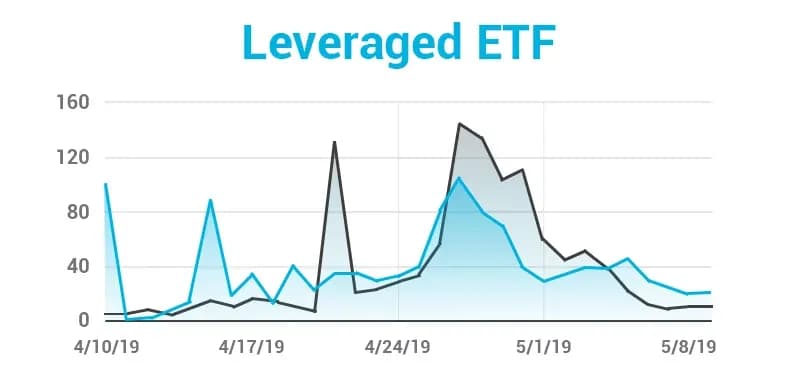
Leveraged ETFs
Adding your own leverage on top of a leveraged ETF stacks one multiplier on another. Choose the ratio deliberately: the product is already amplified before you touch it.
Can leveraged exchange-traded funds be a long-term investment?
Holding a leveraged ETF for years is tempting and mostly a mistake. Trading with leverage does not rule out a long horizon by itself. The product is what works against you over time.
Held with a plan and a risk rule, ordinary ETFs can carry a portfolio for years. The leveraged versions are a different animal. They are harder to read and the running cost is higher, so the horizon that suits them is shorter than most buyers assume.
Should you add a ratio like 1:100 on top to speed things up? No. At 1:1,000 the position will not survive an ordinary drawdown long enough to count as long term.
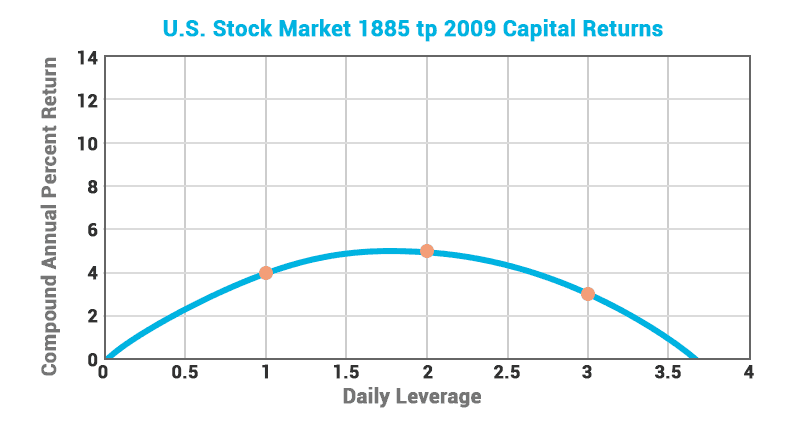
Chart showing holding of leveraged ETFs for long term
There is also the fee gap. Leveraged ETFs cost more to hold than non-leveraged ones, and across several years that difference compounds against you. Work it into the decision before you fix a holding period.
The bottom line
Understanding leveraged trading comes down to one number: how far price can move against you before the position is gone. At 1:20 that distance absorbs ordinary noise. At 1:2,000 it is a rounding error.
The practical version is short. Pick a ratio you can defend out loud, size every trade at 1 to 2 percent of the balance, and set the stop before the entry. Then check what your broker actually gives you, because the ratio in the advert and the ratio in your account type are often different numbers. Our brokers hub lists those terms side by side, and testing your settings on a demo first costs nothing.
FAQ
What is leveraged trading in simple terms?
It is trading with borrowed buying power. The broker funds most of the position and holds part of your balance as margin, while profit and loss are counted on the full position size. At 1:100, thirty dollars of margin controls a three thousand dollar position.
How much leverage do brokers offer in 2026?
It depends on the regulator. The UK's FCA caps retail leverage at 1:30, and other regulated markets sit in a similar range. Offshore brokers advertise 1:2,000 and 1:3,000. The ratio can also vary by instrument inside the same account, so read the leverage table rather than the headline figure.
Why does leverage matter so much for a small account?
Because it decides how much exposure a small balance can hold at once. The loss per pip stays the same whatever the ratio. What changes is how many positions you are able to open, and an account that can open ten usually will. That is where small balances die.
What are the common mistakes with leverage?
Three come up repeatedly. Choosing the ratio first and the position size afterwards. Pairing a huge ratio with scalping, where spread and slippage eat the edge. And treating a margin call as a distant event rather than a threshold that sits close by whenever free margin is thin.
How do I apply this in practice?
Set risk per trade at 1 to 2 percent of the balance and work backwards to the position size. Keep the ratio at 1:20 to 1:30, place the stop before entering, and test it on a demo for a few weeks. A setting that only works at maximum leverage does not work.
Find Your Perfect Broker: Explore Our List Now!
Choose the best with our expert-selected options
Find Your Perfect Broker: Explore Our List Now!
Choose the best with our expert-selected options
Discover top binary options brokers tailored to your region. Browse our curated lists by country: