Updated:November 11, 2026

5 min

Day Trading vs Long-Term Investing
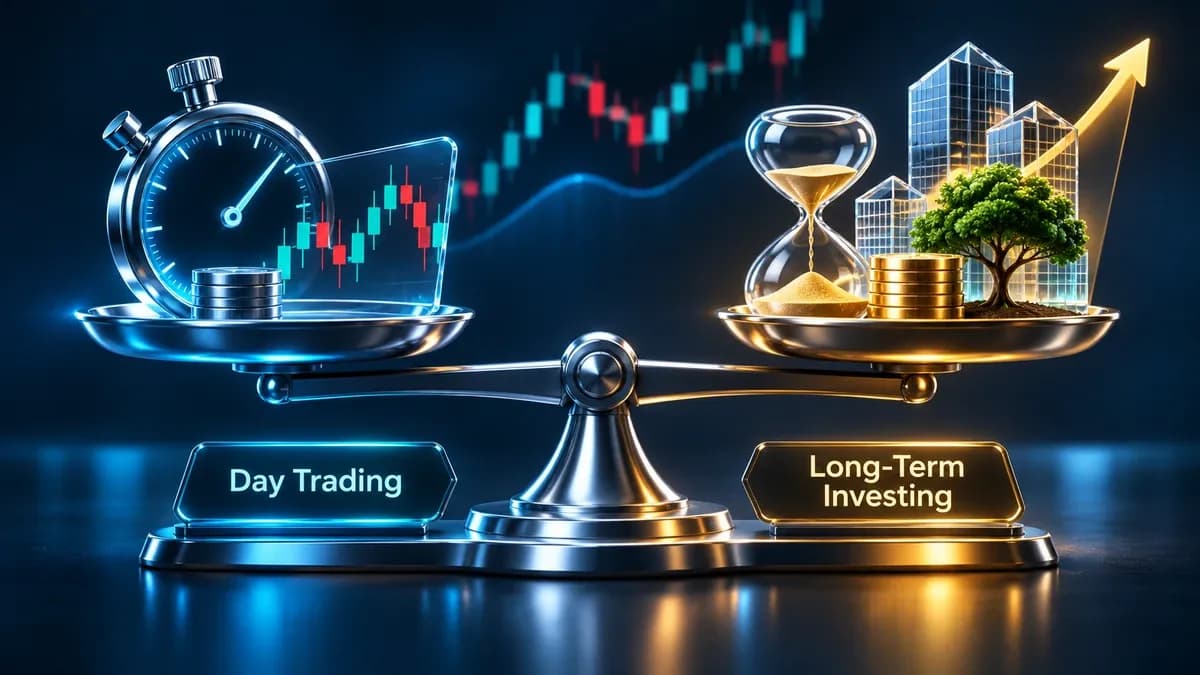
Day trading and long-term investing are not two settings of the same activity. They demand different capital, different time commitment and different temperaments, and the costs work against each other. Updated September 2026.

Cory Mitchell
Author
Updated October 23, 2026
Day trading and long-term investing are not two settings of the same activity. They demand different capital, different time commitment and different temperaments, and the costs work against each other. Updated September 2026.
The core differences
-
Holding period: minutes to hours for day trading, months to years for investing
-
Focus: short-term price movement versus industry growth and company fundamentals
-
Decision speed: near-instant for day traders, deliberate for investors
-
Number of trades: high frequency versus rare adjustments
-
Cost driver: spreads and commissions per trade versus opportunity cost of held capital
-
Time commitment: active screen time versus periodic review
-
Main risk: rapid drawdown from leverage and frequency versus prolonged underperformance
How market trends affect each approach
Market trends affect every strategy, but the two approaches read them differently.
A day trader works from short-term price forecasts for a chosen asset. The relevant horizon is the current session, and a multi-year trend is background noise rather than a signal.
A long-term investor focuses on industry growth, the underlying business and structural shifts in the sector. A single volatile session is noise in that frame, and reacting to it usually costs money.
The same market event therefore produces opposite correct responses. That is the clearest reason not to mix the two approaches inside one position: decide which frame a trade belongs to before you open it.
Risk management
Day traders accept concentrated risk. Short-term trades require constant execution, tight stops and a fixed loss limit per position, because a single unmanaged loss can erase a week of gains.
Long-term investors manage a different kind of risk. Their exposure is not to intraday movement but to being wrong about a business or a sector over years.
One correction is worth making here, because it is a common misconception: holding an asset for longer does not make it safe. A long holding period smooths short-term volatility, but it increases exposure to structural risk, a company losing its market, a sector being disrupted, a currency weakening over years. Risk changes type, not magnitude.
Decision-making
Decision time is far shorter for day traders. Choices are made in seconds because opportunities close quickly, which means the analysis has to be prepared in advance and the rules set before the session starts.
Long-term investors rarely decide in minutes. They have time to analyse a company, read financial statements and wait for a better entry, and that time is one of their genuine advantages.
Emotional demands
Day trading requires tolerance for frequent small losses without abandoning the system after each one. Losing trades are a normal part of a profitable strategy, and reacting emotionally to individual results destroys the edge.
Long-term investing requires a different discipline: sitting through a drawdown that lasts months without selling, and equally, not adding to a position simply because it has fallen. The pressure is slower but no lighter.
Cost: the factor that decides more than most people expect
Every trade costs something, through the spread, a commission, or both. A day trader placing many trades per session pays that cost repeatedly, and the total across a month is substantial.
This is why frequency has to be justified by edge. A strategy that wins slightly more often than it loses can still be unprofitable once transaction costs are deducted. Long-term investors pay these costs rarely, but carry overnight financing charges on any leveraged position.
Choosing with a small deposit
-
Day trading: needs enough capital that per-trade costs do not dominate returns, plus time to be present during the session
-
Long-term investing: workable with smaller amounts added over time, since trading costs are incurred rarely
-
Swing trading: positions held for days to weeks, a middle option requiring less screen time than day trading and less patience than investing
With limited capital, the practical constraint is cost, not ambition. A small account paying a fixed commission on every trade loses a large percentage of each position to fees, which is why frequent trading suits larger accounts better.
Practical risk rules
-
Fix a maximum loss per trade before opening it, as a percentage of the account rather than a currency amount
-
Never risk capital you need for anything else
-
Test any strategy on a demo account across at least one losing streak, not just a winning one
-
Track your actual results including all costs, not the theoretical result of the strategy
-
Choose one approach per position and do not convert a failed short-term trade into a long-term holding
That last rule catches more traders than any technical mistake. Compare platforms suited to your chosen style in our broker reviews, and see related trading guides.
Day trading vs investing: frequently asked questions
Which is more profitable?
Neither by default. Day trading offers more opportunities but pays transaction costs on each one, while investing pays costs rarely but ties up capital for years.
Is long-term investing safer?
It reduces exposure to intraday volatility but increases exposure to structural risk, such as a company or sector declining over years. The risk changes type rather than disappearing.
How much capital do I need to day trade?
Enough that per-trade costs do not consume a meaningful share of each position. Small accounts paying fixed commissions lose a high percentage of every trade to fees.
What is swing trading?
Holding positions for days to weeks. It sits between the two approaches, requiring less screen time than day trading and less patience than long-term investing.
Can I combine both approaches?
Yes, but keep them in separate positions with separate rules. Converting a failed day trade into a long-term holding is one of the most common ways accounts are damaged.
Which suits a beginner?
Longer holding periods are generally more forgiving, because they demand fewer decisions per week and incur lower transaction costs while you are still learning.

which type of trading to choose
Find Your Perfect Broker: Explore Our List Now!
Choose the best with our expert-selected options

Find Your Perfect Broker: Explore Our List Now!
Choose the best with our expert-selected options
Discover top binary options brokers tailored to your region. Browse our curated lists by country: