Updated:November 11, 2026

12 min

What are bullish options? Strategies, definition and types
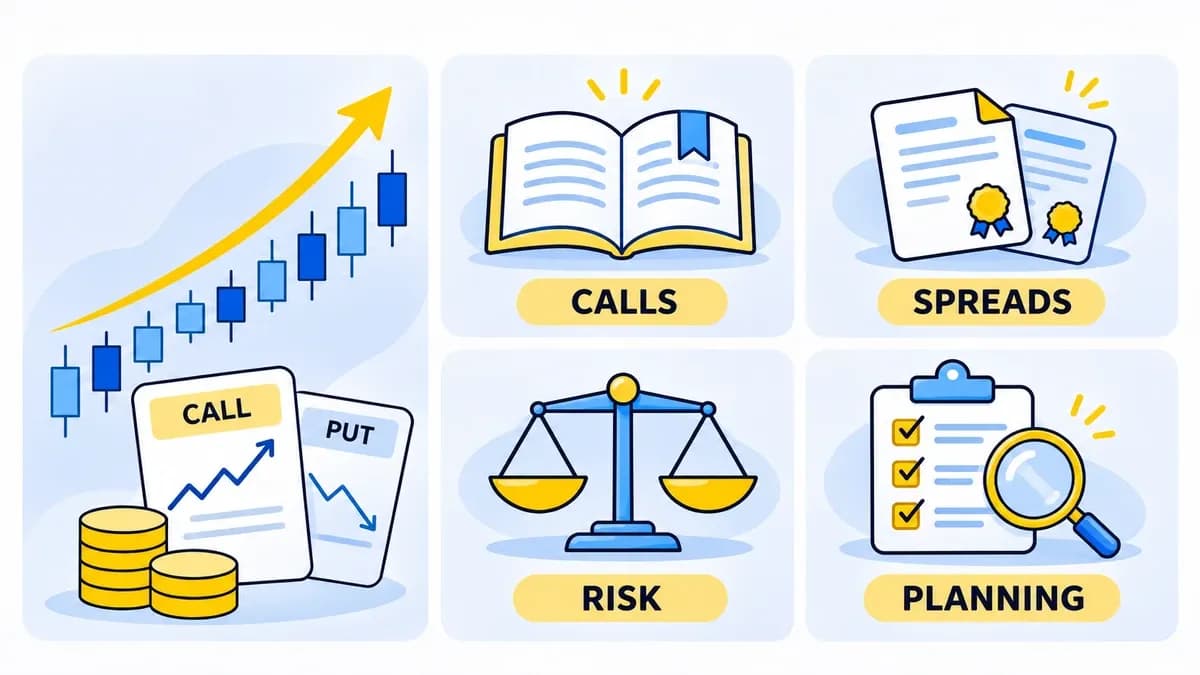
Bullish options strategies are used by traders when they believe the underlying price of an asset will rise. The definition is that plain: any position built to pay off on an upward move. Options cost less than buying the asset outright, which is why many opt to use them.

Cory Mitchell
Author
Updated October 23, 2026
Bullish options strategies are used by traders when they believe the underlying price of an asset will rise. The definition is that plain: any position built to pay off on an upward move. Options cost less than buying the asset outright, which is why many opt to use them.
The downside is that options expire, so timing is everything - and the underlying asset needs to increase in value enough to make your options worth more than you paid for them.
In this article I will explain the basics of the main bullish option strategies, including calls, bullish option spread strategies, and bullish option selling strategies (writing options).
Bullish options strategies: the basics
Options are a financial product that gives the owner of the option the right to buy or sell the underlying asset at a specified price within a time period. For this right, the buyer pays a fee for the option, called the premium.
If you believe the underlying asset will rise or trend higher in price, you buy a call option. The call gives you the right to buy the stock at a predetermined level, called the strike price. The higher the stock price moves above the strike price, the more value the option has.
If you believe the underlying asset will fall in price, then you would buy a put option. The further the stock price falls below the strike price, the more value the option has.
Options have an expiration date, so the price of the underlying asset needs to move in your favor before it expires. With these basics in mind, let's look at some bullish options trading strategies for capitalizing on uptrends in stocks, currencies, futures, ETFs, or other assets that options can be traded on.
Bullish view options strategies: long call
This is the simplest option strategy for a bullish market. It involves buying a call option on the asset you believe will rise.
If Apple Inc. (AAPL) stock is trading at $168 and you believe it will rise over the next three months, you could buy a call option with a strike price of $170 for $7.90 per share. Options are priced per share, but trade in 100 share units; that means this option would cost $790, and it expires in three months.
If the option becomes worth more than $7.90 before expiry, you can sell it for a profit. If you hold it until expiry, you will make money if the stock price is above $177.90 ($170 + 7.90). Because you paid $7.90 for the option, the stock will need to move at least that much above the strike price in order for you to make money.

The more value the option
Your loss is limited to $7.90 per share, or $790 for the option. Your profit potential is unlimited in that the price could rise an unknown amount above $170 before expiration.
Bullish view options strategies: short put (written put)
Writing a put is another way to capitalize on a bullish stock market view (or another asset), although writing a put requires more knowledge as there is the possibility for more risk.
Writing a put means you are giving someone else the opportunity to sell an asset at the strike price before expiration. In exchange, you receive the premium right now. If you believe AAPL, currently trading at $168, will rise over the next month, you could write a put option with a strike price of $165.

Expires in three months

Make money if the stock price
For each share, you will get $3.55 or $355 for a 100 share options contract, assuming you sell at the bid price. That is now your money, and is the most profit you can make. If AAPL is trading above $165 in one month’s time, you get to keep the whole premium as a profit.
The flip side is that you could face large losses if the stock drops below $165 because you will need to buy shares from the option owner (who has the right to sell shares at $165) regardless of what the current stock price is.
If you wish to calculate your required investment, risk and profitability in online trading, you may opt for stock options calculator that help you achieve this in few simple steps.
Bullish options spread strategies: bull call spread
A bull call spread is a way to make limited upside, while keeping the cost of the options low.
A bull call spread is buying a lower strike price call option while simultaneously selling a higher strike price call option.

Short Put (Written Put)

Currently trading
For example, if AAPL stock is currently trading at $168, you could buy a call option with a strike price of $170, and sell a call option with a strike price of $180. You would pick the same expiry date for both options.
If the stock price rises above $170, the first option becomes more valuable. Since you sold the second option, you receive the premium for that option, which helps offset some of the cost/premium of the option you purchased.
In exchange for reducing the cost, you give up any profit over and above $180. Essentially, you can profit from the distance between the options, but not above the highest strike price. Purchasing the call, with an expiry in three months, costs $7.95. Selling a $180 call brings in $3.50. The total cost of the options is $4.45 (7.95 - 3.5).
Apple stock needs to rise above $174.45 in order to start making money. The most you can lose in this situation is $4.45 per share ($445 per contract). The maximum profit is if Apple trades above $180. You will make $555 ($180 - $174.45 = $5.55 x 100).
Bullish options spread strategies: bull call ladder spread
A bull call ladder spread is an options strategy similar to the Bull Call Spread, but it involves an extra transaction that reduces the cost of the trade.
The bull call involves buying a call that will profit if the price of the asset rises. You will then write a call option at a higher strike price. The strike price should be near or slightly above where you think the underlying price will reach before expiration. This can be assessed based on looking at prior stock movements and what is typical.

Bullish Options Spread Strategies: Bull Call Spread
Then, you would write another call at an even higher strike price. It is this transaction that separates a bull call ladder from a bull call spread. The two written calls reduce the cost of buying the single call.
Your maximum profit is when the underlying stock rises to the strike price of the first written call, but doesn’t exceed it. As the underlying price rises above that, your profits diminish and could turn into a loss if the price keeps rising. If the underlying price drops, your loss is limited to cash outlay for the positions.
Bullish options spread strategies: bull butterfly spread
Use a bull butterfly spread if you have clear analysis on where you think the price of an asset is headed. It involves multiple options and requires precision in order to be highly profitable.
This strategy is best used if you believe the underlying asset will increase modestly in price. It involves three simultaneous transactions, all with the same expiry date:
Buy a call at a lower strike price
Write two calls at a higher strike price - this is where you expect the stock to move to by expiration. A target price.
Buy a call at a higher strike price
The maximum profit occurs if the price of the underlying is at the strike price of the two written calls at expiry. Then the written calls are worthless, and the higher-strike bought call is worthless, but you profit from the lower-strike bought call.
The maximum loss is the net cost of acquiring the options. This loss occurs if the price doesn’t move above (or is below) the lowest strike price enough to cover the cost of the options, or if the price of underlying rallies well above the upper strike price.
Bullish options spread strategies: call ratio back spread
This strategy buys more calls than it sells. That reduces the cost of buying calls slightly, while still allowing for big profits if the underlying stock rises.
The Call Ratio Back Spread won’t generate as much profit as buying only call options, but it also won’t cost as much. A ratio means you are going to buy two times - or three times - as many calls as you sell.
In this case you are going to buy three call options, for example, and sell only one or two. All have the same expirations, but the sold options generally have a higher strike price than the bought call options.
If you buy three and sell two, your profit potential is limited up to the strike price on the two you sold (see Bull Call Spread). However, the third bought call can profit indefinitely.
Bullish options spread strategies: bull ratio spread
A bull ratio spread is similar to a Call Ratio Back Spread, but this time you will sell more calls than you buy.
This is a modestly bullish strategy, because ideally the price of the underlying asset only moves up a little bit, which results in the maximum profit for this strategy.
In this scenario, you would sell two call options at a higher strike price, and buy one call option at a lower strike price. Selling more calls than buying often means the trade has no cost, or you may receive a slight premium or may pay a slight premium, but the cost is low.
If the stock price rises, but stays between the two strike prices, you are likely to make some money. If the price falls, you lose the premium you paid (if you paid any). The maximum profit is if the stock is trading at the higher strike price at expiration.
If the price rises slightly above the higher strike price, you likely still make some money. The higher the stock price goes above the higher strike price, your profits will diminish, and could lead to a large loss if the stock price is well above the higher strike.
Picking the right bullish strategy
Each structure above answers a different question, and the AAPL numbers used in this article make the difference concrete. Expecting a large move? The long call is the only one with no ceiling: $790 at risk, break-even at $177.90, unlimited above that. Expecting a moderate move? The bull call spread drops the cost to $445 and caps the gain at $555, which is a better return on risk inside a narrow range. Expecting the stock to sit still or drift up? Writing the $165 put pays $355 up front and asks nothing more of the market.
The butterfly and the bull ratio spread sit at the far end of that scale. Both pay best when the price lands close to a specific level, and both turn against you when the move overshoots. State the pattern plainly: cheaper structures buy their discount by selling away the upside, and every call you write becomes a liability when you turn out to be right by too much. Fees decide part of this too, so compare regulated brokers on commission per contract before you commit to a multi-leg position.
Conclusion
Bullish options need two things to line up: direction and time. Getting the direction right and the expiry wrong costs the same money as being wrong outright, and that is the trap most beginners walk into. Start with one structure rather than five. The long call is the easiest to price and the easiest to close early. The written put is a sensible next step, once assignment risk is something you can size properly. Ladders, butterflies and ratio spreads carry open-ended risk on the sold legs, so they belong to the stage after that. Before any of it, check what your platform charges per contract and whether it permits the sold legs at all, because plenty of retail accounts do not. Our broker ratings cover the venues that do.
FAQ
What are bullish options strategies?
They are option positions built to profit when the underlying price rises. The simplest is buying a call. Others combine bought and sold calls, or sell a put, to cut the cost of the position in exchange for giving up part of the upside.
How do bullish options strategies work in 2026?
The mechanics have not changed. You pay a premium for the right to buy at a strike price before a set expiry, and the position gains value as the underlying moves above that strike. What changes between brokers is the commission per contract and whether your account is cleared to write options at all.
How do I get started?
Start with a single long call on an asset you already follow, sized so the whole premium can be lost without pain. In the AAPL example above that is $790 for one contract. Track it to expiry once before adding a second leg to anything.
What are the common mistakes?
Buying an expiry that is too short for the move you expect. Ignoring the break-even, which sits above the strike by the whole premium. Writing puts without the cash to take delivery. And running a ladder or ratio spread without checking what happens if the price rallies straight through the sold strikes.
Is this suitable for beginners?
A long call is, because the loss is capped at the premium and known on day one. Written puts, ladders and ratio spreads are not, because the sold legs can lose far more than the position cost. Keep to bought options until the payoff diagram is something you can draw from memory.
Find Your Perfect Broker: Explore Our List Now!
Choose the best with our expert-selected options

Find Your Perfect Broker: Explore Our List Now!
Choose the best with our expert-selected options
Discover top binary options brokers tailored to your region. Browse our curated lists by country: