Updated:November 11, 2026

9 min

Top Bitcoin holders: who owns the most Bitcoin in 2026
Top Bitcoin holders are hard to name with any certainty, and that is by design. Bitcoin launched in 2009 to move value without a central authority signing off on it. It trades on exchanges, it pays for goods and services, and it settles on a public ledger called the blockchain. Every transaction is visible. The person behind the wallet is not. That gap is what turns any list of the largest owners into an estimate rather than a record.

Jinia Shawdagor
Author

Updated October 23, 2026
Top Bitcoin holders are hard to name with any certainty, and that is by design. Bitcoin launched in 2009 to move value without a central authority signing off on it. It trades on exchanges, it pays for goods and services, and it settles on a public ledger called the blockchain. Every transaction is visible. The person behind the wallet is not. That gap is what turns any list of the largest owners into an estimate rather than a record.
I spent a few days at The Blockchain Convention in Barcelona, Spain. Bitcoin (BTC) was the subject in almost every room.
Stephen Colbert once called it gold for nerds. Watching speaker after speaker describe the same starting point, the pattern was hard to miss: almost everyone in this industry came in through Bitcoin first.
Most people hold small amounts. A little diversification, or plain curiosity about what the thing actually does. You may well be one of them, since studies put roughly 10% of the population as owning at least some cryptocurrency in their crypto wallets.
Which leads to the obvious question. Who is sitting on the largest positions?
Bitcoin has been in the headlines for years now. It crossed the $1 trillion mark in early 2021, and that number is what pulled in the mainstream.
A wave of new money followed, including some of the wealthiest people alive investing in cryptocurrency for the first time. So who owns the most? The names below come up in every version of this list.
Who owns the most Bitcoin
Ownership on this network is anonymous by default and scattered across millions of addresses. Exact holdings cannot be established from the outside.
A handful of names surface every time anyway. Early adopters and investors such as the Winklevoss twins, and corporate buyers such as Michael Saylor's MicroStrategy.
Large corporations sit in the picture too. Tesla is reported to hold Bitcoin in its treasury reserves. Even so, no single person or company can be called the largest holder with confidence, because the supply is spread across far too many wallets.

Top Bitcoin Holders
Satoshi Nakamoto
The story starts in 2009. Bitcoin was worth a few cents and almost nobody was paying attention. That changed slowly over the years that followed, and the price moved with it.
The earliest large holder was the pseudonymous Satoshi Nakamoto. Nakamoto is believed to have mined over one million Bitcoins in the network's first stretch.
Then Nakamoto vanished, and the identity behind the name has never been established. Nobody knows how many of those coins are still held or whether any were sold. If the stack was never touched, it would place Nakamoto among the wealthiest people alive, with a net worth quoted at over $23 billion.
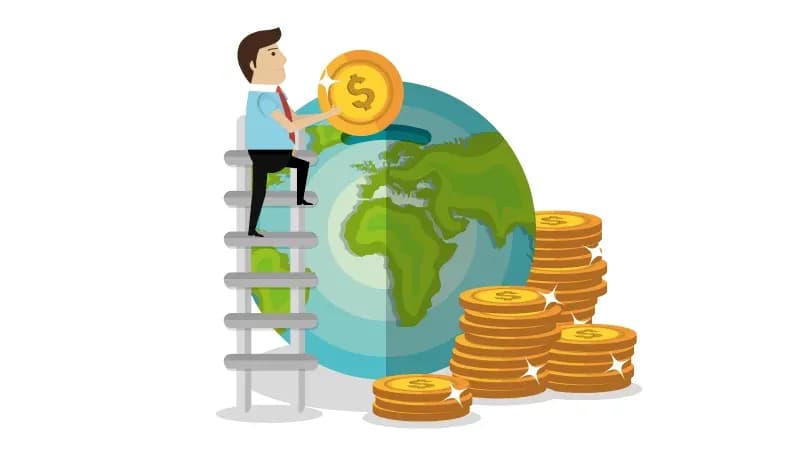
The richest people

Development of the cryptocurrency
The Winklevoss twins
Among named holders, the Winklevoss twins are the best known. Tyler and Cameron Winklevoss first became famous for their legal battle with Mark Zuckerberg over the ownership of Facebook.
They moved into crypto early and stayed. In 2013 the twins disclosed a purchase of $11 million in Bitcoin, bought at roughly $120 a coin. That position is now estimated at over $2 billion, which puts them among the largest individual holders anywhere.
Michael Saylor and MicroStrategy
Michael J. Saylor built the other famous position. He is Chief Executive Officer (CEO) of MicroStrategy, a business intelligence company that turned its balance sheet into a Bitcoin holding.
His description of the asset has become a standard quote in the industry: Bitcoin is a swarm of cyber hornets serving the goddess of wisdom, feeding on the fire of truth, exponentially growing ever smarter, faster, and stronger behind a wall of encrypted energy.
The first announcement came in 2020, when the company bought over 38,000 Bitcoins for $425 million. Buying carried on from there. MicroStrategy's holding is quoted at 132,500 BTC, valued at over $3 billion, and Saylor's personal holding is put at 39,521 BTC.
Elon Musk and Tesla
Elon Musk, chief executive of Tesla and SpaceX, is the other name everyone reaches for. In 2021 Tesla disclosed a $1.5 billion Bitcoin purchase, and the price jumped on the endorsement.
His relationship with the asset has been anything but steady. Musk has posted supportive and dismissive comments about it in roughly equal measure.
In his own words: if the price of Bitcoin goes down, I lose money. I might pump, but I don't dump. I definitely do not believe in getting the price high and selling or anything like that. I would like to see Bitcoin succeed.
His personal holding is thought to be substantial, and it has never been disclosed. Like every other figure on this page, the number is an estimate.
Craig Wright
Craig Steven Wright is the most disputed name here. He has claimed to be the creator of Bitcoin, and most of the cryptocurrency community has rejected that claim.
His holding is estimated at somewhere between 100,000 and 1 million coins. A range that wide tells you how little is actually known. If his claim were valid, his net worth would run past $23 billion.
Grayscale Bitcoin Trust
Grayscale Investments belongs on any serious version of this list. Its Grayscale Bitcoin Trust is the largest investment fund holding Bitcoin, and for a long stretch it was the only route into the asset through traditional finance.
Demand did the rest. As the fund grew, Grayscale had to buy Bitcoin in size simply to keep up with investor inflows.
The trust is quoted at 644,900 BTC, a Bitcoin value of over $15 billion. That makes it the largest single identifiable holder on this page.
The identity behind the name Satoshi Nakamoto is still a mystery. What is not in doubt is that Bitcoin made a small number of people extremely rich.
The Winklevoss twins, Michael Saylor, Elon Musk, Craig Wright. All bought early or bought big, and all are sitting on the result. New whales surface with every cycle.
Concentration is the other side of that, and it worries part of the community. A currency built to remove central control now has a large share of its supply parked in very few wallets.
How that resolves is an open question. New consensus rules or a wider spread of holdings could change the picture. The network's future rests on staying decentralized in practice, not only in design.
A worked example: what these numbers actually say
Line the identifiable holdings up and the concentration speaks for itself. Grayscale Bitcoin Trust: 644,900 BTC. Satoshi Nakamoto: over one million coins, untouched. MicroStrategy: 132,500 BTC. Craig Wright: somewhere between 100,000 and one million, depending on who is doing the estimating. Four lines, and the range on one of them is a factor of ten.
Two things follow from that. Any of those wallets moving is a market event on its own, which is why whale watching is a habit in this market rather than a hobby. And every figure on this page is an estimate tied to the price on the day it was published, so read the list as a snapshot rather than a ledger. Before acting on any of it, check our broker ratings and see what your venue charges.
Conclusion
Barcelona made one thing clear. The fascination with Bitcoin among investors and industry people has not cooled at all.
It is still the first asset almost everyone buys on the way in. It is also the asset a large share of the world's wealthiest people and institutions hold in size.
You can check all of this yourself. The ledger is open and open-source, so transactions and the wallets holding Bitcoin are visible on blockchair.com. Watching large wallets move is how traders read whale activity before a price move rather than after it.
Bitcoin has grown into a normal line inside a diversified portfolio, which was not true ten years ago. Where it goes next depends on what the rest of the industry builds around it.
One last thought before you close the tab. A list of the largest holders is interesting, and it is not a trading plan. Copying someone who bought at $120 a coin in 2013 is not a strategy either. Work out your own horizon and your own position size first. Then compare regulated brokers on fees, custody and withdrawal terms, because the venue you pick will shape your result more than any name on this page.
FAQ
Who are the top Bitcoin holders?
The names that appear on every version of this list are Satoshi Nakamoto, the Winklevoss twins, Michael Saylor through MicroStrategy, Elon Musk through Tesla, Craig Wright and the Grayscale Bitcoin Trust. Only the corporate holdings are disclosed. The rest are estimates.
How is the ranking worked out in 2026?
From two sources. Companies such as MicroStrategy, Tesla and Grayscale publish their holdings, so those figures are firm. Individual wallets are inferred from on-chain activity, which is why the estimate for Craig Wright runs anywhere from 100,000 to one million coins.
How do I check large wallets myself?
Open blockchair.com and follow the addresses. The ledger is public, so balances and transfers are visible to anyone. What you will not see is who controls an address, which is exactly why every name on this page carries the word estimated next to it.
What are the common mistakes?
Treating an estimate as a confirmed holding. Reading a single large transfer as a signal without checking where the coins landed, since exchange reshuffles look identical to a sale. And copying a position that was opened years ago at a price nobody will see again.
Is whale watching useful for beginners?
As background reading, yes. As a trading trigger, no. Large wallets move for reasons that are invisible from the outside, and by the time a transfer shows up on a block explorer the price has usually already reacted to it.
Find Your Perfect Broker: Explore Our List Now!
Choose the best with our expert-selected options
Find Your Perfect Broker: Explore Our List Now!
Choose the best with our expert-selected options
Discover top binary options brokers tailored to your region. Browse our curated lists by country: