Updated:November 11, 2026

8 min

Learn all about forex pips: how to calculate them
Pips are how prices move in forex trading. They decide your profit on each trade, because every pip carries a cash value. Learn all about forex pips and most of the confusion around position sizing disappears: two short rules cover nearly every pair and account currency you will meet.

Cory Mitchell
Author
Updated October 23, 2026
Pips are how prices move in forex trading. They decide your profit on each trade, because every pip carries a cash value. Learn all about forex pips and most of the confusion around position sizing disappears: two short rules cover nearly every pair and account currency you will meet.
The value of a pip depends on the pair being traded and on the currency your account is held in. Below you will find what a pip is, how to work out one pip of movement, and the edge cases that catch people out.
What is a pip in forex?
A pip is the fourth decimal place in most currency pairs. In pairs containing Japanese yen (JPY) it is the second decimal place instead. That one exception causes more sizing errors than anything else on this page.
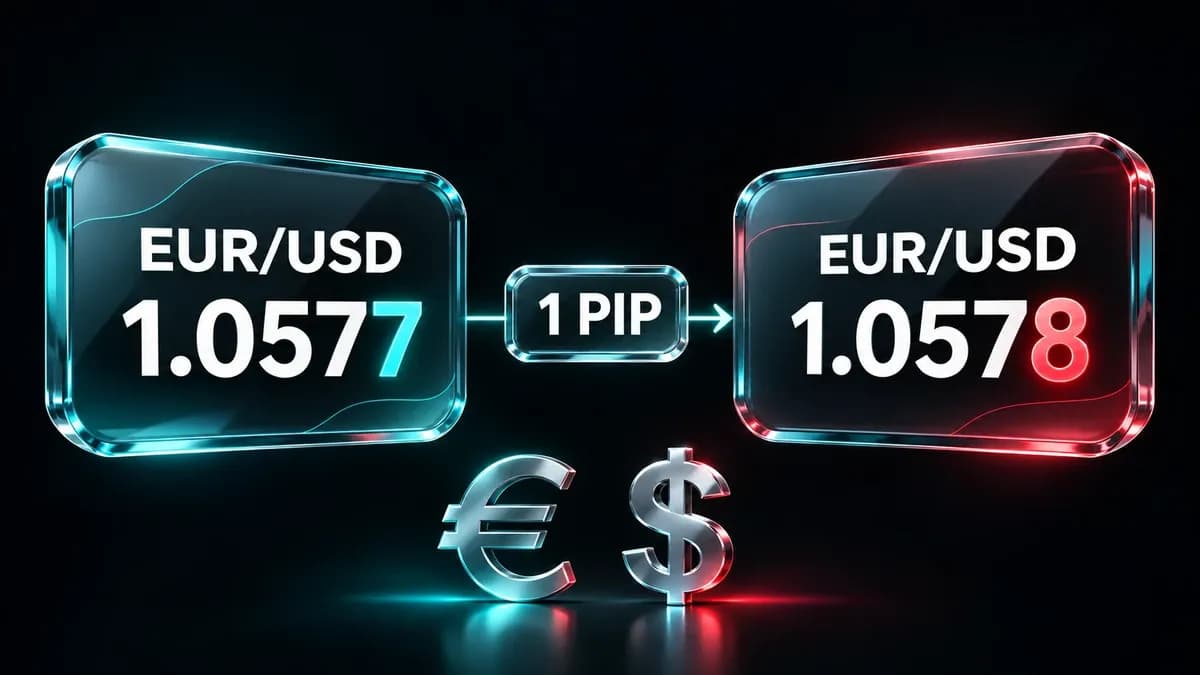
Years ago, most currency pairs were only quoted to four decimal places (two in JPY pairs). Back then, a pip was the smallest price change a currency pair could make. If the price of the EUR/USD moves from 1.0577 to 1.0578, that’s a one pip move.
A move from 1.0577 to 1.0586 is a nine pip move. A move from 1.0577 to 1.0677 is a 100 pip move.
Over time, a fifth decimal place was introduced (third for JPY pairs). This is called a pipette. It is a fractional pip, and most brokers now quote prices down to the pipette, or fractional pip. There are 10 pipettes to a pip.
A move from 1.05773 to 1.05775 is 0.2 pips. A move from 1.05773 to 1.05785 is 1.2 pips.
If you’re trading in a JPY pair, you’ll see prices quoted to three decimal places. 131.323 to 131.326 is 0.3 pips of movement. 131.323 to 131.459 is 13.6 pips.
Calculating forex pip value
Each time the price moves, your profit or loss changes. The profit or loss is based on position size, your account currency, and the value of a pip in the pair you are trading.
Before we get into the math, there are calculators which calculate pip value for you, such as our easy-to-use Pip Value calculator. You can always use the pip value calculator if you wish, but I’ll show you the math so you can see how the calculator works.
Rule 1: The pip value is 10 for a standard lot (1 for a mini lot, and 0.1 for a micro lot) if your account currency is listed second in the pair you’re trading.
For example, if you have a USD account and you’re trading the EUR/USD, the pip value is $10 for a standard lot. That means on a 100K position (standard) lot, every time the price moves one pip you make or lose $10. If you are trading a 10K position, each pip of movement is worth $1, and if trading a 1K position, each pip is worth $0.10.
If you have a GBP account, and you are trading the EUR/GBP, the pip value is £10 for a standard lot. The pip value is still 10, but it is now in a different currency.
What if your account currency isn’t listed second in the pair, or not at all?
For example, let’s say you’re trading the EUR/USD, but you have a GBP account. This is going to require a conversion to get the pip value.
Calculating Forex Pip Value
Rule 2: Divide 10 (for a standard lot) by the rate for YourAccountCurrency/SecondCurrencyListed in the pair you are trading.
As mentioned, you are trading the EUR/USD in a GBP account. From Rule 1 we know that the pip value is $10 if the account were in USD. You need to convert to GBP to get the pip value in your own account currency. Divide 10 by the GBP/USD rate. Assume GBP/USD is 1.2130 (use our exchange rate tool to see current rates).
10 / 1.2130 = 8.24 GBP.
Every time the EUR/USD moves one pip, if you have a standard lot position, the profit or loss in your GBP account will change by £8.24. This is confirmed by the Trading.biz calculator.
Your position size may vary by trade. For instance, if you bought two standard lots, you would be making or losing £16.48 (£8.24 x 2 lots) every time the price moves one pip. If you bought 2000 worth of currency, two micro lots, the pip value is £0.1648 (£8.24/100 x 2 lots).
Why divide the pip amount by 100? This is because a standard lot (100K) is 100 times greater than a micro lot (1K). To get the pip value for a micro lot, divide the standard lot pip value by 100. For a mini lot, divide the standard lot pip value by 10.
The difference between a tick and a pip
These two terms get mixed up constantly, and the confusion costs money when someone sizes a futures position as though it moved in pips. Here is where they differ.
A “tick” can have multiple meanings. Here are the two most common definitions of a tick in terms of trading:
A transaction. A “tick chart” draws a new price bar after a specified number of transactions. Or the tick chart can show every transaction.
The minimum price movement of a futures contract. Futures contracts move in points and ticks. There is a specified number of ticks within a point, and this can vary based on the futures contract.
As it relates to a pip, a tick is like a pipette, in that there are 10 pipettes to every pip. However, futures contracts aren’t all the same, so tick values vary. For example, the S&P 500 e-mini futures trade in increments of 0.25 (a tick) and there are four ticks to a point. A tick on oil trading, however, is 0.01 and there are 100 ticks to a point.
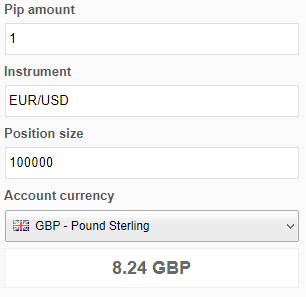
Trading.biz calculator
The difference between a pip and a basis point (BPS)
A pip is closely related to a basis point, and the two often turn up in one sentence. Here is how they line up.

The Difference Between a Tick and a Pip
A “basis point” is 1/100 of a percent. If the Federal Reserve of the US raises interest rates by 25 basis points, that means they raised interest rates by 0.25%. For most currency pairs, there is a value of 100 pips within a cent. Put another way, a pip is 1/100th of a cent. If the EUR/USD is 1.0500, it takes 100 pips of movement to move the price to 1.0600.
For JPY pairs, each 100 pip move increases the price by one yen. If we examine a move from 113.25 to 114.25, that would be a 100 pip move. In this case, a pip is 1/100th of a yen. Most people talk in percentages, you could also talk in basis points. For example, if your account increased 1% today, you could say the account increased 1%, or 100 basis points.
A worked example from entry to stop
Say you hold a GBP account and buy one standard lot of EUR/USD at 1.0577. Rule 1 gives you $10 a pip. Rule 2 converts it: 10 divided by a GBP/USD rate of 1.2130 gives 8.24 GBP a pip.
Now place a stop 30 pips away. It is worth 30 x 8.24, or 247.20 GBP. The sizing question answers itself. If 247 GBP is more than you want to risk on one idea, you do not widen the stop. You cut the lot. Two mini lots bring the same 30 pip stop down to 49.44 GBP.
Notice what moved and what did not. The pip count stayed at 30. Only the money changed.
Putting pip value to work
Pip value is the bridge between the chart, where you think in pips, and the account, where you gain or lose currency. Work it out before the trade, not after.
Two checks are worth the minute they take. See whether your broker quotes four decimals or five, and what the smallest lot is, because both change the arithmetic above. Then look at cost: a spread of 1.2 pips against 0.6 pips doubles what a trade owes before it moves. Our broker comparison sets those numbers side by side, and the shortlist of regulated brokers is a shorter start. Compare spreads in pips, not in marketing copy.
FAQ
What is a pip in forex?
The fourth decimal place in most currency pairs, and the second in yen pairs. One pip on EUR/USD is a move from 1.0577 to 1.0578.
How do I calculate forex pip value?
If your account currency is listed second in the pair, a standard lot is worth 10 of it per pip. If not, divide 10 by the rate of your account currency against that second one.
What are the common mistakes with pips?
Assuming a pip is always ten dollars, counting yen pairs to four decimals, and reading pipettes as whole pips. Each misstates risk by ten or a hundred times over.
How do I apply pip value in practice?
Convert the stop distance into money before sizing. Multiply the stop in pips by the pip value, and if the result exceeds your risk limit, cut the lot instead.
Find Your Perfect Broker: Explore Our List Now!
Choose the best with our expert-selected options

Find Your Perfect Broker: Explore Our List Now!
Choose the best with our expert-selected options
Discover top binary options brokers tailored to your region. Browse our curated lists by country: