Updated:November 25, 2026

8 min

0
How swap in forex is calculated and when swap-free helps
Overnight financing is charged on the position you hold, so a small margin deposit can support a much larger swap bill. Work through the calculation, Wednesday rollover and the alternative charges attached to swap-free accounts before keeping a trade open.

Pogodin Viktor
Author

You deposit $500 and hold a currency position worth $11,000 overnight. The broker calculates financing on the relevant position value. Your $500 deposit does not set the size of that calculation.
That distinction matters when a trade stays open for three weeks. A modest daily debit can consume a meaningful share of the intended profit, even while the price remains near your entry.
Swap in forex: what it is and why it exists
Swap in forex usually means the financing adjustment applied when a retail currency position remains open across the broker's rollover time. Depending on the currency pair, direction and broker's rate, it can be a debit or a credit.
The underlying economics include the currencies' financing relationship and the provider's adjustment. Retail rates also depend on the contract and legal entity. Subtracting two central-bank policy rates will rarely reproduce the amount on your account statement.
OANDA's US financing explanation uses a 5 pm Eastern Time cutoff and publishes separate annualised funding rates for long and short positions. Those rates can change daily. Another broker can quote swap in points or cash per lot, which requires a different conversion.
The forex swap discussed on a retail trading screen also needs context. An institutional FX swap is a transaction involving an exchange of currencies and a reverse exchange at another date. The overnight adjustment on a rolling retail position is the practical focus here.
How swap is calculated, with an example
First identify the quotation method. For an annualised percentage, a simplified calculation is position value multiplied by the applicable annual rate, divided by the stated day-count denominator, then multiplied by the days charged. Include account-currency conversion where required.
Consider a hypothetical long position of 10,000 EUR in EUR/USD at 1.1000. Its dollar value is $11,000. Assume a financing rate of minus 3.6% a year and a 365-day convention. These are teaching assumptions, not a current broker quote.
The one-day debit is $11,000 × 0.036 ÷ 365, or about $1.08. A three-day adjustment is approximately $3.25. If the position value and rate stayed unchanged for 30 charged days, the total would be about $32.55 before other trading costs.
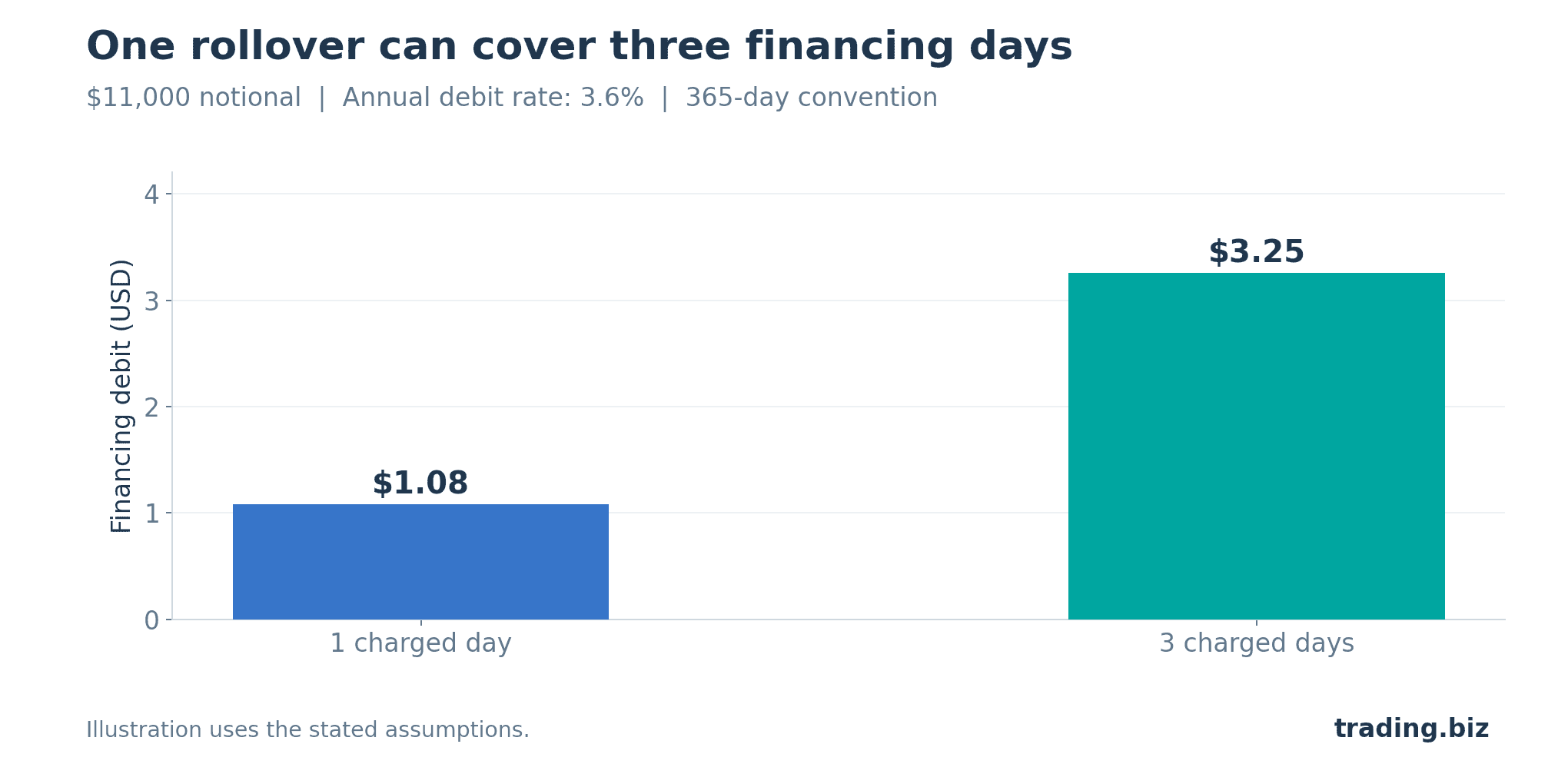
Figure 1. A hypothetical $11,000 position financed at an annual debit rate of 3.6% costs about $1.08 for one day and $3.25 for three days, using a 365-day convention.
For a points-based quote, inspect the contract specification. A displayed minus 5 points could mean something different across a five-decimal currency pair, a yen pair and a metal contract. You need the point value, contract size, lot quantity and account currency before converting it into money.
Leverage changes the margin required to hold the position. It does not shrink the financed notional when the position size stays unchanged. Reducing 0.20 lots to 0.10 lots generally halves a size-proportional adjustment, assuming the other inputs remain the same.
Account currency can add one more conversion. A euro-denominated financing amount booked to a dollar account needs the provider's applicable conversion method. Compare the cash entry and any separate conversion charge with the rate visible at that rollover.
Save the actual long and short swap rates before entry. After the first rollover, compare the statement with your estimate. That catches a unit or currency-conversion mistake before a longer holding period makes it expensive.
Triple swap on Wednesday and weekends
For many rolling spot FX contracts, Wednesday rollover carries three days of financing because settlement moves across a weekend under the usual settlement convention. You can therefore receive or pay three days while holding the position across one cutoff.
The familiar Wednesday swap is a convention with exceptions. Some currency pairs use different settlement arrangements. Public holidays can move or increase the number of financing days. Indices, commodities and other CFDs can follow a separate schedule entirely.
Suppose the example's rate stays unchanged and a normal trading week is charged as one day on Monday, one on Tuesday, three on Wednesday, one on Thursday and one on Friday. That represents seven financing days, roughly $7.59 in total.
Check the broker's instrument-level calendar before a holiday week. An account described as having no separate Saturday debit can still charge the weekend through an earlier multi-day rollover. The timing and the economic number of days are separate details.
Swap-free account: how it works and what replaces swap
A swap-free forex account removes the standard swap adjustment under specified terms. Providers may call it an Islamic account. Eligibility, covered instruments, holding periods and replacement charges depend on the account agreement.
An administration fee can begin after a grace period. A holding charge might apply to selected products. Spreads and commissions can remain payable from the first trade. Read those items together when assessing what is swap-free in forex.
For example, imagine an ordinary account charges $2 per day on your chosen position. Five charged days cost $10. An alternative account hypothetically applies a $12 administration charge after the relevant grace period. The cheaper arrangement depends on the actual holding pattern and charging rules.
If you are researching how to avoid swap fees forex, closing a position before the cutoff may avoid that particular overnight adjustment. Reopening adds another spread, possible commission and execution risk. A genuine longer-term position needs a full cost comparison before being repeatedly closed for this reason.
Brokers offering swap-free accounts and their fees
Read the offer for the exact legal entity serving your country. A brand can publish different eligibility and charging schedules on different regional pages. The examples below identify what requires verification; they do not establish a universal tariff.
| Provider example | Published structure | Detail to check |
|---|---|---|
| Pepperstone | Regional swap-free offering with administration charges | Grace period, instruments and charge per lot |
| IC Markets | Swap-free offering with holding-fee conditions | Current schedule, qualifying account and entity |
The Pepperstone regional swap-free page describes an administration charge after a specified holding period. Its displayed terms should be matched to your account agreement. A page for another Pepperstone entity can use a different period.
IC Markets' global swap-free information also requires checking holding charges and applicable conditions. A search for a swap free forex broker should end with the instrument's actual fee schedule and a worked example for your intended position.
Ask when the grace period begins, whether it resets after closing, and whether the charge is daily or event-based. Keep the written answer with the account terms. A single label cannot answer those three questions.
Swap and carry trades: costs and caveats
A carry trade seeks to benefit from a favourable financing relationship while accepting currency exposure. A positive swap rate can contribute income. The exchange-rate move can overwhelm that income quickly.
Assume a hypothetical position earns $1.50 per charged day. Thirty days produce $45 if the rate stays unchanged. A $300 adverse price move leaves a $255 loss before spreads and commissions. The positive financing credit provides only a partial cushion.
Rates can also change while the position is open. A central-bank decision, funding-market disruption or broker adjustment can reduce a credit or turn it into a debit. A carry strategy therefore needs price-risk limits and a rule for reassessing the financing assumption.
Before placing the trade, put the expected holding period beside the current long or short rate. Recalculate after a material rate change. A position intended to last two days deserves another cost review when it reaches day twelve.
Financing terms on the statement
The same cost can be presented in percentages, points or cash. These terms help you identify which inputs belong in the calculation.
| Term | Meaning |
|---|---|
| Rollover | Broker cutoff and process for carrying a position overnight |
| Swap rate | Contract-specific financing debit or credit quotation |
| Triple swap | Adjustment covering three financing days |
| Carry trade | Currency exposure intended to earn favourable financing |
| Holding fee | Alternative charge applied under an account's terms |
FAQ
What is swap in forex when I hold a short position?
The broker applies its short-side rate for that instrument. It can be a debit or credit. Check the published short rate; reversing a long position does not guarantee an equal opposite adjustment.
Can both long and short positions have negative swap?
Yes. The broker's published adjustments can make both directions chargeable. Use the two actual rates in the contract specification instead of assuming one side must earn overnight interest.
Does a swap-free account remove every trading cost?
Spreads, commissions and alternative holding or administration fees can still apply. Compare the complete bill for a defined size and holding period before selecting the account.
Where should I check the next overnight charge?
Open the instrument's current contract specification and financing calendar. Record the rate, rollover time and days multiplier, then reconcile the next statement entry against that estimate.
Find Your Perfect Broker: Explore Our List Now!
Choose the best with our expert-selected options
Find Your Perfect Broker: Explore Our List Now!
Choose the best with our expert-selected options
Discover top binary options brokers tailored to your region. Browse our curated lists by country: