Updated:November 25, 2026

8 min

0
What counts as insider trading and how the law treats it
A confidential earnings file, an advance listing notice or a tip from a director can create legal exposure before anyone makes a profit. Learn how insider trading rules distinguish lawful transactions from misuse of information, with US and Indian examples.

Gloria Chimelu
Author

Imagine receiving a company's unreleased earnings spreadsheet at 8:30 am. You buy its shares at 9:00. The results become public at 10:00. The legal questions begin with how you obtained the information, its significance and your duties when you used it.
A profitable trade alone cannot answer those questions. Neither can the explanation that somebody else passed along the tip.
Insider trading meaning in plain words
Insider trading covers transactions associated with people who have access to company information. In everyday discussion, the phrase often refers to unlawful trading using confidential information. Company officers can also carry out lawful, disclosed transactions under the applicable rules.
For the US, Investor.gov's insider trading definition describes illegal securities trading involving material, nonpublic information and a breach of a fiduciary duty or another relationship of trust and confidence. Tipping and misuse of information obtained from another person can also create liability.
Material information is significant to an investment decision. Examples can include an unannounced takeover, a major earnings surprise or the loss of a critical contract. Nonpublic means the information has not been appropriately disseminated to the market.
India uses the concept of unpublished price sensitive information, or UPSI. The SEBI insider trading regulations govern its communication and trading while in possession of it, subject to the rules' specific provisions and defences. The exact legal test differs across jurisdictions.
Illegal vs legal insider trades
A director buying shares after following disclosure, dealing-window and other relevant requirements can make a legal insider transaction. A director using unreleased results to trade can face a very different analysis. Being allowed to hold company shares does not provide permission to use every fact learned at work.
For employees, a compliance approval and a permitted dealing window are procedural controls. They do not automatically neutralise possession of confidential price-sensitive information. A scheduled trade can also require assessment under the relevant jurisdiction's trading-plan rules.
A tipper can face exposure without placing the trade personally. Passing an unreleased acquisition detail to a friend who trades can bring the communication into the investigation. A consultant, accountant or supplier can also encounter confidential company information through a professional relationship.
Public research has another information path. Reading published filings, comparing disclosed sales figures and developing an original estimate generally begins with publicly available material. Record where the inputs came from so the origin remains clear if the trade is later questioned.
Famous insider trading cases
The Rajat Gupta insider trading proceedings concerned confidential corporate information passed to hedge-fund manager Raj Rajaratnam. In July 2013, the SEC announced a $13.9 million civil penalty against Gupta, alongside permanent industry and officer/director restrictions. A separate criminal proceeding had produced a two-year prison sentence and a $5 million fine.
In November 2011, the SEC obtained a $92.8 million civil penalty against Rajaratnam. The agency also described the parallel criminal conviction and 11-year sentence. Civil penalties, forfeiture and criminal fines are separate amounts, so a headline figure needs its label.
Those were US proceedings. Readers searching for famous cases of insider trading in India should avoid treating an individual's Indian background as the location of the prosecution.
An Indian example is Balram Garg v SEBI, decided on 19 April 2022. The Supreme Court allowed the connected appeals and set aside the challenged SEBI and tribunal orders. The judgment examined whether the evidence established communication or possession of UPSI; a case reference should include that outcome.
Consider a hypothetical trader who learns of an unreleased contract cancellation and sells shares for $50 each. After the announcement, the relevant reference value is $40. On 1,000 shares, the difference is $10,000 before the applicable legal measurement adjustments. An investigation can examine loss avoided as well as profit earned.
The timing also needs a precise record. A rumour discussed publicly on Monday and a confidential board paper obtained on Tuesday have different information histories. Saving the Monday source cannot explain away the later document. Describe the actual sequence when seeking advice.
How regulators detect insider trading
An unusually timed position can trigger scrutiny. Investigators can compare order records, account ownership, communications, professional relationships and the sequence of corporate events. A purchase made minutes before an announcement can be an initial lead.
The next task is establishing the information path. Who had access to the draft? When was it accessed? Did the trader communicate with that person? What explanation and supporting records exist for the decision? Legal standards and available investigative powers depend on the jurisdiction.
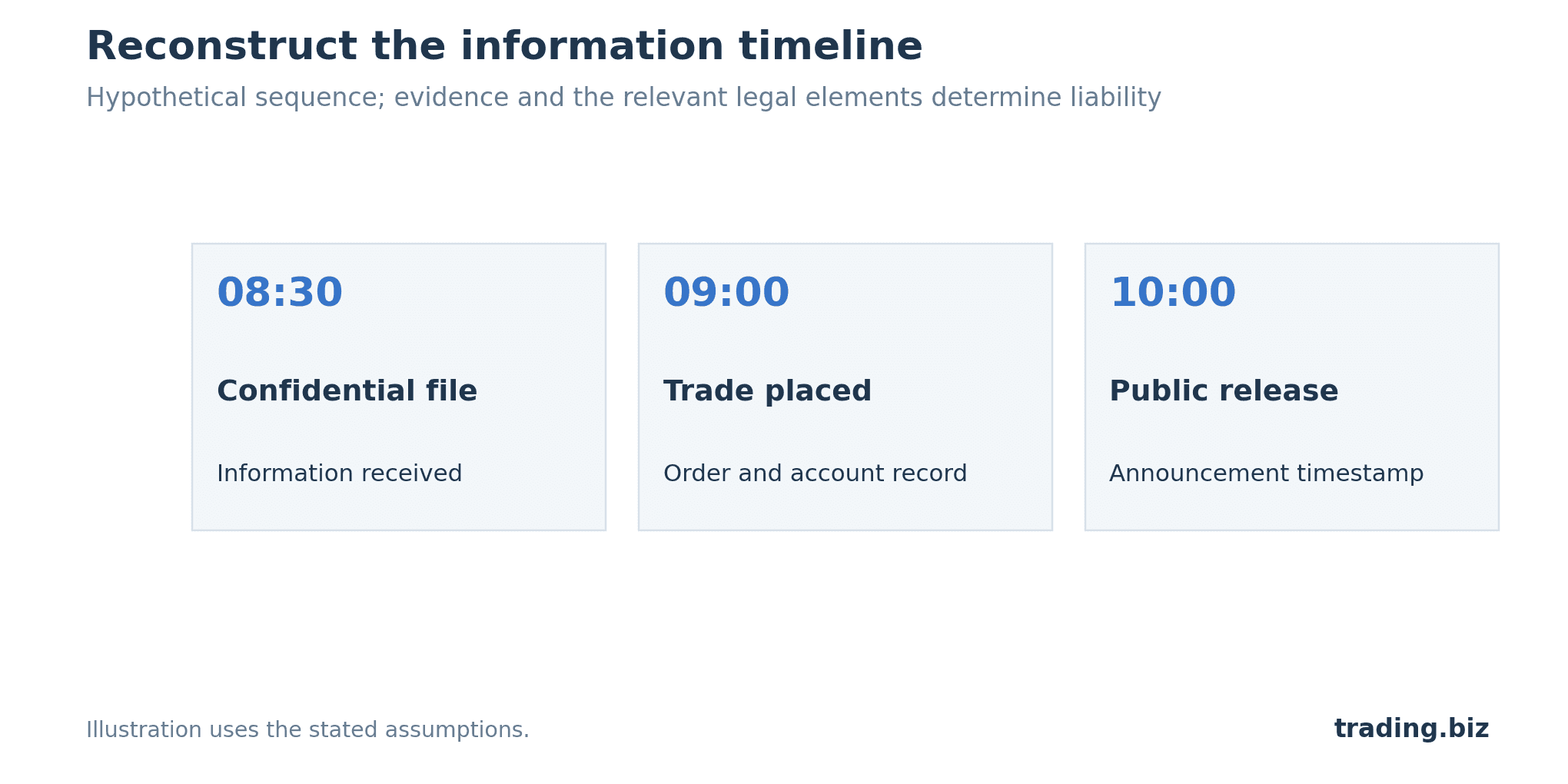
Figure 1. A hypothetical information timeline links receipt of a confidential file, an order and the public announcement. The sequence can prompt investigation; liability requires the applicable legal elements and evidence.
Repeated successful trades around confidential events can add context. So can the purchase of short-dated options that creates unusually concentrated exposure. Neither observation independently proves the complete case. Investigators assess the evidence together, while courts and tribunals can reject an unsupported inference.
For a legitimate research process, keep dated notes and source documents. A timestamped public filing and a saved calculation can help explain why a position existed before an announcement. Inventing a rationale afterwards creates another problem.
Insiders trading in crypto and forex: gray areas
Confidential exchange-listing information has already led to criminal enforcement. In May 2023, Ishan Wahi received a two-year US prison sentence after pleading guilty to conspiracy to commit wire fraud involving advance Coinbase listing tips.
The charge matters. That outcome does not establish that every cryptoasset is legally a security. Fraud, misuse of confidential business information, securities rules and other market-conduct laws can apply through different routes.
Forex also spans different products. Spot currency transactions, exchange-traded futures and securities-linked instruments can fall under different regimes. Confidential client orders or an unreleased policy decision can raise duties, misuse and market-conduct questions even when a share-market rule does not fit the product directly.
Calling a market decentralised or global cannot resolve the legal analysis. Identify the product, information source, relevant countries and professional obligations before acting on a supposedly exclusive tip.
Penalties and how traders stay compliant
Under US Exchange Act Section 21A, the civil penalty for the person committing the violation can reach three times the profit gained or loss avoided. This maximum civil penalty for insider trading is separate from other possible remedies and criminal consequences.
For India, Section 15G of the SEBI Act provides a minimum penalty of ₹10 lakh, with a ceiling of ₹25 crore or three times the relevant profits, whichever is higher. That statutory penalty provision does not describe every possible enforcement consequence.
The practical response to a questionable tip is to stop trading on it, preserve the communication and contact the relevant compliance or legal adviser. Do not forward the tip into a trading group while asking whether it is usable.
Employees should follow restricted lists, pre-clearance and disclosure requirements. Independent traders should document public research and avoid requests for confidential employer or client information. Check the current SEBI insider trading amendments alongside the consolidated rules when an Indian obligation is involved.
Distinguish an allegation, an interim restriction and a final finding when reading an enforcement headline. An appeal can change the operative result, as the Balram Garg example shows. Read the final order and any later appeal before describing a named person as having committed an offence. That discipline matters when a search result preserves an early accusation more prominently than the eventual decision.
Terms used in an insider-trading investigation
These definitions identify the information and conduct being assessed. The relevant law determines the precise meaning in a particular case.
| Term | Meaning |
|---|---|
| MNPI | Material nonpublic information, commonly used in US discussion |
| UPSI | Unpublished price sensitive information under Indian securities rules |
| Tipping | Passing information to another person in circumstances raising liability |
| Tippee | Person who receives the information |
| Loss avoided | Economic loss escaped through the transaction under investigation |
FAQ
How do you define insider trading without assuming every insider trade is illegal?
Separate the person's status from the information used and the transaction's compliance. A company officer can make lawful trades. Misusing confidential information raises a different legal question.
Can a person lose money and still face an investigation?
Yes. A losing outcome does not automatically remove the underlying information misuse. The legal elements and evidence remain relevant even when the expected profit never arrives.
Does a social-media post make a confidential tip public?
An informal repost does not automatically establish adequate public dissemination under the applicable rules. Preserve the original source and seek advice before treating the information as tradable.
What should I do after receiving an unreleased company document?
Avoid trading or forwarding it. Preserve the message and ask the responsible compliance or legal professional to assess the information and your obligations before your next transaction.
Find Your Perfect Broker: Explore Our List Now!
Choose the best with our expert-selected options

Find Your Perfect Broker: Explore Our List Now!
Choose the best with our expert-selected options
Discover top binary options brokers tailored to your region. Browse our curated lists by country: