Stock market newsBreaking
ETFs in 2024: Outperfomers, Underperfomers, and Trends
The decline in ETF valuations shows the lack of new buyers, hinting at a broad-based move away from riskier assets.
 Artem KirillovTrading.Biz
The Nasdaq ADL is at 2009 levels despite rising prices. This divergence doesn’t signal weakness — and here’s why it shouldn’t worry investors.

 Elizabeth KazandzhiTrading.Biz
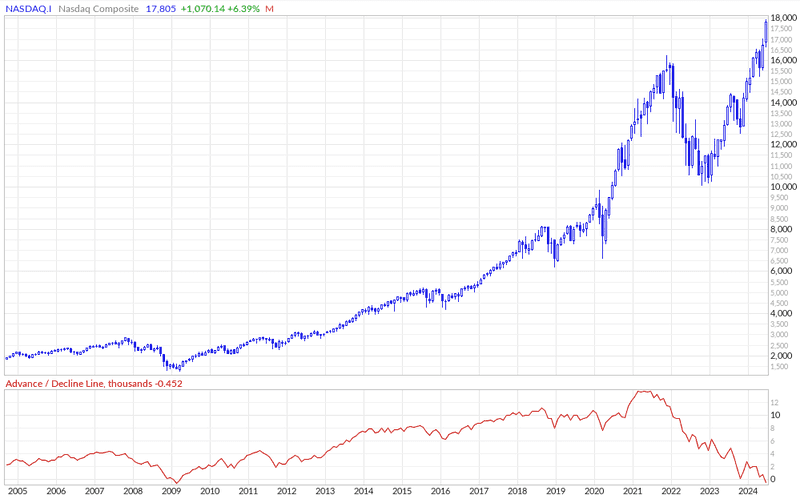
As the Nasdaq Composite has surged higher in 2023 and 2024, the Nasdaq Advance Decline Line is currently at its lowest level since 2009. The advance/decline line or ADL is a breadth indicator that sums the advancing stocks minus the declining stocks each day.
The extremely low ADL reading on the Nasdaq Comp. has received some publicity, as it has radically diverged with surging stock prices over the last year and a half.
While the price rally will run out of steam at some point, as all bull markets eventually come to end, the Nasdaq advance/decline line is not a good determinant of market health, says Cory Mitchell, an analyst with Trading.biz.
“A better indicator of market health is the NYSE ADL. The NYSE has more stringent requirements for a stock to be listed on its exchange. The Nasdaq is filled with start-up companies that often never reach profitability and end up delisted.
When these companies are dropped from the Nasdaq Composite index, the declining stock price no longer harms the index, but its drag on the advance/decline remains. This is why the Nasdaq ADL can fall even as the indices soar. It is not a good measure of market health, and should not be used to assess whether the Nasdaq indices are likely to rise or fall.”
The following chart from MarketInOut shows the Nasdaq Composite along with the Advance/Decline Line. The ADL started falling in late 2021 and has been falling since, even though the index is up nearly 80% in that time. This tells us that many stocks didn’t do well and were delisted, even while stocks that remain have done well on average.
If looking to assess the health of the Nasdaq Composite (which includes all Nasdaq stocks) or the Nasdaq 100 (the largest 100 companies listed on the Nasdaq exchange), there are better indicators for doing so.
The decline in ETF valuations shows the lack of new buyers, hinting at a broad-based move away from riskier assets.
Artem KirillovTrading.Biz
Trading.biz reports that the S&P 500 hit a fresh high even though most individual stocks remain below their 50-day moving average.
 Semelyuk Alexandra Trading.Biz