Stock market newsBreaking
ETFs in 2024: Outperfomers, Underperfomers, and Trends
The decline in ETF valuations shows the lack of new buyers, hinting at a broad-based move away from riskier assets.
 Artem KirillovTrading.Biz
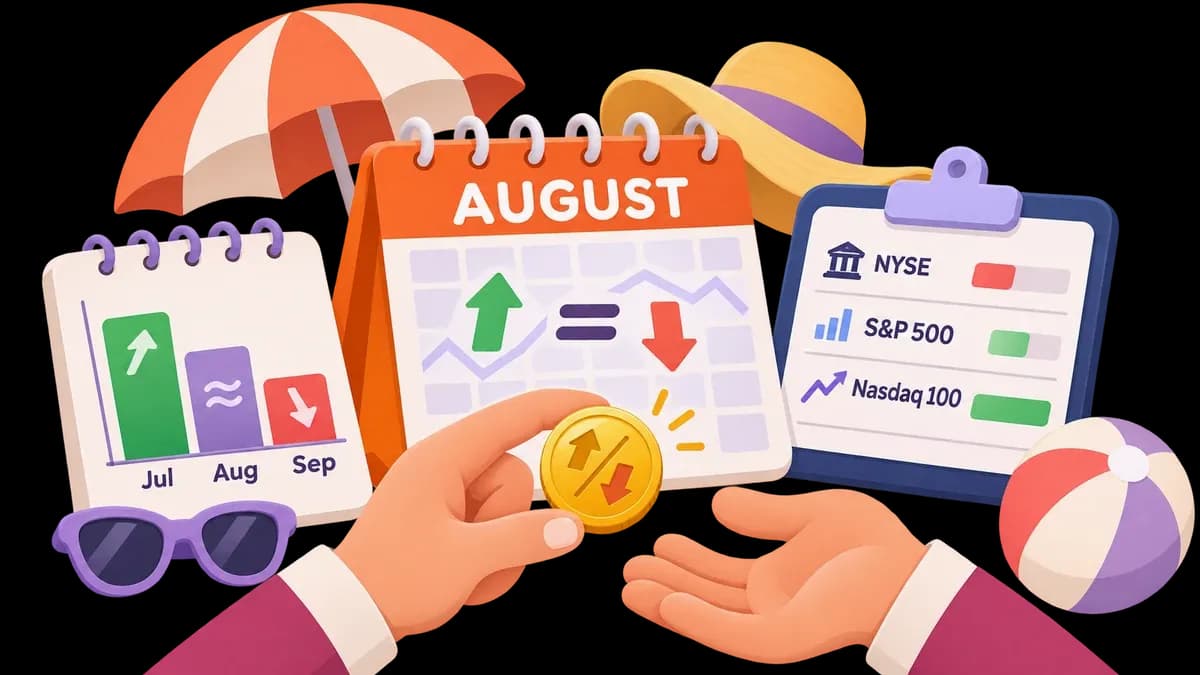
Trading.biz reviews how the S&P 500, Nasdaq 100, and NYSE Composite have historically performed in August based on long-term seasonality data.
 Artem KirillovTrading.Biz
August has historically been a coin flip as to whether stock indices will go up or down. There isn’t a strong directional bias, like there is in some months, and average returns tend to be marginally positive or negative depending on the index.
Cory Mitchell, an analyst with Trading.biz, summarizes stock performance in August over the last 20 years. “April, July, and November are three of the strongest months of the year. January, June, and September are a few of the worst. August is pretty much a neutral month.
Historically it isn’t bad, but it isn’t good. Looking at several stock indices over the last 20 years, it is pretty close to 50% on whether it will rise or fall in the month, and average returns range from 0.1% on the S&P 500, -0.6% for the NYSE Composite, and 0.7% for the Nasdaq 100. It’s summer vacation for kids, so a lot of professional traders take time off in August. Not a bad idea.”
Over the last 20 and 10 years, here is how the NYSE Composite, S&P 500, and Nasdaq 100 have performed in August.
The following chart from StockCharts shows how QQQ has performed by month over the last 20 years. The number at the bottom of the column is the average gain or loss. The number at the top of the column is how often (%) the index has closed higher over the time frame in that month.
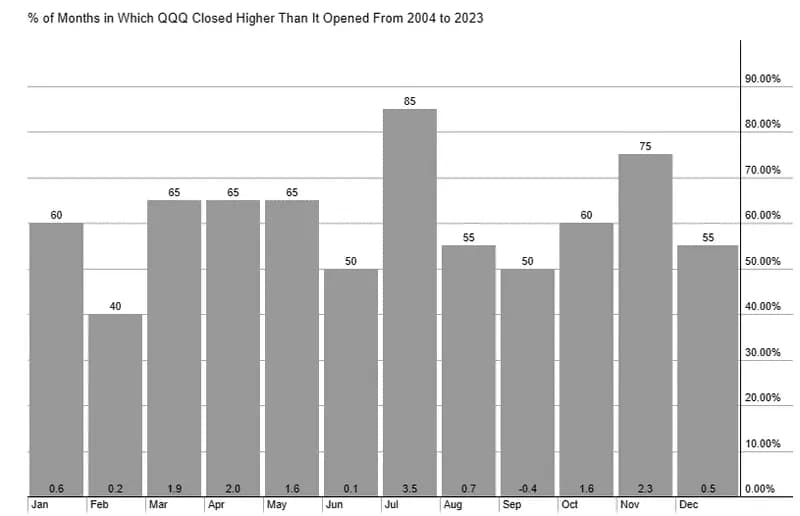
The Nasdaq 100 tends to perform a bit better in terms of average returns in August compared to the other indices, but it is pretty much a coin flip as to whether the index will rise or fall in August. Not an ideal month for investing, historically.
August is followed by September, which is one of the weakest months of the year. From an investing standpoint, if stocks are often flat in August and lower in September, making purchases toward the end of September or early October (a historically strong month) has been a historically superior strategy.
Most sector ETFs don’t perform particularly well in August either, nor does Bitcoin. With lots of people on summer vacation, that seems to be reflected in the markets.
How an asset or index performs during certain months of the year is called seasonality. It is a tool, and shouldn’t be used in isolation for making trading decisions. It highlights what has happened in the past but doesn’t predict what will happen this year.
The decline in ETF valuations shows the lack of new buyers, hinting at a broad-based move away from riskier assets.
Artem KirillovTrading.Biz
Trading.biz reports that the S&P 500 hit a fresh high even though most individual stocks remain below their 50-day moving average.
 Semelyuk Alexandra Trading.Biz