Updated:October 13, 2026

8 min
8 min

Bill Williams was born in 1932 and had a successful career for more than half a century.

Author

He became a trading educator and wrote several books on technical analysis. He also created a set of widely used and popular indicators.

These indicators are technical analysis tools used in trading to predict market trends. They measure various market factors such as rate of change, trend presence, momentum, local highs and lows, trend confirmation and decreasing momentum, and market strength or weakness.
Let’s examine each of these Williams technical indicators more in-depth so that you can use them in your trading.
The Awesome Oscillator is similar to other momentum indicators like the RSI, stochastic, and MACD. It’s an oscillator that plots the difference between a 34-period and a 5-period moving average (MA).
That’s basically a fancy way of saying that it shows price momentum and turning points. To see how it works, I added a 34-period and 5-period moving average to a chart of Tesla Inc. (TSLA) stock.
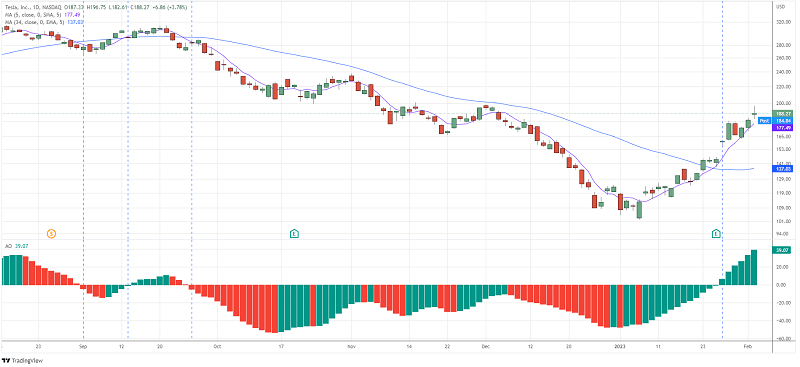
When the Awesome Oscillator moves from below zero to above zero, it means that the 5-period MA has crossed above the 34-period MA. When the Williams Awesome Oscillator drops below zero, however, it means the 5-period crossed below the 34 MA.
When the 5-period is accelerating away from the 34-period, the Oscillator values move away from zero, reflecting the difference in price between the two moving averages.
The basic idea is that you want to trade in the trend direction:
Also note that the Awesome Oscillator changes color, giving us further information:
There are potentially many ways you can use this indicator. These are just a couple of examples.
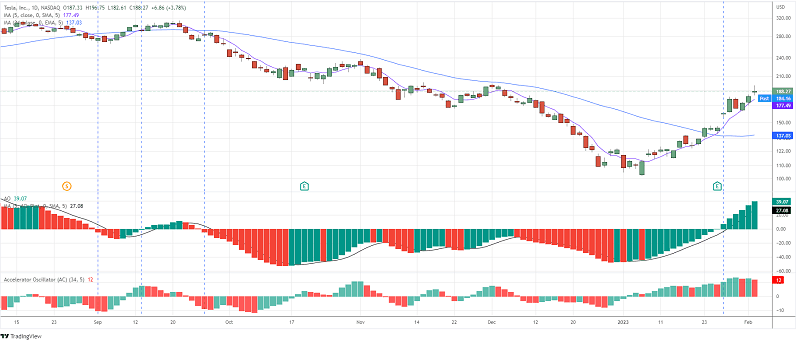
The Accelerator Oscillator is a technical indicator based on the Awesome Oscillator, measuring the difference between the Awesome Oscillator and its 5-period simple moving average.
The Accelerator Oscillator is a leading indicator that helps traders avoid poor entries. The indicator is below zero if the Awesome Oscillator is below its 5-period moving average. If the indicator is above zero, then the Awesome Oscillator is above its 5-period moving average.
Whether the numbers are increasing or decreasing is based on the distance between the Awesome Oscillator and its moving average. In the chart below, I have added a moving average to the Awesome Oscillator so that you can see how the Accelerator Oscillator is moving with it.
This is another tool that you can use to fine-tune your entries and exits.
Keep in mind the trading guidelines for the Awesome Oscillator as well. The indicators should be used together.
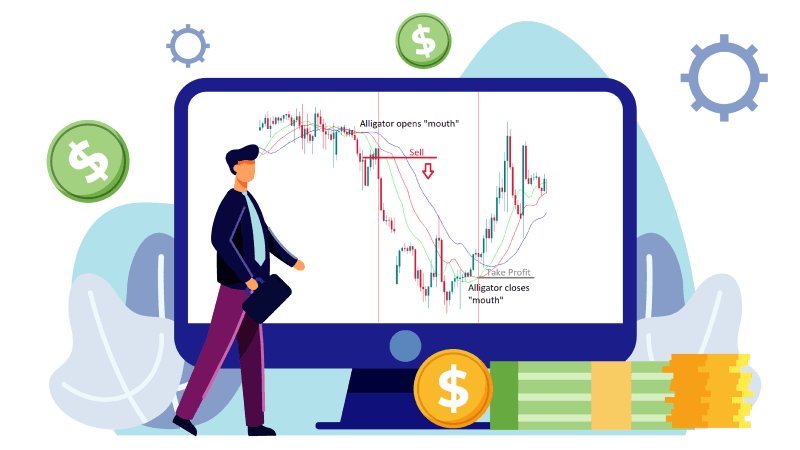
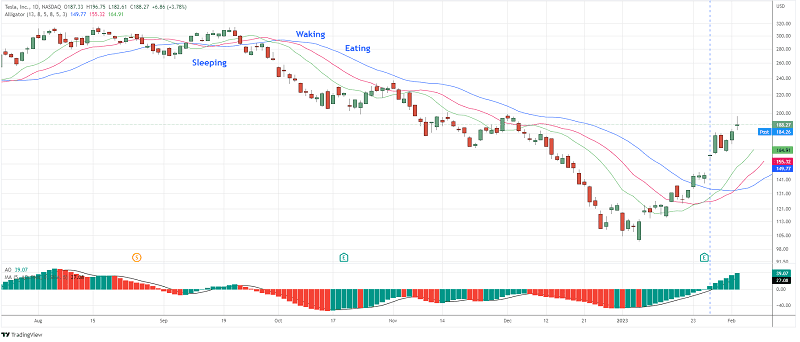
The Alligator indicator is composed of three smoothed moving averages, aimed at helping traders determine the best times to trade in a trending market.
The Alligator’s jaw line is a 13-period smoothed moving average projected 8 bars into the future. It is typically shown in blue.
The Alligator’s teeth line is an 8-period smoothed moving average projected 5 bars into the future and is shown in red.
The Alligator’s lips line is a 5-period smoothed moving average projected 3 bars into the future and is shown in green or black. The “alligator” tells you when to “feed” on the market.
“Only 15 to 30 percent of the time does the market trend.”– Bill Williams
Here’s how the indicator works:
You can combine the other indicators to tell you when to take trades in the direction of the alligator moving averages.
The Gator Oscillator uses the Alligator indicator to analyze when the trend is strengthening or weakening, visually displayed as a double histogram. The histogram bars (green for strengthening, red for weakening) show the trend’s change compared to previous periods.
The Gator Oscillator has four phases, each indicated by the color of the bars on the histogram:
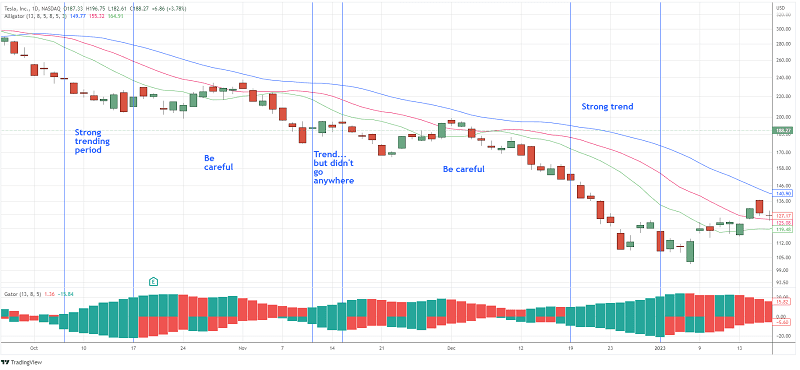
The indicator is showing the difference between the moving averages. Above the zero line is the difference between the blue and red lines; below the zero line is the difference between the red and green lines.
From the chart above, you can see the indicator says to stay out or be careful when the colors are mixed or red on the indicator. This effectively tells traders to stay out when the price is chopping sideways.
On three occasions, the bars turned green for more than two bars. The first time, the price dropped. The second time, the price moved sideways, which is a false signal because the price didn’t trend. On the third signal for a trend, the price had a significant drop and then Gator warned to exit when the price started moving up.
Fractals is a technical analysis indicator that highlights short-term turning points in price.
Fractals are based on 5 candles.

A Fractal acts as either resistance (buy fractal) or support (sell fractal). A break above a buy fractal triggers a buy signal, while a break below a sell fractal triggers a sell signal. The appearance of an arrow is NOT a signal to buy or sell on its own. It simply marks a recent high or low point in price.
Here is how to use Fractals for trading.
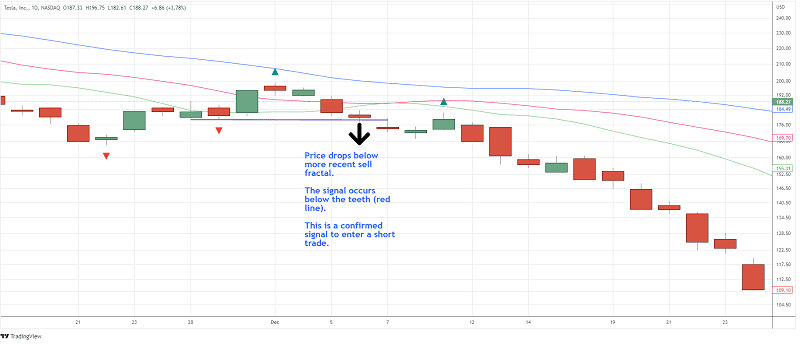
The chart shows trade examples, with the black arrow marking when the trade is taken and the direction of the trade.
The MFI is based on price change and volume. It provides an evaluation of market sentiment or the strength of the trend.
The indicator is color-coded with each color signifying a different market condition.
Colors change frequently on the chart, so this indicator must be used with the other Williams indicators.
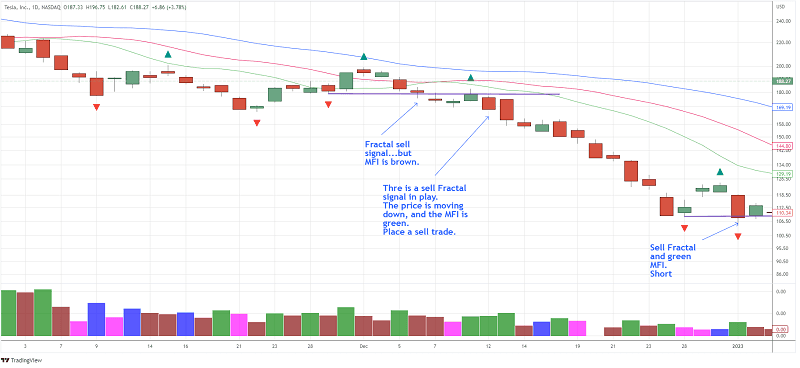
The MFI can be used to confirm or reject trade signals from the other Williams indicators. On the chart, a fractal sell signal occurred, but a trader could wait to enter a short trade until a green MFI bar occurs and the price is moving down. On the second trade, the two sell signals occurred together. Proceed with the short trade.
Find Your Perfect Broker: Explore Our List Now!
Choose the best with our expert-selected options
Find Your Perfect Broker: Explore Our List Now!
Choose the best with our expert-selected options
Discover top binary options brokers tailored to your region. Browse our curated lists by country:
4295