Updated:November 11, 2026

18 min

Expanding triangle pattern: shelter from the storm
What do you know about one of the most mysterious classic patterns? The expanding triangle is a continuation pattern that every trader should recognise. It appears when the market has lost its bearings, and it turns that chaos into something readable. Learn the rules and a share of your losses turn into entries instead. Join me in the world of triangles.

Pejman Zwin
Author

Updated October 23, 2026
What do you know about one of the most mysterious classic patterns? The expanding triangle is a continuation pattern that every trader should recognise. It appears when the market has lost its bearings, and it turns that chaos into something readable. Learn the rules and a share of your losses turn into entries instead. Join me in the world of triangles.
The year is 1300 and it’s a stormy night on the ocean, just off Alexandria.
“The storm is intensifying, captain. I can’t see anything.” “I know the sea’s chaotic. Sheet the sails; we must be close to the port.”
“But captain, I see nothing but rain! Wait…I see light. Is that the lighthouse?”
“Yes, the lighthouse of Alexandria. Change direction and head toward it.”
Relieved after a stormy night, the sailors reached the coast and the safety of Alexandria. They were wet and cold but the lighthouse had saved them.
They brought metal from Spain and would later take papyrus from Egypt to Europe. The sailors went to the inn and celebrated there. They had made good money from this trip: that they were still alive to spend it they owed to the lighthouse.
The great lighthouse of Alexandria was one of the ancient world’s seven wonders. Its beam saved many sailors from the turbulent sea on stormy nights. The light was visible for miles and guided ships toward safety.
Now, in the modern world, there is a strong lighthouse that saves traders in the turbulent seas of the markets. Anyone who sees it will be guided toward the light, soon to be set free from danger.
This ‘lighthouse’ for our times might have caught your attention already. It’s called the Expanding Triangle; a pattern that develops when there is market turbulence and a fierce battle between buyers and sellers.
Most traders don’t know which side to open a position on when higher tops and lower bottoms form. They get caught in a wolf trap and are slaughtered. I’m going to tell you how to hunt wolves instead and make money doing it.
By following this pattern, I have added almost 10% to my account in 2022, making nearly $45,000. Had those ancient mariners been able to make their money trading this pattern, their ships would have never left harbor… Stay with me, and I will talk you through this pattern, starting from scratch.
Expanding triangle pattern in upward trends
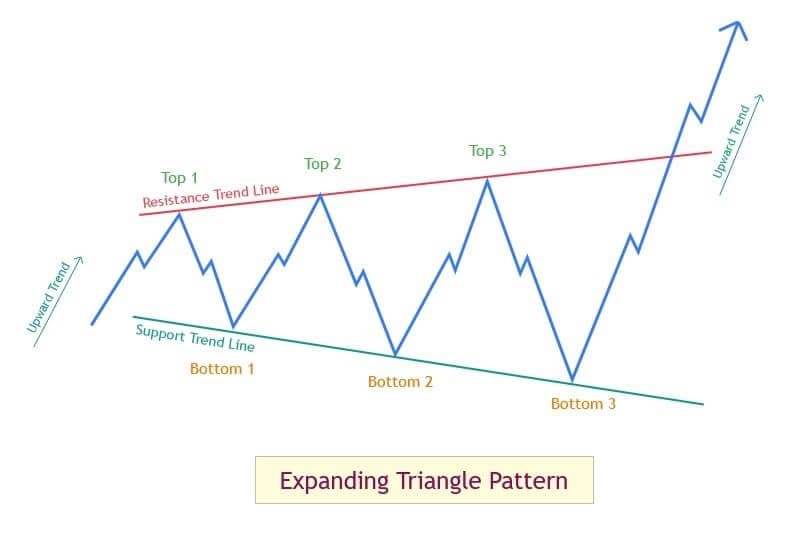
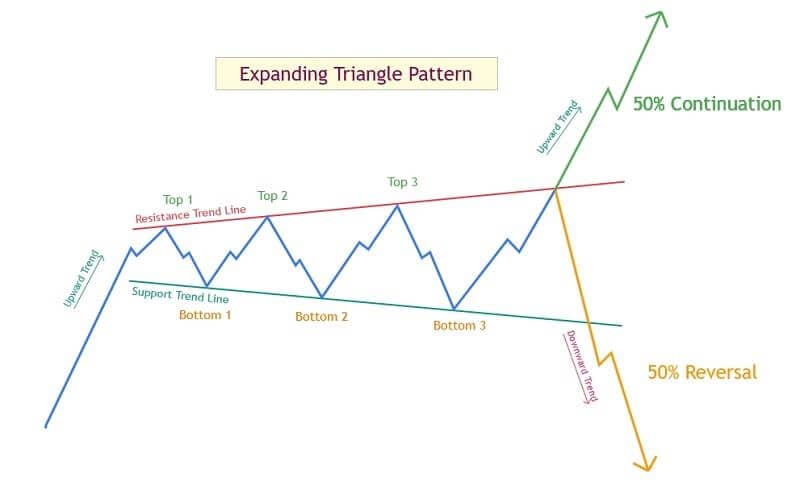
The expanding triangle in an uptrend is a continuation pattern. Price climbs, stalls, then swings wider and wider before carrying on in the original direction. The shape goes by other names too. Megaphone is the common one, because the tops and the bottoms broaden at the same time.
The pattern suits two-sided markets. Do you know why? Stay with me and I will explain it.
Sellers hit the bid hard and carve out lower bottoms. Buyers stay confident in the asset and push higher tops at the same time. In that battle both sides lose.
The range widens with every swing. A support line with a negative slope forms along the bottoms. A resistance line with a positive slope forms along the tops. See the diagram below.
The two lines diverge as time passes. The market is confused, and confused markets are usually best left alone. The expanding triangle is the exception. It marks the way out.
The Expanding Triangle pattern is a correction that tends to strengthen price momentum. This pattern is a kind of triangle. But why is it only a partial triangle, with no apex? This is an inverted triangle, but its function is precisely like the triangles I have explained. Symmetrical, ascending, descending, and expanding are all continuation patterns.
How strong is the pattern? Not very. I rate it low, because the follow-through is weak. Six major pivots are needed to form it. Three tops and three bottoms.
Price first makes top 1 and bottom 1, then makes higher tops and lower bottoms to complete the megaphone shape. Patterns consisting of more than 6 major pivots have less credibility and my advice is not to take risks with them.
Trading an expanding triangle in an uptrend
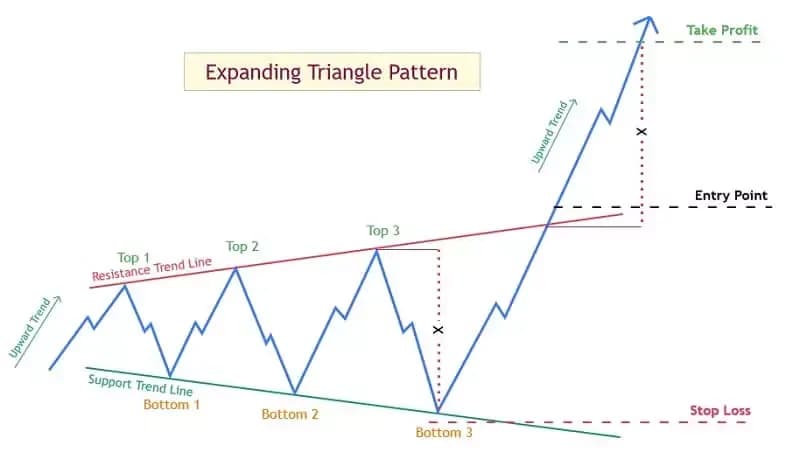
When the price forms the third bottom and rises to touch the resistance line, the pattern completes, and we can wait for the confirmation of entry into a long position. After the resistance trend line breakout, the price signals that we can enter a long position. The resistance trend line should be broken with a legitimate breakout candle. The candlestick patterns can be of assistance to us.
The distance between the pattern’s highest top and lowest bottom determines the take-profit level for this pattern (see x lines on the chart below). My advice is to close your position at that first target and take your profit, because the targets are typically small and the pattern is weak.
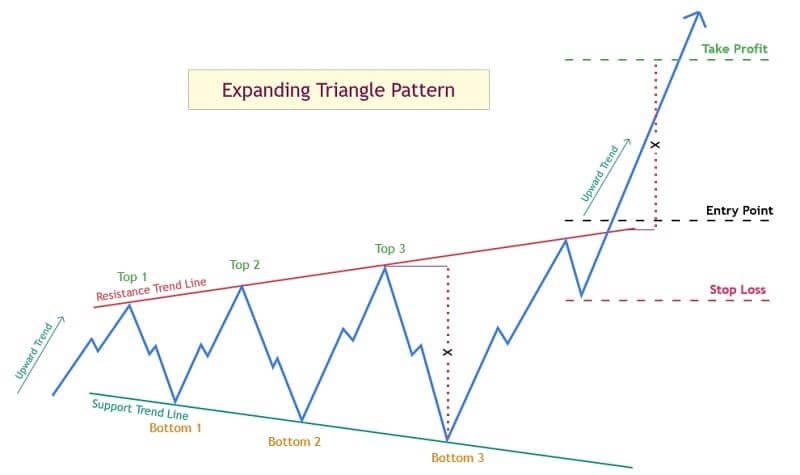
If you employ the usual approach, the stop-loss level is excessive (I will describe some preferable alternatives in a moment) but it should be placed below the last bottom, following the pattern standards. This way, the pattern has a 1:1 risk-to-reward ratio but I know other ways that help you.
The first involves candlestick patterns and putting the stop loss below the breakout candle. The second method uses a pivot in the price movement. Occasionally, during its last attack on the resistance line, the price forms a small pivot or a small bottom in the lower time frame (see chart below).
You can place the stop-loss below this pivot. I have tried this way, and it is the best option. Identifying pivots is very important. I’ll go into detail about the pivot concept and its varieties in subsequent articles.
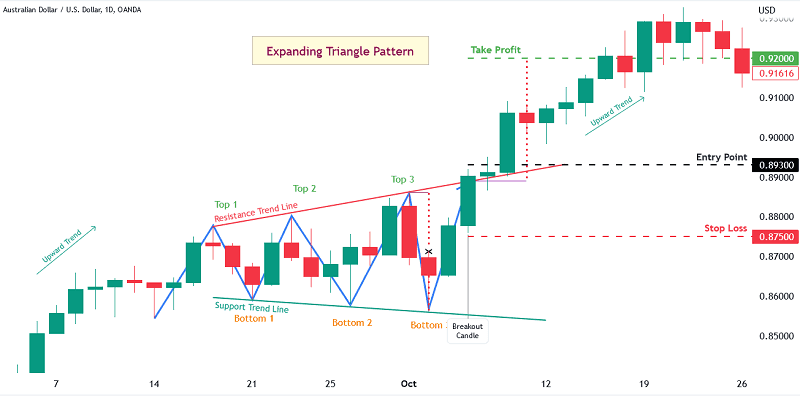
Please, watch my trade on the AUD/USD chart below, in the daily time frame. I saw an expanding triangle pattern on the AUD/USD chart and waited for entry confirmation after the price broke the resistance trend line.
A valid break occurred when the first breakout candle closed above the resistance trend line. I entered a long position at 0.89300 USD and placed the stop-loss under the breakout candle at 0.87500 USD to create a higher R:R. I calculated the take-profit level using the distance between the highest top and lowest bottom and set it at 0.92000 USD. I gained almost $9,000 from this position.
Expanding triangle as a reversal pattern
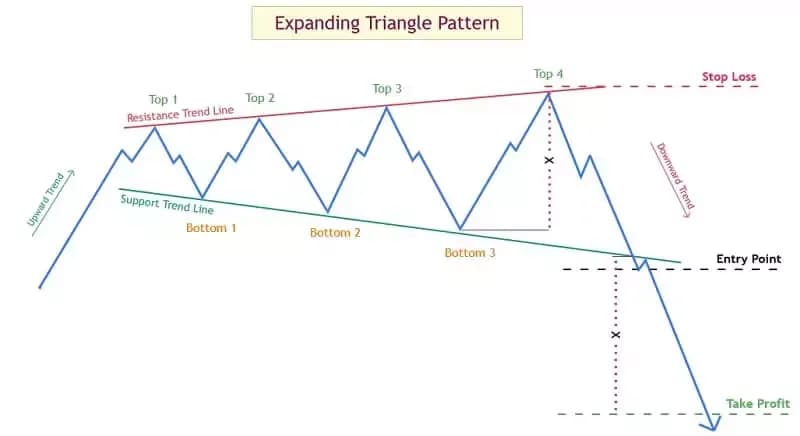
In some circumstances, the expanding triangle is a reversal pattern, and the price moves downward after forming it. The Reversal Expanding Triangle pattern has 7 major pivots.
After breaking the support trend line, the pattern becomes a reversal pattern, and the price will enter a downward trend. We can open a short position on such patterns only in two-sided markets such as forex and cryptocurrency.
You just need to place a short position below the valid breakout candle and place the stop-loss above the candle or above the pattern, depending on your opinion. You can use the distance between the highest top and the lowest bottom for the take-profit level.
Expanding triangle pattern in downward trends
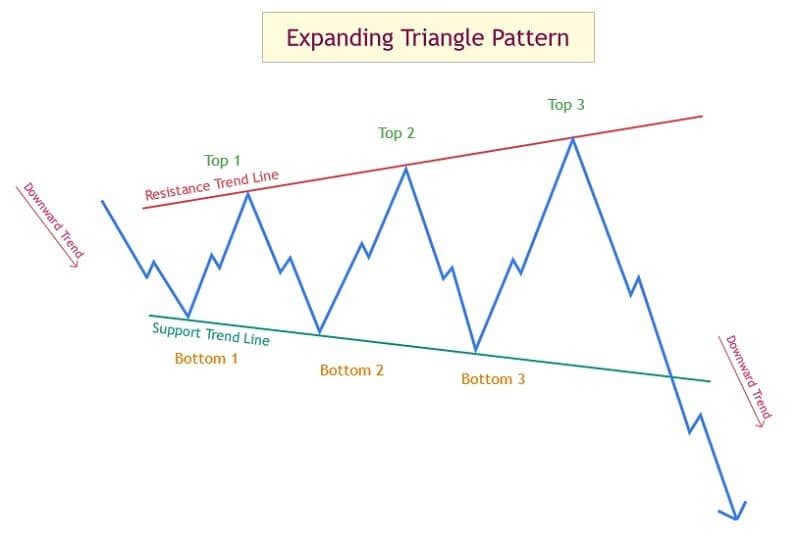
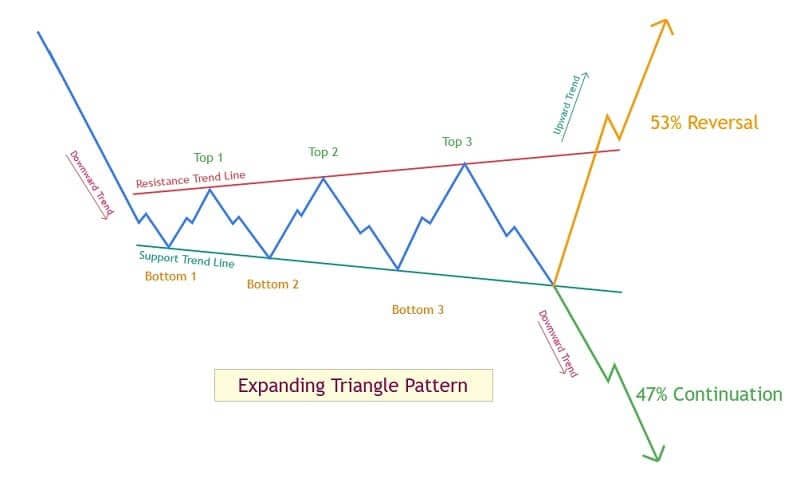
The Expanding Triangle in a downtrend is a type of correction that develops downward when price momentum decreases. In this instance, buyers enter the market with all their strength and create higher tops, while sellers, confident of the downward trend, enter the market with all their strength and form lower bottoms.
Identifying the trend in this circumstance is challenging because the market is agitated. After the first top and the first bottom, the price enters the expanding cycle and makes higher tops. At the same time, the bottoms go down step by step.
In this case, a resistance trend line with a positive slope forms above the pattern and a support trend line with a negative slope forms at the bottom of the pattern. As a result, this pattern has two trend lines that diverge over time. We need 6 major pivots to complete this pattern, namely three bottoms and three tops.
If the price falls to the support trend line following the formation of the third top, the pattern is complete. More than six major pivots will reduce the pattern’s validity. Expanding triangles are regarded as weak patterns and can rarely be relied upon because the price does not begin a sharp downward trend after the pattern.
This pattern attracts traders in forex and cryptocurrency. Because we must take a short position to make a profit, this can only be done in two-sided markets.
Expanding Triangle pattern in upward trends
Trading the expanding triangle in a downtrend
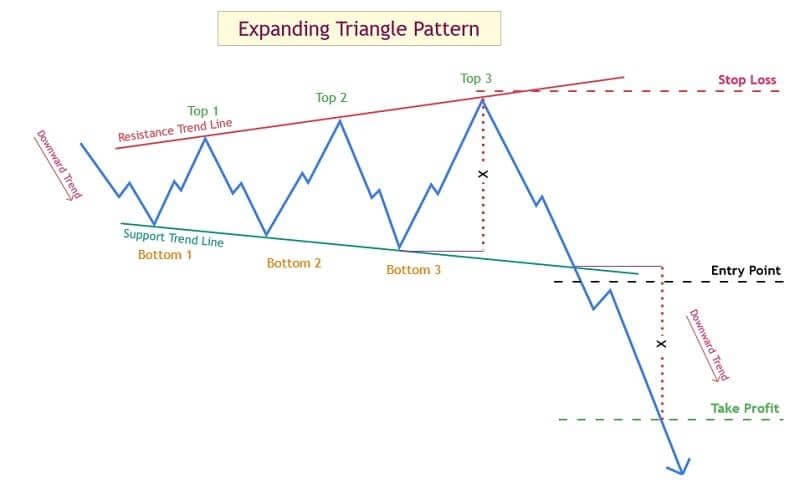
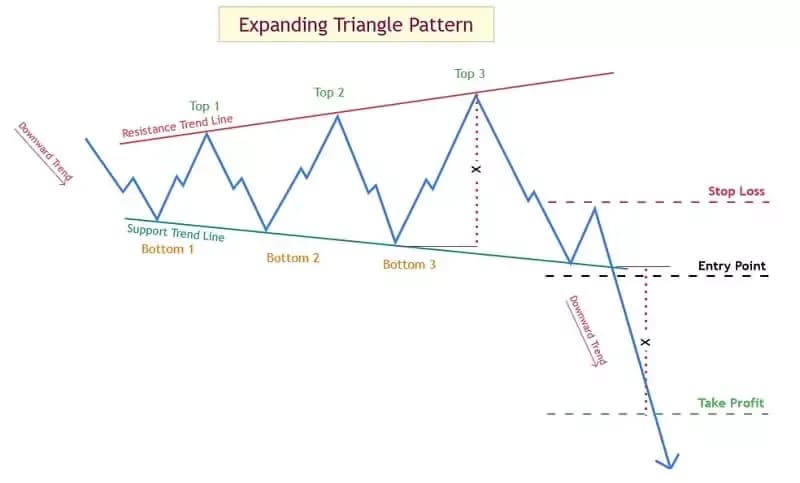
The pattern is complete when the third top forms and the price reaches the support trend line. We should wait for a breakout through the support trend line. Only after that can you place a short position. The distance between the highest top and the lowest bottom determines the take-profit level. You can place the stop-loss above the last top.
Other techniques can be used to place the stop loss. For example, when the price attacks the support trend line for the last time to break it, it is possible to form a slight pivot or a small top. You can place a stop-loss above this pivot (see chart below). Or put it on the breakout candle.
Please take a look at my trade on BTC/USDT in the 1-minute time frame.

Trade on an expanding triangle in an uptrend
After recognizing this pattern in the downtrend, I waited for the break of the support line. After breaking the support trend line with a breakout candle, I entered the short position at 19308.00 USDT and placed the stop loss above the breakout candle at 19330.00 USDT.
My take-profit level was equal to the distance between the highest top and the lowest bottom, and I placed it at 19270.00 USDT. I made a profit of about $7,000 in this short position; it was a memorable day.
Sometimes, an expanding triangle pattern in a downward trend acts as a reversal pattern, and the price enters an upward trend after forming it. To form a reversal pattern, we need 7 major pivots: four bottoms and three tops.
Ways that help you
After breaking the resistance trend line with a valid breakout candle, you can place a long position above the candle and put the stop loss under the last bottom. There are additional methods that I described for selecting the stop loss. The distance between the highest top and the lowest bottom determines the take-profit level in this pattern.
Subsequent articles
AUD/USD chart
Expanding Triangle as a Reversal pattern
Market volume
In correction patterns, the market volume typically decreases as each new wave forms. In other words, as time goes on, the market volume in the pattern declines until the final breakout.
In the last attack to break the trend line, the volume increases, so a sudden increase in market volume indicates that the price may be about to break the trend line.

Expanding Triangle pattern in downward trends
We can determine that the price is prepared to break the Expanding Triangle pattern in an upward trend if the volume of the bottom three is higher than the volume of the bottom two. You can open a long position to increase your profits when the third bottom forms, but I do not advise it because it is essentially gambling.
In the downtrend version, compare the volume at the third top with the volume at the second top. If the third is heavier, the odds of a support break rise, because sellers are getting ready to start the move down.
In this case, when the price rises to form the third top, you can enter a short position at the third top price, but the risk is high, and I do not recommend it.
Expanding triangles are regarded as weak patterns
Trade on Expanding Triangle in downward trends
The breakout candle
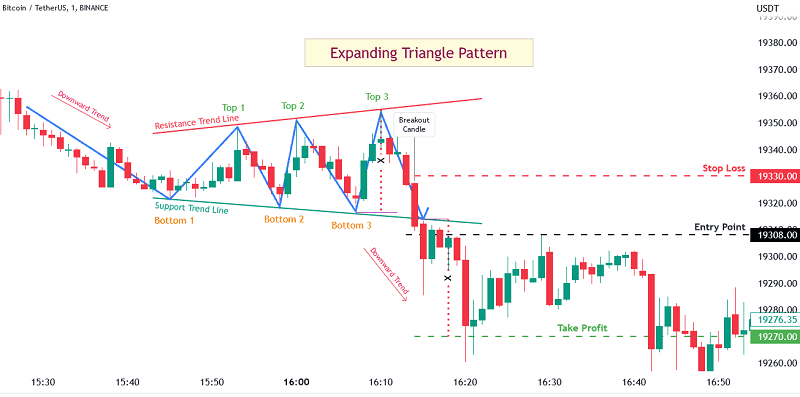
BTC/USDT in the 1-minute time frame
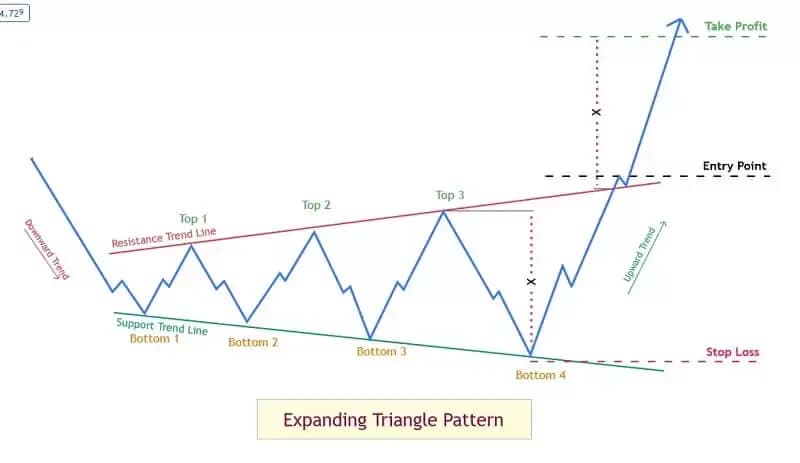
Expanding Triangle as a Reversal pattern
The half-triangle rule
There is an unwritten rule that most people have never heard of. I worked it out from years of chart reading rather than from a textbook. It tells you which way the pattern is leaning before the break.
Just draw a horizontal line through the pattern to divide it into two halves, the upper and lower half. Compare the number of candles in these two parts.
If there are more candles in the upper half, the price will probably break the resistance trend line and rise. But if there are more candles in the lower half, the price will probably break the support trend line and fall.
Expanding triangle with five pivots
The expanding triangle has several modes, and the chart shows them. One case deserves its own explanation. Here the pattern still works as a continuation, but it does not start where you expect.

The Half-Triangle Rule
Sometimes the expanding triangle in an uptrend does not begin at the first top
Sometimes the first pivot, marked Top in black on the chart below, sits higher than the second top. That first top never reacts to the resistance line. Price only enters the expanding triangle once the first bottom has formed.
The same thing happens in downtrends. Price first prints a Bottom that does not count among the pivots inside the pattern. In that case the pattern starts after the first top.
In many cases the first bottom sits lower than the rest. Not always, though. That first pivot, written as Bottom in black on the chart below, takes different shapes. It can be higher or lower than the next bottom. The point is that it never reacts to the support line.
The price enters the Expanding Triangle pattern after forming the first top and the pattern completes after forming the third top.
This approach works better for analyzing waves in the context of Elliott’s wave theory because, in that theory, corrective movements have 5 sub-waves. In the Elliott theory section, I will go into more detail.
What the researchers found about the expanding triangle
Thomas Bulkowski is one of the most outstanding researchers of classical patterns. He achieved exciting results in his research on the Expanding Triangle pattern.
Also, he researched hundreds of patterns and provided a general statistic for the price direction after the Expanding Triangle pattern.
In the following section, I will tell you some interesting points from Bulkowski, and I suggest you read them carefully. According to Bulkowski, the Expanding Triangle in uptrends is a continuation pattern 50% of the time and acts as a reversal pattern 50% of the time.
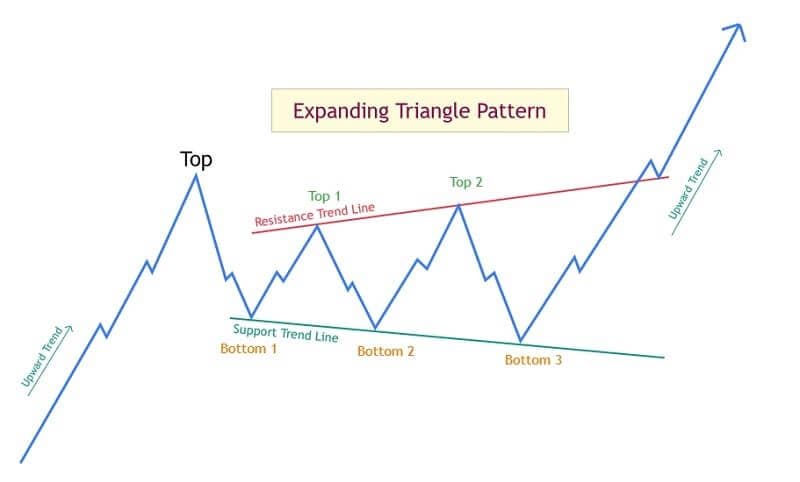
Expanding Triangle with 5 pivots
The Expanding Triangle in a downward trend is a continuation pattern 47% of the time, and a reversal pattern 53% of the time.
He also studied the targets. In his view the take-profit level on this pattern needs picking more carefully than the standard rule suggests. Call X the distance between the highest top and the lowest bottom. Bulkowski puts the target at 62% of X when an uptrend expanding triangle continues, and at 37% of X when it reverses.
In his research on expanding triangles in downtrends, he arrived at 59% of X as the target for a continuation pattern and 44% of X as the target for a reversal pattern. But Charles Kirkpatrick II and Julie Dalquist reached disappointing results in their research.
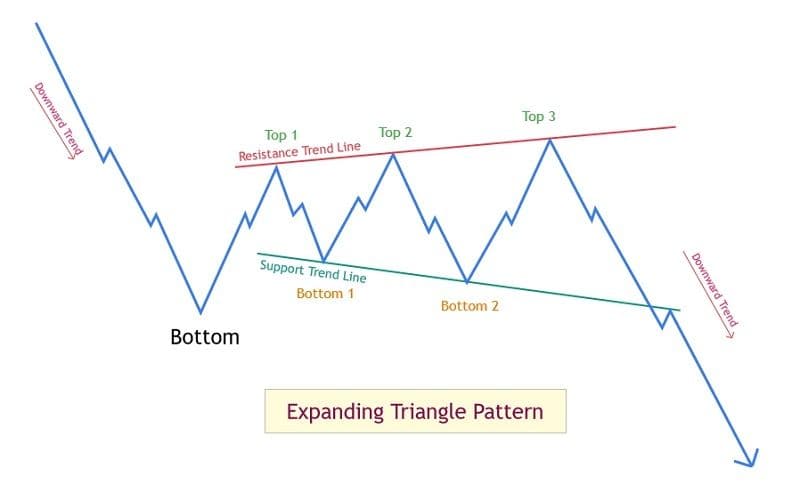
Forming the third top
They discovered that the expanding triangle pattern is weak and the stop-loss is very high. They said this pattern is rarely found in the chart and is challenging to identify.
Elliott theory
The expanding triangle can be seen in classical pattern analysis and Elliott waves. You may not know much about Elliott waves, but you will learn a little about them with the following explanations.
Of course, Elliott’s waves are a much broader subject, one I will explain entirely in the future.
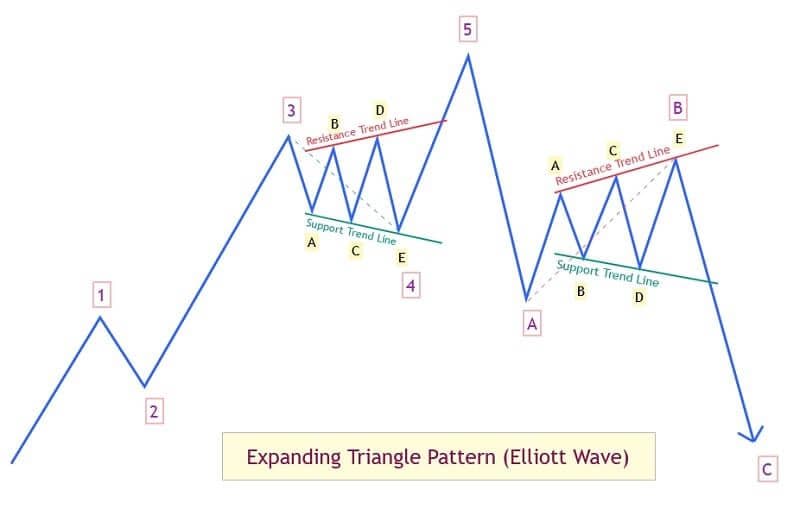
In Elliott waves, the expanding triangle is very helpful, and we can see it in correction waves. Of course, in the following chart, wave 2 does not reveal this triangle, but waves 4 and B do. The expanding triangle in Elliott’s theory has five sub-waves: A, B, C, D, and E.
Scientist’s research on the Expanding Triangle
The Expanding Triangle in Elliott Waves requires five pivots to form. This is the same unique situation I told you about before; in the uptrends, the first bottom forms first, and in the downtrends, the first top forms first.
The Expanding Triangle in a downward trend
Five mistakes that ruin this setup
The pattern is weak on its own. Most of the damage, though, comes from how it gets traded rather than from the shape itself. These five come up again and again:
-
Counting more than six pivots and trading it anyway. Validity drops with every extra swing.
-
Entering at the third bottom or the third top on a volume guess. That is a bet, not a setup.
-
Using the pattern where you cannot go short. Half the entries need forex or crypto, not a cash equity account.
Elliott Theory
Dropping the stop below the last bottom by default. It follows the textbook, and it flattens the ratio to one to one.
Holding past the first target. Follow-through here is weak and the second target rarely arrives.
Conclusion
That is the expanding triangle, start to finish. It is one of the more interesting classic patterns, and also one of the weaker ones. Treat the rules above as constraints rather than suggestions, and it will pay for the time you spend learning it.
Remember, the market is like the sea; it can confuse you and cost you everything. So try not to drown in it. Do not open a position on the days when you cannot find clear patterns when analyzing a chart. Because in these markets, you get excited and make irrational decisions.
Every technical pattern needs confirmation to enter the market, so be sure to enter the position after confirmation. Do not exit the position until the price hits the target. Float on the ship of profits and enjoy it.
Don’t forget capital management because proper capital management is the difference between a profitable trader and a losing trader. You may also enjoy our article on Bill Williams indicators, such as the Alligator and Fractals.
Next step: open a chart, set it to the daily, and mark every expanding triangle you can find over the last two years. Count the pivots. Check what the price did after the breakout candle. Twenty worked examples will teach you more than another article. One practical point before that. Short entries need a two-sided market, so check your account allows them at all. Our list of brokers shows which ones cover forex and crypto, and the broker comparison sets the costs out side by side.
FAQ
What is an expanding triangle?
A broadening price formation, also called a megaphone. Higher tops and lower bottoms print in turn, so the support line slopes down while the resistance line slopes up and the two diverge over time. Six major pivots make the standard version: three tops and three bottoms.
How does the expanding triangle work in 2026?
The mechanics have not moved, because they come from price alone. Six pivots, then a candle that closes beyond the trend line, then entry. The target is measured from the widest point of the pattern. The weakness has not changed either, so treat the first target as the exit rather than a waypoint.
Why does the expanding triangle matter for traders?
Because it makes a chaotic market readable. When higher tops and lower bottoms print at once, most traders have no side to take. This pattern supplies entry, stop and target rules for exactly that situation. Bulkowski puts continuation at 50% in uptrends, so treat it as a framework, not an edge.
What are the common mistakes?
Trading a shape with more than six pivots. Entering at the third pivot on a volume signal instead of waiting for the breakout candle. Setting the stop below the last bottom, which drags the ratio down to one to one. Holding past the first target. And using the pattern where shorting is not possible.
How do I apply it in practice?
Wait for the third bottom in an uptrend, or the third top in a downtrend. Wait for a candle that closes beyond the trend line. Enter there, put the stop under that breakout candle or under the small pivot before it, and measure the target from the highest top to the lowest bottom. Close at the first target.
Find Your Perfect Broker: Explore Our List Now!
Choose the best with our expert-selected options

Find Your Perfect Broker: Explore Our List Now!
Choose the best with our expert-selected options
Discover top binary options brokers tailored to your region. Browse our curated lists by country: