Updated:November 11, 2026

11 min

Dead cat bounce: how to profit when others lose
The dead cat bounce is one of the least discussed patterns on the chart and one of the most expensive to misread. It shows up after a sharp fall. Price jumps back, everyone decides the bottom is in, and then the decline carries on. Below is where the pattern forms, why it forms, how to tell it apart from a genuine reversal, and three ways to trade it.

Pejman Zwin
Author

Updated October 23, 2026
The dead cat bounce is one of the least discussed patterns on the chart and one of the most expensive to misread. It shows up after a sharp fall. Price jumps back, everyone decides the bottom is in, and then the decline carries on. Below is where the pattern forms, why it forms, how to tell it apart from a genuine reversal, and three ways to trade it.
Classic patterns are worth knowing because they repeat. The market is wide and technical analysis has no end to it, but the classic patterns are where the reading starts.
I have written about other classic patterns before, reversals and continuations among them. The dead cat bounce belongs to the second group. The name is odd. Do not judge it by that.
It is also one of the more deceptive shapes on a chart. Everything about it looks like the selling is over. That is precisely the trap.
Wall Street investors defined the pattern in the 1990s and gave it that strange name. They used the term when the stocks of certain companies fell. There is the clue already: a falling price.
I made a profit of 20,000 dollars on this pattern during the bearish cryptocurrency market of 2022. In a falling market it is one of very few setups that pays anything at all, which is reason enough to learn it.
The dead cat bounce pattern
The dead cat bounce is a continuation pattern. It appears inside downtrends that are moving with real momentum.
Despite the name, nothing in it points to a reversal. It signals that the downtrend is continuing. Read it correctly and it pays you while most of the market is losing money.
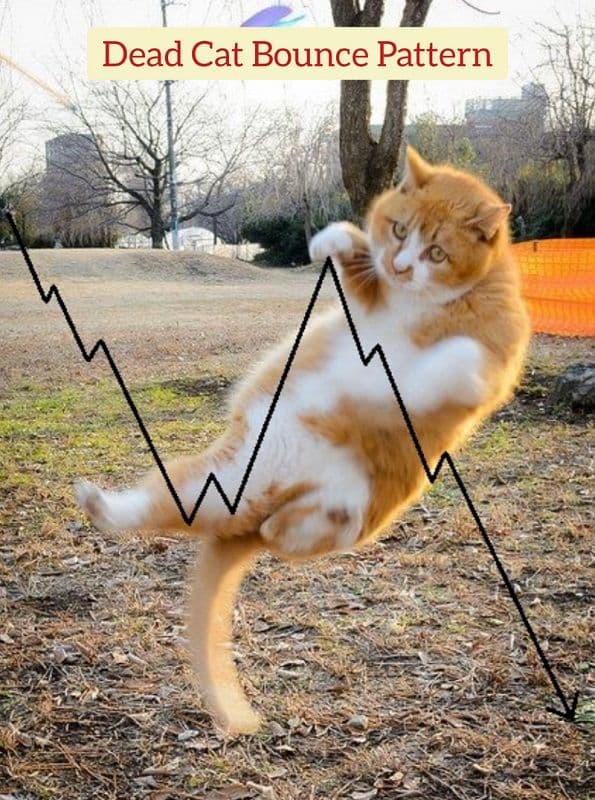
Dead Cat Bounce Pattern
Why do we call it the dead cat bounce?
There is an English saying that even a dead cat will bounce if you drop it from high enough. I hope you never see that scene or picture it.
Where does a dead cat bounce form?
It forms in downtrends with high momentum. Put simply: a stock or a currency falls hard, and the pattern shows up on the chart of that fall.
The pattern often appears at the lowest bottom the price has ever printed. Traders read that area as strong support, they step in, and the price bounces a little.
Round numbers do the same job. They affect how people think and act like a support zone even when nothing else supports the price there.
Why does a dead cat bounce form?

Why do we call it the Dead Cat Bounce?
After a sharp fall, traders feel the price has reached the lowest support area and is worth buying. They start buying, and the price rises with plenty of momentum behind it.
But the cat is dead. It cannot bounce all the way back up. What you get is a dead cat bounce and nothing more.
By this point the stock or the currency has lost its value. The bounce happens for psychological reasons among traders, not because anything changed in the asset itself. The price has no reason to rise.
Buyers get hopeful and pile in during the bounce. What they miss is that nothing underneath has changed. After the small rise, the price falls again with the same momentum it went up with.
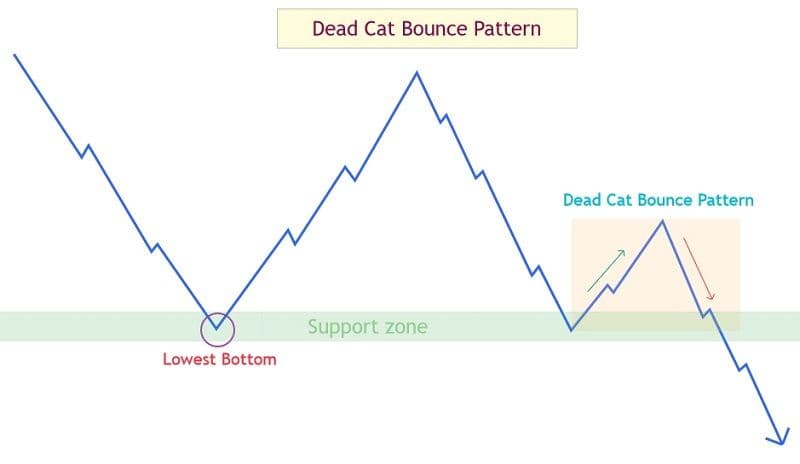
Where does Dead Cat Bounce form?
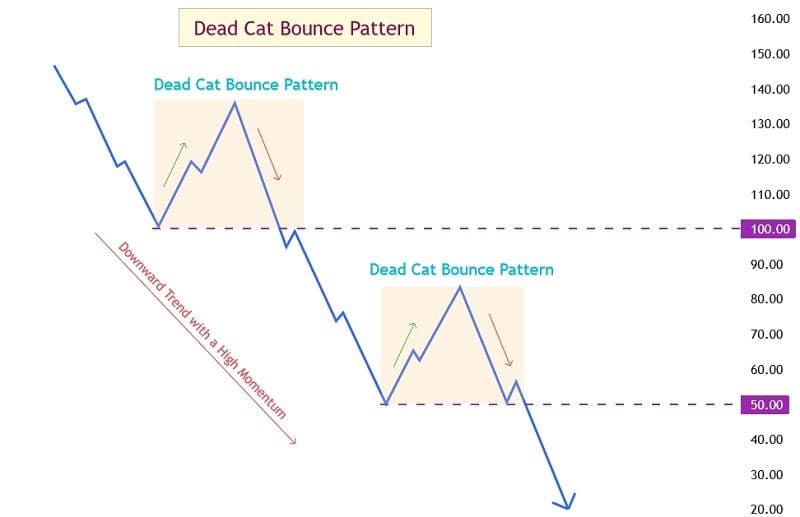
Act like a support zone
How to recognise the dead cat bounce
The pattern is vague and awkward to call in real time. There is still a way to find it, and the profit is in finding it early.
Some traders believe it can only be recognised once it is complete, and that there is no way to identify it while it forms. I disagree. A few methods give you a workable read before the move is finished.
The first method is fundamental analysis. Confirm that the trend is down and that the stock or currency has genuinely lost value. Read the news around it. If the information is still negative, the price has no reason to rise.
That is exactly the setup: the news confirms the asset is worth less, while chart analysts call the market bullish on the back of one sudden rise. Follow the news. Volume and indicators are the second half of the answer, and together they tell you whether this cat is alive.
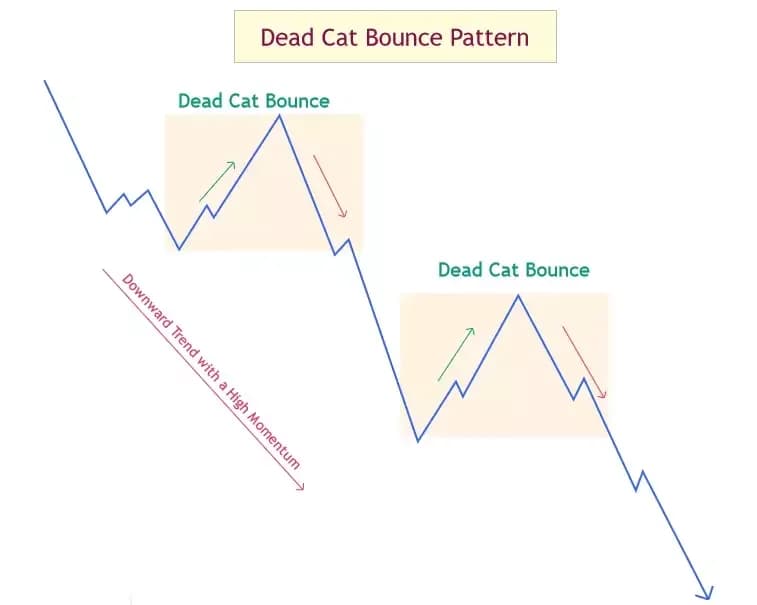
It has risen and goes down
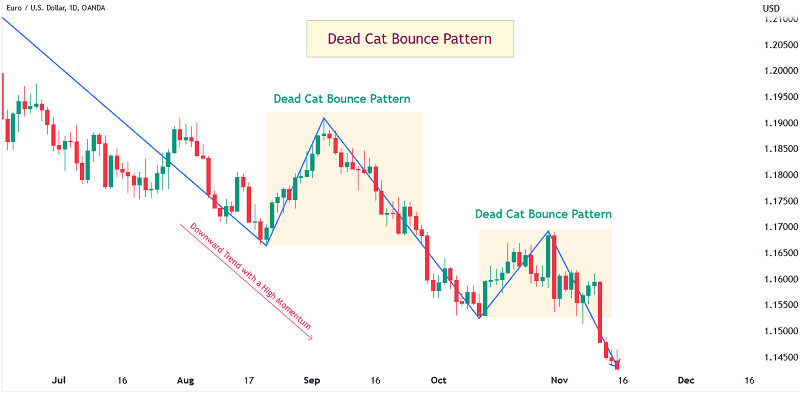
Trend indicators do the checking. RSI and MACD both show whether momentum still points down or whether it has genuinely turned upward, and a bounce on falling volume is a bounce with nothing behind it. In the photo below, you can see an example of this pattern on the EURUSD chart:
Trading the dead cat bounce
Trading this pattern is not simple and it demands care. The rules below come from years of trading it, and they are worth reading in full before you place anything.
There are specific rules to follow. As I said, while the pattern is forming, nobody can say with certainty that this is a dead cat bounce and not the start of a recovery.
It can be identified with confidence after completion. There are several ways to trade it. These come from experience and backtesting rather than theory.
The first method
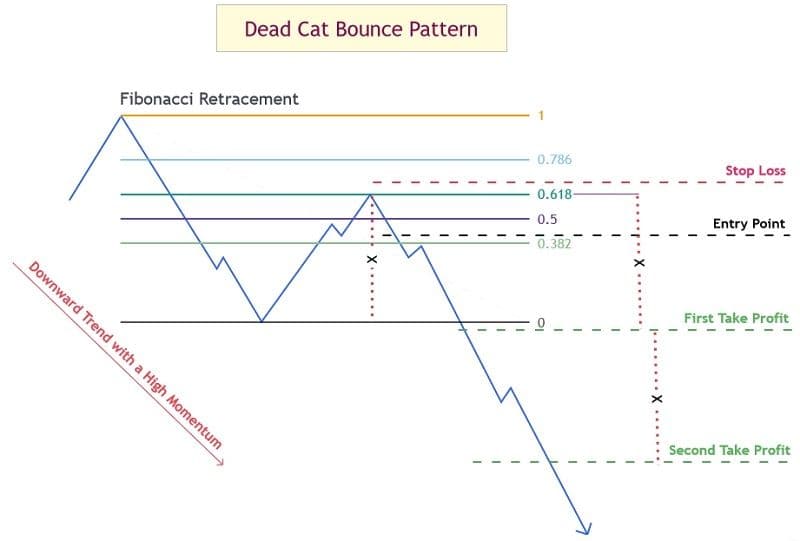
You can use Fibonacci Retracement. This tool is used to detect retracement levels. Combine it with indicators and you can find a strong resistance zone. Once that zone is identified, place a short position as a limit order and set the stop loss above the resistance zone or above the Fibonacci level.
EUR\USD chart
Or wait for a bearish reversal candlestick pattern in the resistance zone, which gives you a second signal. A shooting star candle is the classic case. Enter short once it forms and put the stop loss above the candle or above the resistance zone.
The take profit here equals the distance from the last major bottom to the highest price of the bounce. In simpler words, it equals the vertical size of the dead cat bounce pattern.
This is a strong continuation pattern, so you can close half of the position at the price of the last bottom and the rest at twice that size.
The pattern also combines with other continuation shapes, such as symmetrical triangles or flags. Take the target rules from those patterns and apply them here.
The second method
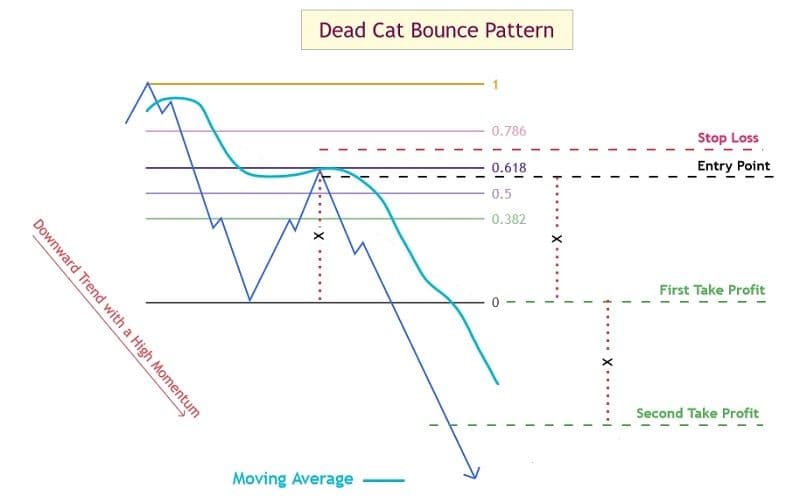
Find the retracement areas with Fibonacci and add a moving average. Here is how it works. If the price reaches a moving average that has already acted as strong resistance on that chart, and it does so at one of the Fibonacci levels, those two together make a good area for a short. Enter there.
The stop loss in this method sits above the resistance zone or above the moving average line. Your take profit can equal the size of the bounce, meaning the distance from the last major bottom to the last major top.
You can hold the whole position to the second target, or take half at the first target and let the rest run to the second.
The third method
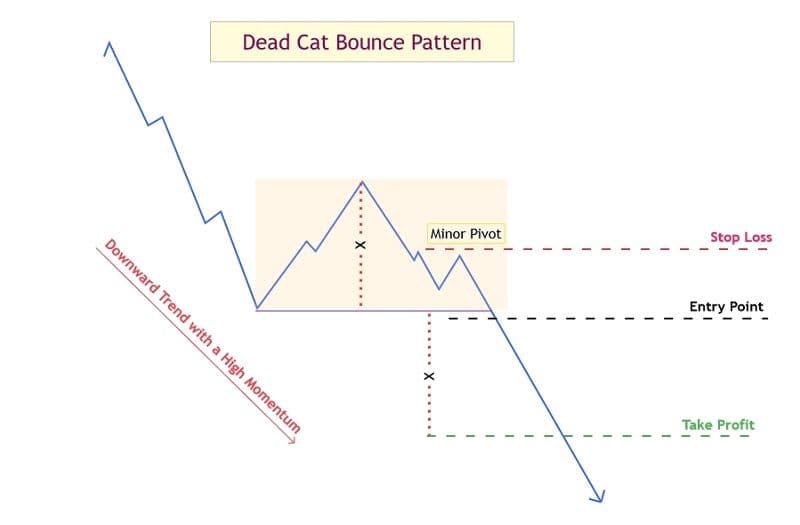
The third method waits for the pattern to complete. Enter short once the price passes the level of the last bottom on a valid breakout candle.
Place the stop loss above the breakout candle or above the last minor pivot. One of the take profit points can equal the distance between the last bottom and the last top.
A real example: the Luna crash
You may have heard the name Luna. The Luna coin crash came from the connection between this token and UST. It was a token in the cryptocurrency market that experienced a fall. Over $2 billion worth of UST was unstaked (taken off the Anchor Protocol), and hundreds of millions of it were quickly liquidated. In that fall, every bounce and pullback was a dead cat bounce.
The currency had lost its value, so it had no reason to rise. Each of those small rises gave buyers hope, and that hope cost a lot of traders their capital. It was a sad event, and it is the reason this pattern is worth learning properly.
The single most useful habit here is following the news of the market you trade and staying current. Many traders went bankrupt in that fall. I made 15,000 dollars using the dead cat bounce pattern, and fundamental analysis was the only reason for it.

Trade on the Dead Cat Bounce
I knew this cryptocurrency would fall. Many did not. Look at my trades on LUNAUSDT in the 4-hour time frame:
When the price made that bounce, I knew it was only a dead cat bounce and that a further fall was coming. So I used the Fibonacci tool to find the retracement areas. The second step was to mark the support and resistance zones.
At one point the 50% level and the resistance area overlapped, which created a strong resistance zone. I placed a short position below the 50% Fibonacci level as a limit order. The stop loss went above the 0.618 level, because that level is one of the strongest Fibonacci levels and it sat above the resistance area as well.
I expected a violent fall, so I took a third of the position off at the first target, which was the size of the bounce, and set the second target lower. Luna's project ended up worth almost nothing.
make a profit in the dead cat bounce pattern
Enter the market at this price
The last bottom and the last top
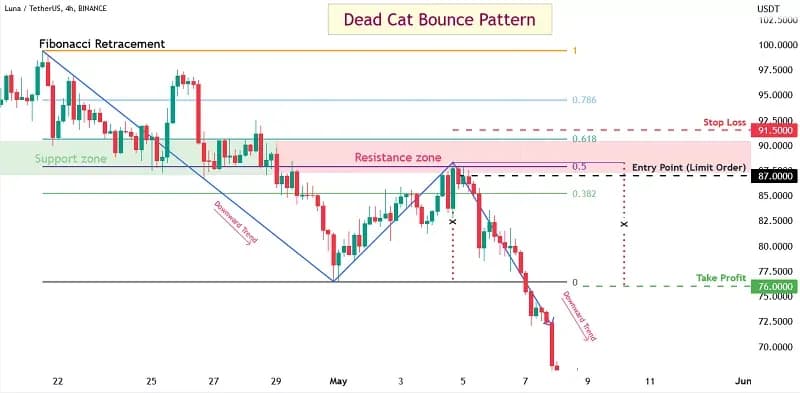
LUNAUSDT in the 4-hour time frame
Where traders get it wrong
Four mistakes account for most of the losses on this pattern. The first is buying the bounce because it looks like a reversal, which is the whole trap the name describes. The second is shorting too early, while price is still climbing: the bounce can run further than seems reasonable, and a stop placed under the nearest candle gets taken out on the way. The third is skipping the news. A chart alone cannot tell you whether the asset lost value permanently or is simply oversold, and that difference decides everything. The fourth is a target set by hope rather than by measurement. The distance from the last bottom to the top of the bounce is the number to use, and half the position can come off at the previous low.
Before you take the trade
Treat the dead cat bounce as confirmation, not as a prediction. The sequence that works is simple. Check the news first and establish that the asset really has lost value. Mark the resistance zone with Fibonacci levels and a moving average. Wait for price to reach it and for a bearish candle to form. Only then place the order, with the stop loss above the zone rather than under the last candle. Practise the read on old charts before you risk money on a live one, because this pattern gives few clean signals and each one arrives inside a panic. If you are still choosing where to trade it, our broker reviews cover spreads, order types and the platforms that support limit entries.
FAQ
What is a dead cat bounce?
It is a short recovery inside a sharp downtrend that ends with the price falling again. The pattern is a continuation pattern, not a reversal. It gets its name from the saying that even a dead cat will bounce if it falls from high enough.
How does a dead cat bounce work in 2026?
The mechanics have not changed. A hard fall reaches a level traders read as support, often an all-time low or a round number, and buying pressure lifts the price briefly. Nothing improved in the asset itself, so the move fades and the downtrend resumes.
How do I tell a dead cat bounce from a real reversal?
Look outside the chart first. If the news around the asset is still negative, there is no reason for a lasting recovery. Then check momentum and volume: a bounce on thin volume, with RSI and MACD still pointing down, is the bounce this article is about.
What are the common mistakes?
Buying the bounce, shorting before price reaches resistance, ignoring the fundamentals behind the fall, and setting a target by feel. A stop placed just above the last candle instead of above the whole resistance zone is the fourth way to lose on a correct call.
How do I trade a dead cat bounce in practice?
Mark the resistance zone where a Fibonacci level meets a moving average that has already rejected price. Wait for a bearish candle there, then short with the stop above the zone. Take the first target at the previous low and measure the second by the height of the bounce.
Find Your Perfect Broker: Explore Our List Now!
Choose the best with our expert-selected options


Find Your Perfect Broker: Explore Our List Now!
Choose the best with our expert-selected options
Discover top binary options brokers tailored to your region. Browse our curated lists by country: