Updated:November 11, 2026

21 min

Mastering candlestick patterns: entries, stops and targets
Candlestick patterns are the shorthand traders use to read a chart. Each candle records four numbers: the open, the close, the high and the low of one period. The body and the wicks turn those numbers into a picture of the fight between buyers and sellers. Mastering candlestick patterns is less about memorising shapes than about knowing where a shape counts and where it does not.

Pejman Zwin
Author

Updated October 23, 2026
Candlestick patterns are the shorthand traders use to read a chart. Each candle records four numbers: the open, the close, the high and the low of one period. The body and the wicks turn those numbers into a picture of the fight between buyers and sellers. Mastering candlestick patterns is less about memorising shapes than about knowing where a shape counts and where it does not.
A pattern on its own is not a strategy. It matters when it lands somewhere that already means something: a support level, a resistance zone, a trend line, the tail end of a long run. The same hammer in the middle of a quiet range is noise. That distinction runs through everything below.
Think of the market as a battlefield, with buyers (bulls) and sellers (bears) fighting for control. Each candlestick pattern is a battle report. It shows who won the period and by how much. The open, the close, the high and the low are the whole record.
Candlestick patterns work alone or alongside other technical tools. No tool is flawless and every one of them carries risk. The job is to find the side that is winning and join it before the move is over.
What follows is the working list: the patterns worth knowing, the entry, stop and target for each, and the filters that keep you out of the weak ones. One of them, the shooting star, produced an $8000 trade for me on Bitcoin, and the exact levels are further down. Start with the basics.
How to read a candlestick chart
Candlestick charts are the default in technical analysis, and reading them is the first skill to build. Shape and colour carry the information. Everything after this section assumes you can look at a candle and say what happened inside that period.
A candlestick chart shows how the price of a stock, a currency pair or any other asset moved over time. It replaces a single line with a record of what happened inside each period.
The chart is made up of candles, and each one covers a period you choose: a minute, an hour, a day. The body shows the opening and closing price for that period. The wicks, also called shadows, show the highest and lowest prices reached along the way. A long wick means price went there and was rejected.
The body is green or white when the close is above the open, red or black when it is below. Candlestick patterns are specific formations of one, two, three or five candles that carry information about what may come next. Reading them well is what turns a chart into a decision.
The important point is where they form. A candle matters far more at a dynamic or static support level, at resistance, or on a trend line than it does in open space. Spend the time on the market context before the trade, not after it. As Aristotle is supposed to have said, patience is bitter but its fruit is sweet.
If candlestick patterns and support and resistance are new to you, read the articles on both first and then come back here. With that groundwork in place, the trading part is straightforward.
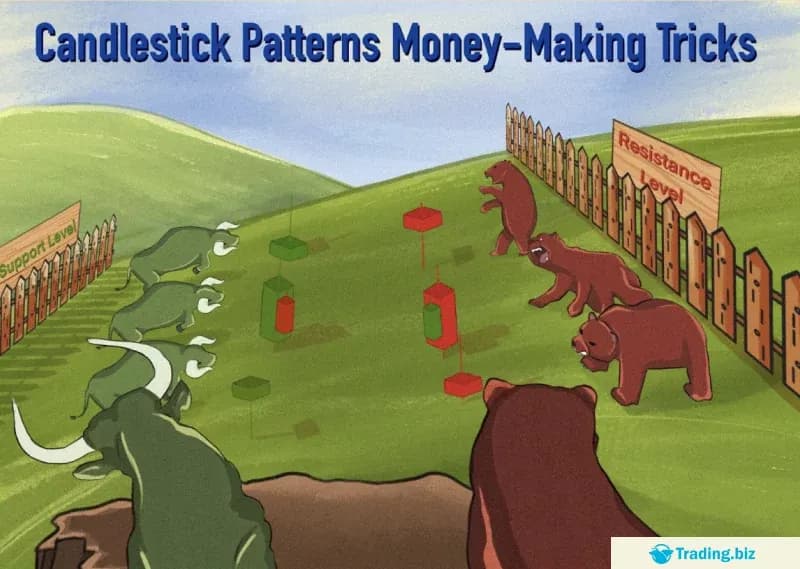
Candlestick patterns
How to trade with candlestick patterns
A strategy built on candlestick patterns can work well, but only with the surrounding context in place. Before opening anything, check the timeframe you are on, the trend lines, and the nearest support and resistance levels.
The entry point, the stop loss and the take profit matter as much as the pattern itself. This section covers each pattern in turn, with the levels for all three.
At first glance it looks impossible to say which side will take control. It gets easier once the analysis is done. Mark the support and resistance zones, draw the trend lines, then look for a pattern forming near one of them. The next move is far easier to read from there.
Each pattern comes with its own entry point, stop loss and take profit logic, and the differences between them are what the rest of this article is about.
The psychology and the structure behind these formations are covered in my article "How to Read Candlestick Charts? (The Battle of 2 Species)", so this one goes straight to the trading. First on the list is the hammer.
The frame behind every pattern below
Every setup on this list uses the same three decisions, so they are worth stating once. Entry goes beyond the level the pattern defines, normally after a confirmation candle has closed in your direction. The stop goes on the far side of the pattern, or on the far side of the zone it formed against, so that a move through it proves the read wrong rather than merely uncomfortable. The target comes from structure and not from a round number: the next opposing zone, a Fibonacci level, or a fixed multiple of the risk. Two times the risk is the floor. Below, each pattern adds only what is specific to it.

How to trade with candlestick patterns?
Hammer
The hammer is one of the simplest buy signals to spot. It has a small body sitting at the top of the candle and a long lower wick, at least twice the height of the body.
It is a bullish reversal pattern and it usually forms on a support zone. The long lower shadow is the evidence: price dropped, buyers stepped in, and the close came back near the open. If drawing support and resistance zones is unfamiliar, read the article on that first.
Entry goes above the high of the hammer. Waiting for a green confirmation candle costs you a few points and filters out a good share of the failures. The stop goes below the low of the hammer. If price trades through there, the buyers who created the wick have given up and the read is wrong.
For the target, aim for at least twice the distance from entry to stop. That gives a risk to reward ratio worth taking and gets you out before the move runs out of fuel.
Fibonacci levels, classic chart patterns and harmonic patterns all work for setting that target. So does a reversal pattern appearing at the next resistance zone. Whichever you use, check the risk to reward before the entry rather than after it.
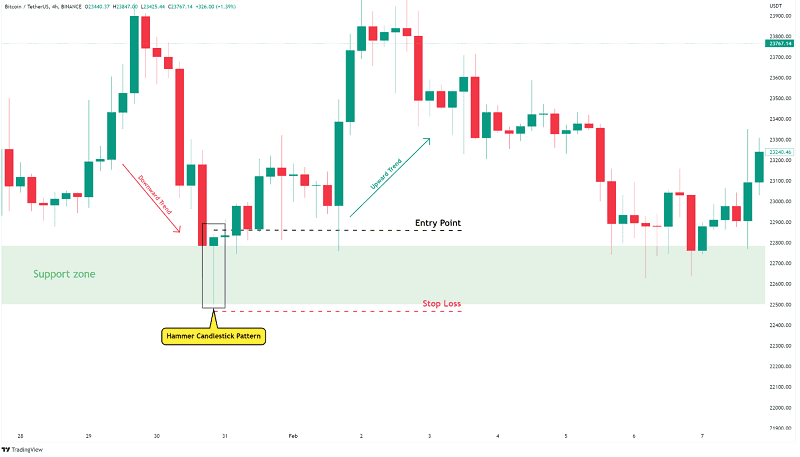
Hammer candlestick pattern
One thing to watch: a hammer that fails to turn the price flips meaning. Once price closes below the hammer low and keeps going, that same candle becomes a bearish continuation signal. There is also an inverted version, which is next.
Inverted hammer
The inverted hammer is the mirror image and it has a following, though it is both less common and less reliable than the standard version.
It appears after a fall, with a long upper wick and a small body at the bottom. Buyers pushed price up during the period and could not hold it, but the fact they tried at all is the signal. Support has been found. The move up may start from here.
Wait for the next candle before acting. If it opens and moves higher, the reversal is confirming. Enter once that green candle closes.
The stop goes below the low of the inverted hammer, which caps the loss if price carries on down instead. For the target, use the same approach as the hammer. Nothing here is guaranteed, and the inverted hammer fails more often than most.
Do your own analysis before every trade. Used with the context above, this pattern is a useful way to spot a turn early.
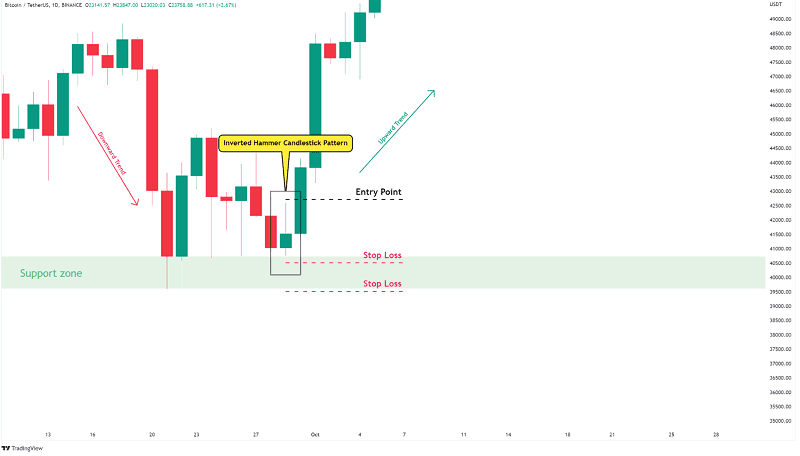
Inverted Hammer
That covers the bullish reversals. Now the bearish side, where an uptrend turns down, starting with the hanging man.
Hanging man
The hanging man is bad news for anyone long. It says the market has reached a resistance zone and a bearish reversal is possible. Price rose through the period, then ran into sellers at the top and closed back near the open.
That makes it a place to sell. The entry sits just below the hanging man. As with the hammer, waiting for a red confirmation candle first is the safer version of the same trade.
The stop goes just above the high of the hanging man. Placing it above the resistance zone instead gives the trade more room and avoids being taken out by a last kiss back into the level. The target follows the same logic as the two patterns above.
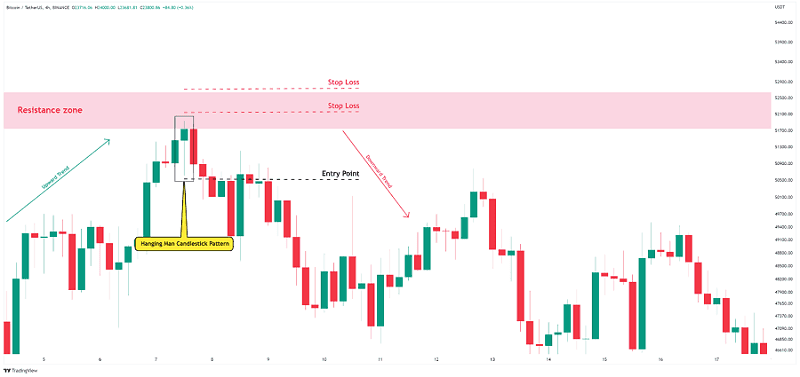
Hanging Man
The hanging man is not reliable on its own and it produces false signals. Filter it. The Relative Strength Index and a moving average both work here: if RSI is nowhere near overbought and the trend is intact, the signal is weak.
Shooting star
The shooting star is the inverted version of the hanging man, and it is both more common and more reliable. It points the same way: bearish reversal.
The upper shadow is created by a strong resistance zone, and the taller that wick, the stronger the pattern. Enter short below the shooting star, or wait for a red confirmation candle and enter after it.
If your capital management allows it, split the entry: one part below the shooting star, the other below the low of the red confirmation candle. That averages the fill and keeps you in the trade if the first level is missed.
The stop goes just above the high of the shooting star, or above the resistance zone itself if you want to survive a last kiss back into the level. The target uses the same method as the earlier patterns.
Like everything else here, the shooting star produces false signals. It is one input among several, not a decision on its own.
Used together with other indicators and with the market context, it is one of the more dependable bearish signals on the list. My best trade with it is worth going through in full, because the levels show how the frame above works in practice.
When I noticed one of the most reliable bearish reversal patterns(the shooting star) forming in the Bitcoin 4-hour chart(BTCUSDT), I entered my short position a bit lower than the shooting star’s low at $41980. Like other professional traders, I knew the importance of a proper stop loss, so I placed my stop loss at $44040.
The take profit went at $30020. The pattern did what it was supposed to do, the downtrend followed, and price reached the target. That trade added $8000 to the portfolio. The risk was $2060 per unit against a target nearly six times that, which is why it was worth taking even though most shooting stars fail.
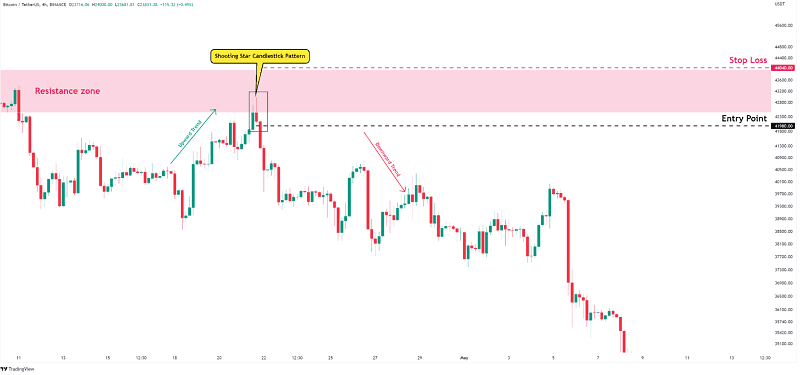
Shooting Star
Marubozu
The marubozu is a candle with almost no wicks: it opens at one extreme and closes at the other. It marks strong, one-directional pressure inside the period. The common mistake is to confuse it with any large-bodied candle in a range, which means nothing at all.
A marubozu candle forms in trending markets and always forms in the direction of the trend with high trading volume.You must consider several factors to enter a trade based on the Marubozu candlestick pattern. First is the location of the marubozu candle, whether it’s near an important support/resistance zone or not.
If it is not near an important area and volume backs it, open in the direction of the trend and expect price to keep pushing for several more candles. A stop is always necessary. In a bullish trend with a green marubozu, it goes below the marubozu candle.
But what if the Marubozu acts as a breakout candle for a support/resistance zone? In that case, you must look for classic patterns such as Cup-and-Handle, Flag and Pennants, Wedges, etc.
These patterns and indicators, such as Stochastic, Moving average Convergence/Divergence(MACD), Trading Volume, and Relative Strength Index(RSI), can help you find valid breakouts and accurate take-profit points.
They can also help you identify fake breakouts(fakeouts) before it’s too late. Such fake outs are also known as Bull/Bear traps.
If a marubozu breaks a resistance zone cleanly, enter long after a green confirmation candle and put the stop below the resistance zone, so a last kiss back into the level does not take you out. Two more strategies using breakout candles and support and resistance zones are in my article on those levels.
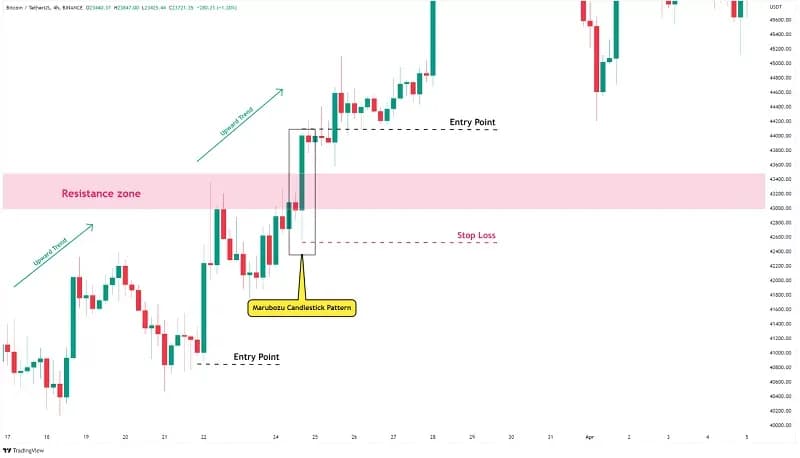
Marubozu candles
Bullish engulfing
The bullish engulfing is one of the stronger reversal signals on the chart. Two candles: a red one, then a green one whose body completely covers it. In a single period, sellers lost everything they had gained.
Enter long after the engulfing candle closes, or wait for a third green candle as confirmation. The second route is safer and costs you the occasional trade, because in a fast reversal that third candle may already be well above your level.
The target uses the same tools as the earlier patterns. The stop goes below the low of the green engulfing candle. Every trade needs one, without exception.
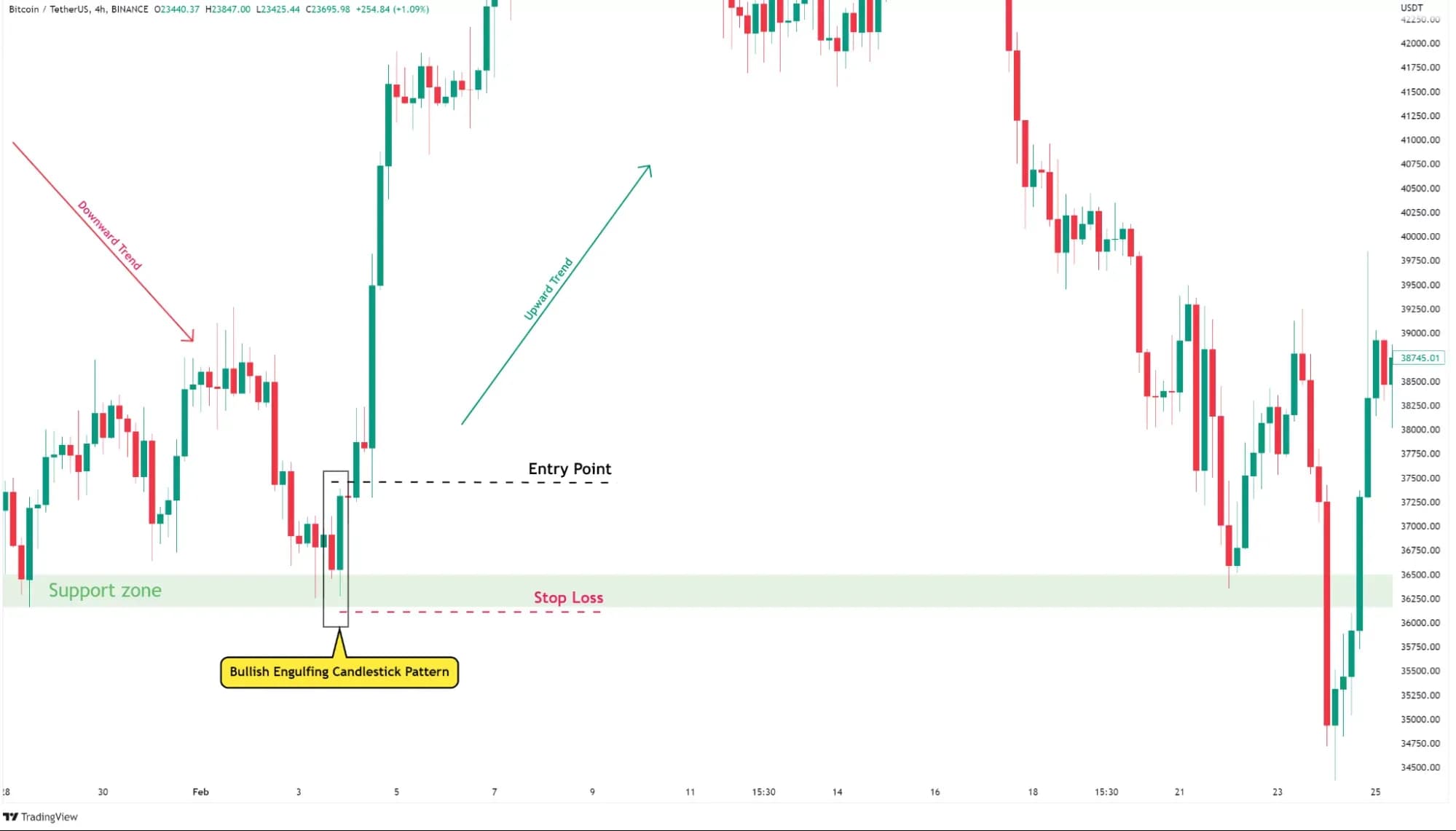
Bullish Engulfing
Bearish engulfing
The bearish engulfing is the same pattern in reverse: a green candle, then a red one that swallows it, turning an uptrend down. Use the mirror image of the entries above. One option is to go short when the third candle body drops below the low of the engulfing candle.
The stop goes above the high of the engulfing candle, and the target follows the same method. In both versions, an engulfing candle that covers several previous candles rather than just one is a considerably stronger signal.
Two relatives are worth knowing. The dark cloud cover looks like a bearish engulfing, except the second candle only covers half of the first or a little more. That makes it the weaker of the two.
The bullish piercing line is the same idea on the buy side: like a bullish engulfing, but the second candle covers half the first rather than all of it. Again, the full engulfing is the stronger signal of the pair.
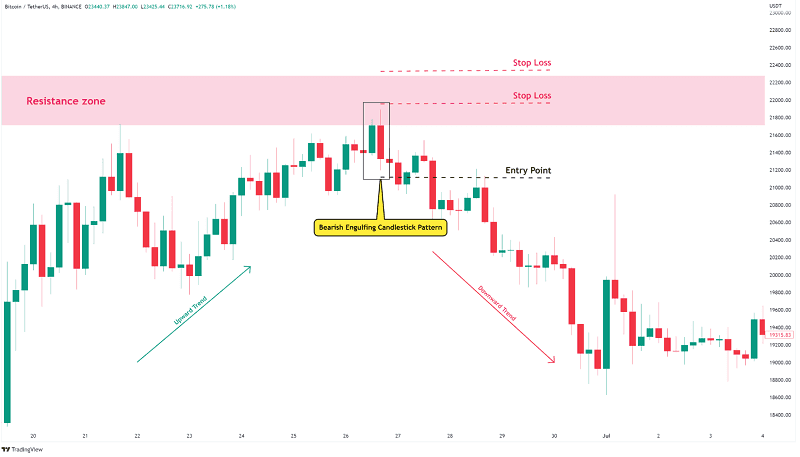
Bearish Engulfing
Bullish harami
The bullish harami points to a turn from downtrend to uptrend. It is two candles: a large red one, the mother, and a smaller green one inside it, the child. The selling has run out of size.
For the entry, wait for a third green confirmation candle and go long above its high. The more reliable version is to place the order above the high of the mother candle instead, which asks the market to prove the reversal before you are in.
The stop goes below the low of the first candle, or below the support zone the pattern formed on. There is no fixed target for a harami. Use Fibonacci retracement levels, look for a chart pattern, or place it below the next resistance zone.
The harami is generally weaker than the engulfing. Both are two-candle patterns, but in a bullish engulfing the second candle covers the first completely, and that difference in size is a difference in conviction.
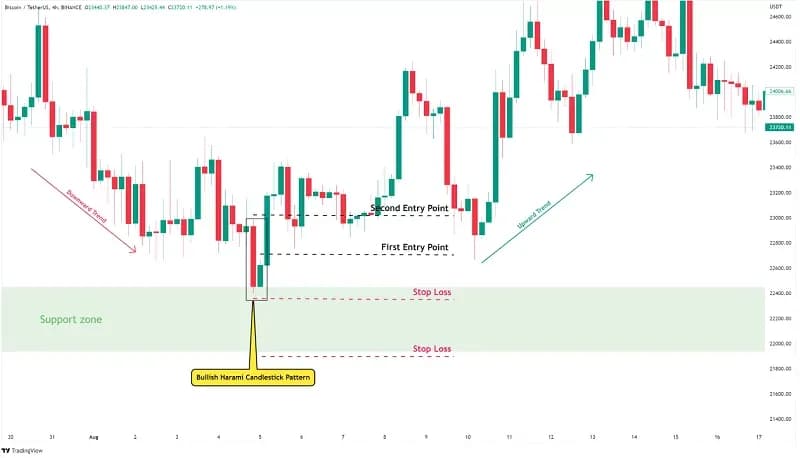
Bullish Harami
Bearish harami
The bearish harami is the same structure with the colours swapped: a large green mother candle, a smaller red child inside it. It turns an uptrend down rather than the other way round.
Entry and target work the same way as the bullish version. The stop moves to the other side: above the high of the first green candle.
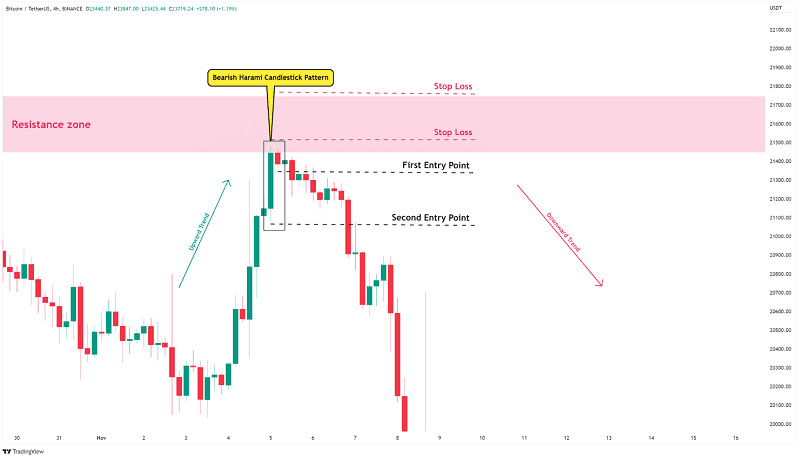
Bearish Harami
Tweezer top and bottom
A tweezer forms when two candles of different colours share almost the same high or the same low. It is not really a new pattern. It is a special case of an engulfing, a harami or something similar, with the matching extremes as an extra detail.
I do not trade it alone. What it does well is confirm: when a tweezer sits on top of an engulfing or a harami at a level you already care about, the case for the trade is stronger than either signal by itself.
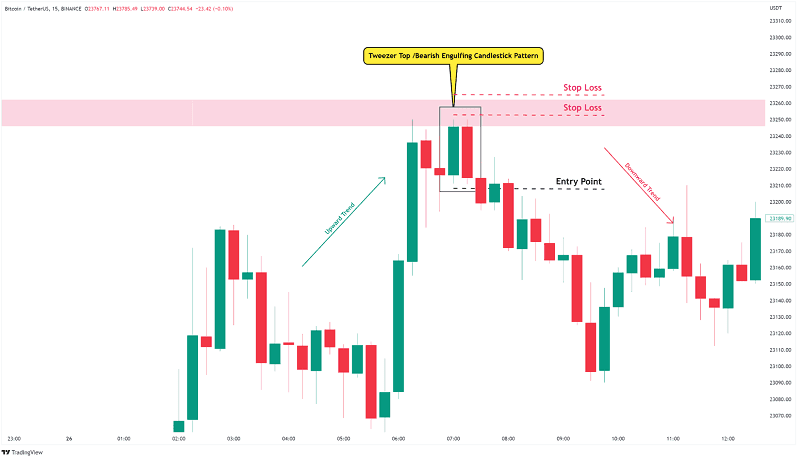
Tweezer Top/Bottom
Morning star
In a falling market the morning star is the first sign of a floor. Three candles: a long red one, a small-bodied star that usually gaps away from both neighbours, then a strong green one. The gap is the point. Sellers no longer have the size they had on the first candle.
Once the third candle closes, the entry sits above its high. The stop goes a little below the middle candle, the star itself, because a move back through it says the floor did not hold. For the target, use the same method as the earlier patterns.
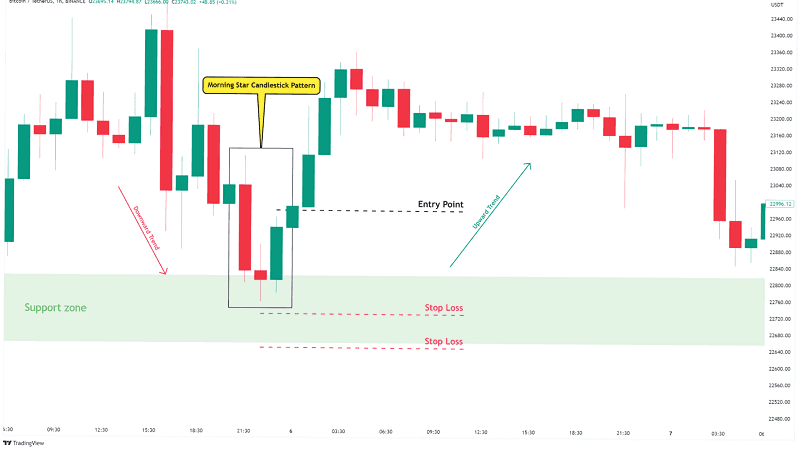
Morning Star
Evening star
The evening star is the bearish mirror: three candles at the top of a move rather than the bottom. Entry goes below the third candle, and the stop above the upper shadow of the second.
The stop can also go above the resistance zone if you want more room. As with the morning star, the exit comes from structure: classic chart patterns, Fibonacci levels or the next opposing zone.
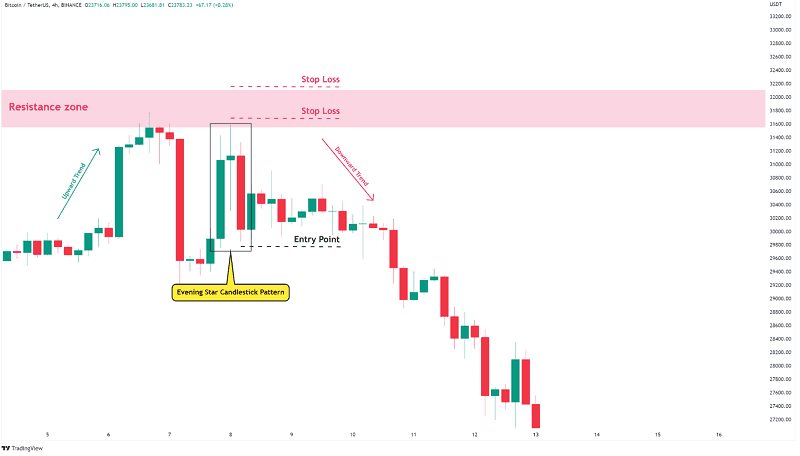
Evening Star
Three white soldiers
Three white soldiers is among the more reliable formations in technical analysis. Three long green candles in a row, each closing higher than the last, each opening inside the previous body.
It works both as a reversal and as a continuation signal. At the end of a downtrend it marks buying pressure arriving and an uptrend starting. Mid-trend it says the buyers are still in control and getting stronger.
The entry is usually the opening price of the fourth candle. That fourth candle needs to continue the move; if it opens with a long upper wick and stalls, the pattern has already done its work and the edge is gone.
The stop goes below the low of the first or the second candle in the pattern, at a level where a break means the formation has failed. A third option is below the support zone the three soldiers formed on, which is the widest stop of the three and the least likely to be hit by noise.
For the target, the same structural approach applies: the next resistance zone, a Fibonacci extension, or a fixed multiple of the risk. On this pattern the risk is often wide, because the stop sits under three full candles, so check that the target still pays at least two to one before entering.
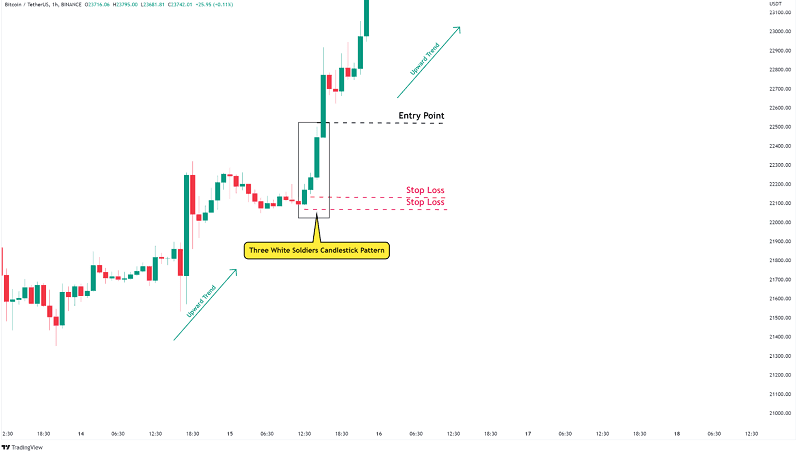
Three White Soldiers
Three black crows
Three black crows is the bearish counterpart and a signal worth respecting. Three long red candles at the end of an uptrend, each closing lower. Buyers cannot hold the market and a downtrend is likely.
It also works mid-trend as a continuation signal, marking a bear-controlled market that is likely to keep falling. The trading logic matches three white soldiers in reverse. Wait for the last candle to close and complete the pattern before going short.

Three Black Crows
There are three places for the stop. Above the second red candle is the tightest. Above the high of the first candle is the middle option. Above the resistance zone is the widest and the safest from noise. Pick one according to the position size you want, not the other way round.
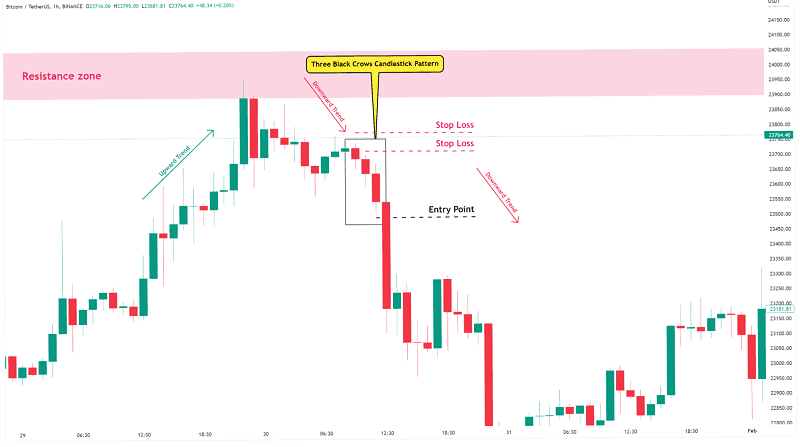
The same as the previous ones
Rising three method
The rising three method is a bullish five-candle continuation pattern: a long green candle, three small ones drifting back inside its range, then another long green candle that closes above the first. Enter long when that fifth candle completes the pattern.
The stop goes below the low of the first green candle. For the target, use the same tools set out at the start of this section, and remember that a continuation pattern is measuring the rest of an existing move, not the start of a new one.
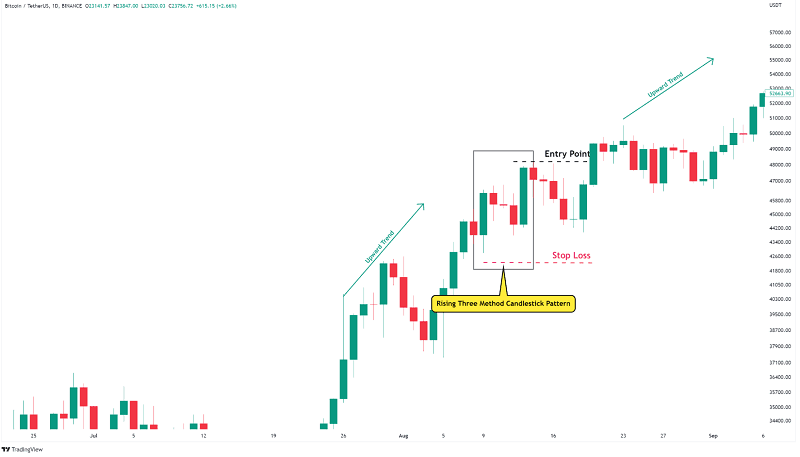
Rising Three Method
Falling three method
The falling three method is the same five-candle continuation structure with the direction reversed. Everything about it is bearish rather than bullish.
Enter as the fifth candle completes the pattern and put the stop above the high of the first candle. The target works the same way as the rising version.
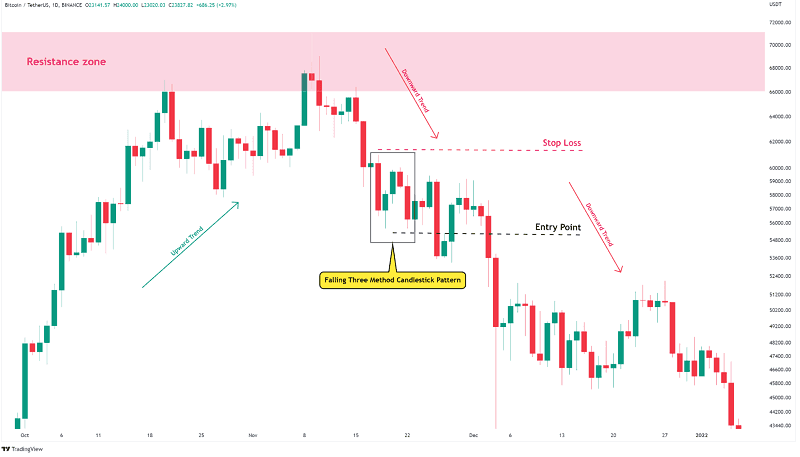
Falling Three Method
Many amateur traders mix up the Rising/Falling three method with the three rising valleys(or three falling peaks)pattern. Make sure you avoid this common mistake.
Filters that separate a signal from noise
Most patterns fail. That is normal and it is why the filters matter more than the shapes. Four of them do the heavy lifting. Location comes first: a reversal candle at a level you marked before it appeared is worth trading, the same candle in open space is not. Volume comes second, and it is the one most people skip. A reversal on volume well above the recent average means real size changed hands. Timeframe is third. A hammer on a five minute chart is a coin flip; the same hammer on the four hour or daily chart has hundreds of times the participation behind it. The fourth is agreement with the higher timeframe. If the daily trend is down, take the bearish signals on the four hour chart and leave the bullish ones alone.
One more habit is worth building. Write down what would make each trade wrong before you place it. If a hammer forms and price closes below its low, the pattern has failed and it often flips into a continuation signal in the opposite direction. Traders who wrote that line down beforehand exit; traders who did not tend to widen the stop and hope.
That is the full set of battle reports. Knowing them is not the same as trading them, so put each one on a chart and go back through the last year of price action before risking anything. Two habits matter more than the patterns themselves: only take a signal that forms at a level you had already marked, and size the position from the stop rather than from how confident you feel. If you are still choosing where to trade, start with the broker directory and check the spread and execution terms before funding an account. For the wider framework these patterns sit inside, read the principles of technical analysis, then come back and pick two patterns to learn properly instead of eighteen at once.
FAQ
What is mastering candlestick patterns?
It means reading each candle as a record of one period of trading, then recognising the formations that repeat and knowing where each one carries weight. The skill is not memorising eighteen shapes. It is judging whether a shape appeared somewhere that matters.
How do candlestick patterns work in 2026?
Exactly as they always have. The candle still shows the open, close, high and low, and the pattern still reflects the balance between buyers and sellers over one or a few periods. What has changed is the noise level on short timeframes, which is why the four hour and daily charts remain the more dependable ground.
Why do candlestick patterns matter for traders?
They give you three usable numbers rather than a vague opinion: where to get in, where the idea is proven wrong, and roughly where to get out. A hammer defines its own stop, below the wick. That is the practical value, and it is why they survive alongside every newer tool.
What are the common mistakes?
Trading a pattern in the middle of a range instead of at a level. Ignoring volume. Confusing a marubozu with any large candle. Mixing up the rising three method with the three rising valleys pattern. And moving a stop once it is set, which turns a small planned loss into an unplanned large one.
How do I apply candlestick patterns in practice?
Mark your support and resistance zones first, on a chart with no indicators on it. Then wait for one of the patterns above to form at one of those levels. Enter after a confirmation candle, put the stop on the far side of the formation and target at least twice the risk. Learn two patterns properly before adding a third.
Find Your Perfect Broker: Explore Our List Now!
Choose the best with our expert-selected options

Find Your Perfect Broker: Explore Our List Now!
Choose the best with our expert-selected options
Discover top binary options brokers tailored to your region. Browse our curated lists by country: