Updated:November 11, 2026

12 min

Rounding top and bottom patterns: how they work
Classical chart patterns are the backbone of technical analysis, and the rounding top and rounding bottom patterns sit near the front of that list. Both are reversal shapes. Price stops making progress, curves over or under, and hands the trend to the other side. Below is how each one forms, where the neckline sits, where the stop and the target go, and what the numbers say about how often they pay.

Pejman Zwin
Author

Updated October 23, 2026
Classical chart patterns are the backbone of technical analysis, and the rounding top and rounding bottom patterns sit near the front of that list. Both are reversal shapes. Price stops making progress, curves over or under, and hands the trend to the other side. Below is how each one forms, where the neckline sits, where the stop and the target go, and what the numbers say about how often they pay.
Increasing your technical analysis knowledge and adapting your strategy accordingly is necessary to survive in the market. As Yvan Byeajee states, “Trading doesn’t just reveal your character; it also builds it if you stay in the game long enough.”
You may remember The Wolf of Wall Street, where the character played by Leonardo DiCaprio builds a fortune by being the most aggressive person in the room. New traders walk into the market as lambs among wolves. The way out of that role is knowing the patterns better than whoever is on the other side of your trade.
So this article deals with the rounding pattern at the top and at the bottom: how to spot it, how to trade it, and when to leave it alone.
I earned $35,000 in 2022 with this pattern. The rounding top and rounding bottom patterns are two of the most profitable patterns, so let’s get into how they work.
Rounding top pattern
The rounding top is a classic reversal pattern. This pattern forms at the end of upward trends, and the price enters a downward trend after that.
In a one-sided market the completed pattern tells you the stock or the currency has become expensive. It is no longer worth buying. In a two-sided market you can go further and open a short, because the move after the neckline break is usually worth taking.
The rounding top looks like an umbrella. It is one wide top built from several minor tops, curved like a semicircle, with a left lip and a right lip at the bottom. That shape is exactly what fools traders who only look at the last two candles. Read it properly and you can stand under the umbrella while the market storms around you.
To form this pattern, we need several top majors, which, by forming next to each other, form the shape of the rounding top. The price trend is ascending on the left side of the pattern, and on the right side, the trend is descending.
After a strong uptrend price runs into a resistance zone and momentum drops. The rise gets slower. Sooner or later the chart stops producing higher highs and higher lows, and the whole move flattens out.
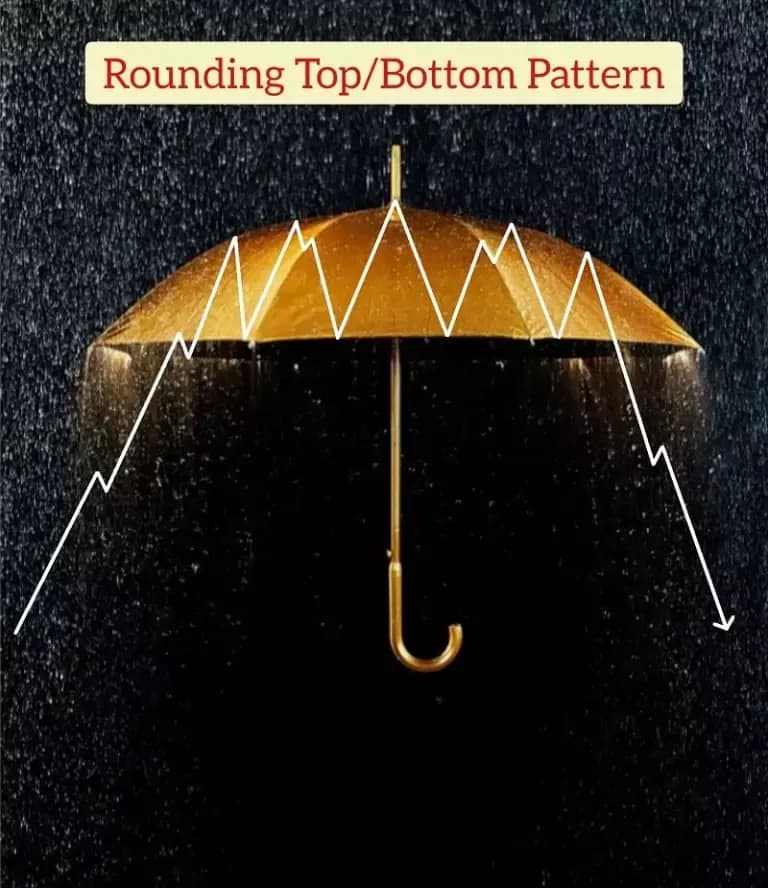
Rounding Top/Bottom pattern
Occasionally price breaks the resistance zone and pivots above it. That is a bull trap. Then it drifts back down with gentle momentum until it reaches the neckline. But where is the neckline? There is a simple way to find it.
Williams indicators help confirm the slowdown. The oscillator rolls over while price is still grinding out its last highs.
Look at the uptrend before the pattern and find the point where momentum dropped. In that area, find the lowest or first minor bottom, then draw a horizontal line from its price. That line is the neckline. When price comes back to it after the rounding shape is complete, the pattern is confirmed.
The rounding top is also called the inverse saucer, and it is close to the triple top. Many traders equate it with the double top. I disagree. A double top has two peaks, and this shape needs more than two major tops before it counts.
The rounding top forms in every market, but the short side is only available in two-sided markets such as forex and crypto. In a one-sided market such as stocks the pattern works as an exit signal. It tells you the shares have topped out and are no longer worth holding.
Volume is high while the pattern starts to build. Through the consolidation it drains away, right up to the neckline break. On the break itself volume picks up again.
Trade on the rounding top pattern
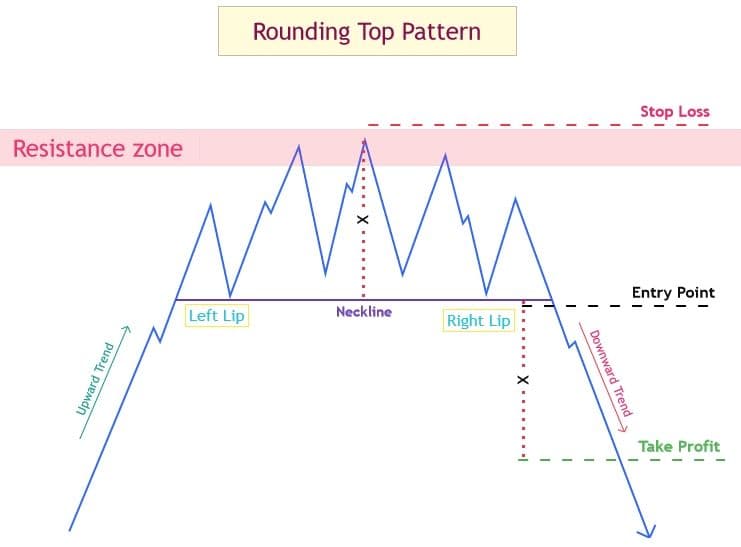
You can earn good money from this pattern, and the entry itself is simple. Once the rounding top has formed to the standards described above, wait. When price drops through the neckline, open the short position and place the stop loss above the highest top in the pattern.
You still need to check the confirmations. A clean breakout candle, a marubozu for example, makes the neckline break valid. Enter the short after that candle closes below the neckline, and put the stop loss above it.
There are alternative ways to place the stop loss in this pattern. You can place a stop loss above the last minor pivot before breaking the neckline in this pattern. This way, you get a higher risk-to-reward ratio. The take profit in this pattern equals the distance from the neckline to the highest top in the pattern.
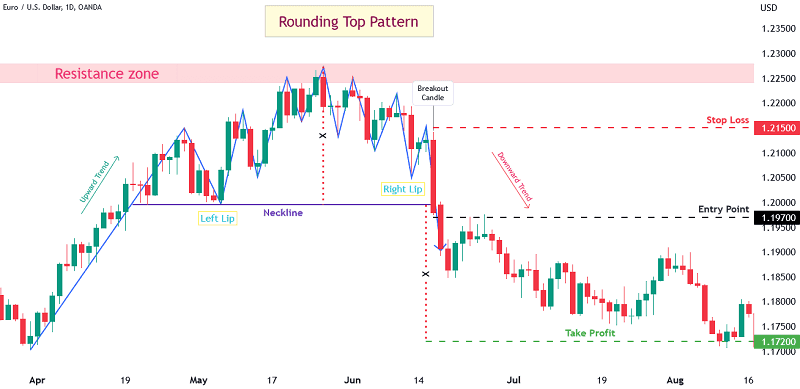
Please look at my short position on the EUR/USD chart on the daily time frame:
Once the rounding top was in place I waited. Price had to break the neckline first. It did, and the break came with a valid breakout candle.
After the breakout candle closed I entered below it at 1.19700 USD, with the stop loss above the candle at 1.21500 USD. The take profit equalled the distance from the neckline to the highest top in the pattern, which put it at 1.17200 USD. The position brought in $8,000. It was a good day.
Failed rounding top
Sometimes, this reversal pattern fails, and the price continues its upward trend after completion. The price should rise and pass the highest top in the pattern to fail a rounding top pattern. In this case, this pattern will fail, and the price will enter a definite upward trend.
That is no reason to worry. You can trade the failure with a long position. Enter after price passes the highest top, put the stop under the breakout candle or the right lip, and set the target at the distance from that top to the neckline.
Rounding bottom pattern
The rounding bottom is the mirror image, and it deserves at least as much attention as the top. It closes a downtrend. Sellers run out of size at a support zone, the curve flattens, and a fresh upward trend starts out of the bowl.
This pattern develops in all markets. Forming this pattern means that the price reaches a support zone and indicates the cheapness of the stock price or the currency.

Rounding Top pattern
The rounding bottom is shaped like a soup bowl. It is one wide bottom made of minor bottoms, arranged in a semicircle with a left and a right lip at the top. The bowl is not filled with soup. It is filled with profit, which is reason enough to watch for it.
To form this pattern, price falls with high momentum into a support area, and then the momentum fades. Lower bottoms and lower tops keep coming, but each one moves less. At some point price cannot make a lower bottom at all. It turns up gently, and from there the upward momentum builds.
In this case, the rounding bottom pattern forms, and this pattern completes when the price reaches the neckline again. But where is the neckline? It’s easy to find.
When the price decreases the momentum, find the highest minor top and draw a horizontal line from the price of this top. This horizontal line is the neckline, and if the price passes it, that’s your signal to buy.
The rounding bottom is also known as the saucer, and it is close to the triple bottom. It forms in every market. The long side works everywhere too: in one-sided markets such as stocks and in two-sided ones such as forex and crypto.
Volume behaves the same way on the bottom, only mirrored. It runs heavy while the decline is still going, dries up through the rounded base, then jumps as the neckline gives way. A breakout on thin volume is the single most common reason these setups fail.
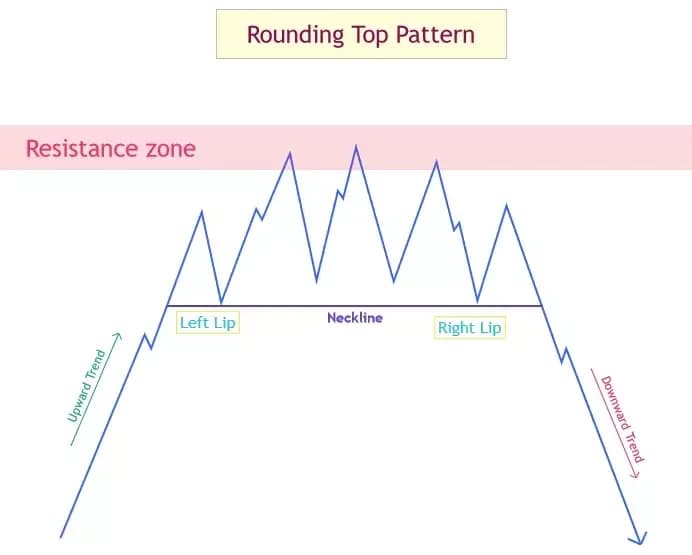
Rounding Top pattern
Sometimes the pattern forms together with a gap. Check that case carefully, because it may be an island pattern instead. The two look alike on a small chart and behave differently, so it pays to learn the island setup properly before you trade either one.
Trade on the rounding bottom pattern
You can enter the long position when the rounding bottom pattern completes, and the price passes the neckline. To be more precise, you can wait for the breakout candle to close above the neckline and then enter the long position.
It will help if you place the stop loss below the lowest bottom in the pattern in standard mode. For a higher risk-to-reward ratio, set the stop loss below the breakout candle or below the last minor pivot before breaking the neckline. The take profit in this pattern is equal to the distance from the neckline to the lowest bottom.
Please look at my trade on the ETH/USDT chart in a 1-hour time frame.
After completing the pattern and crossing the neckline, I waited for the breakout candle to close above the neckline. Then I entered the long position at 3028 USDT, and placed the stop loss below the breakout candle at 2910 USDT.
The take profit equalled the distance from the neckline to the lowest bottom of the pattern, so I set it at 3150 USDT. That trade returned $6,500.
Rounding Bottom pattern
Failed rounding bottom pattern
Price went down and passed
The rounding bottom is a reversal pattern, but sometimes it reverses nothing and price keeps falling after the shape completes. That is not a dead end. The failure itself is tradable.
The rounding bottom fails when price drops back below the lowest point of the shape after the pattern has completed. That is your short entry. The stop goes above the right lip, and the target equals the distance from the neckline to the lowest bottom.
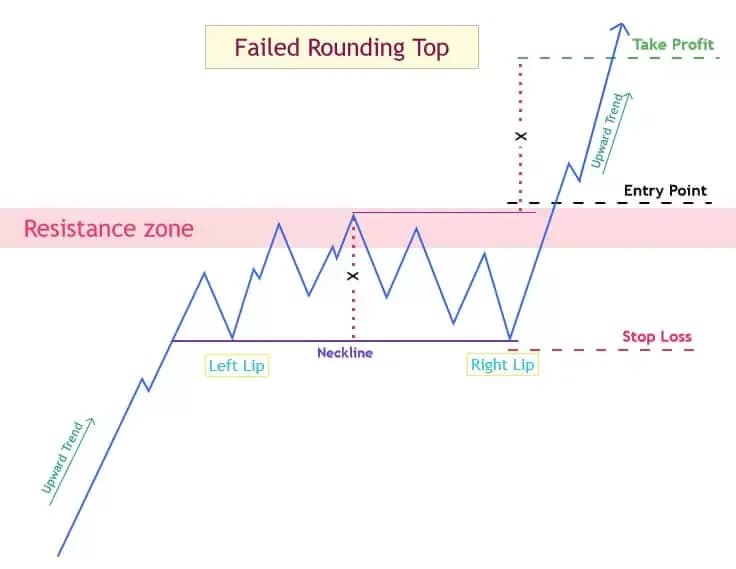
Failed Rounding Top
What the research says about rounding tops and bottoms
Analysts are always looking to improve their win rate using applied statistics. Bulkowski, Kirkpatrick & Dahlquist are prominent scientists who have done much research on this pattern.
This research can shorten your learning curve by a year or two. Here are the findings in plain language.
One of the most exciting parts of technical analysis is the statistics of great scientists and analysts. Kirkpatrick and Dahlquist state that rounding bottoms are seen more often than rounding tops in the chart. According to them, this pattern is usually long-term and takes a lot of time to form. They also said that tall patterns have more credibility.
Bulkowski optimised the targets for this shape, and using his numbers lifts both profitability and win rate. For the rounding top he sets the target at 24% of the vertical distance from the right lip to the highest top.
For the rounding bottom the figure is 57% of the vertical distance from the right lip to the lowest bottom.
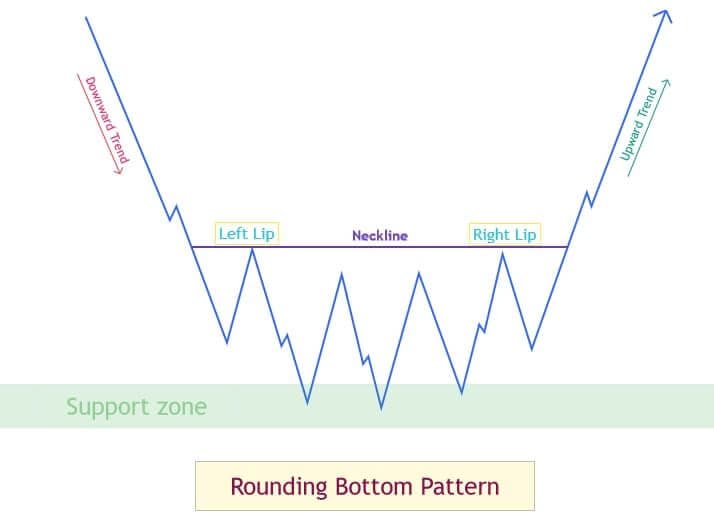
Your signal to buy
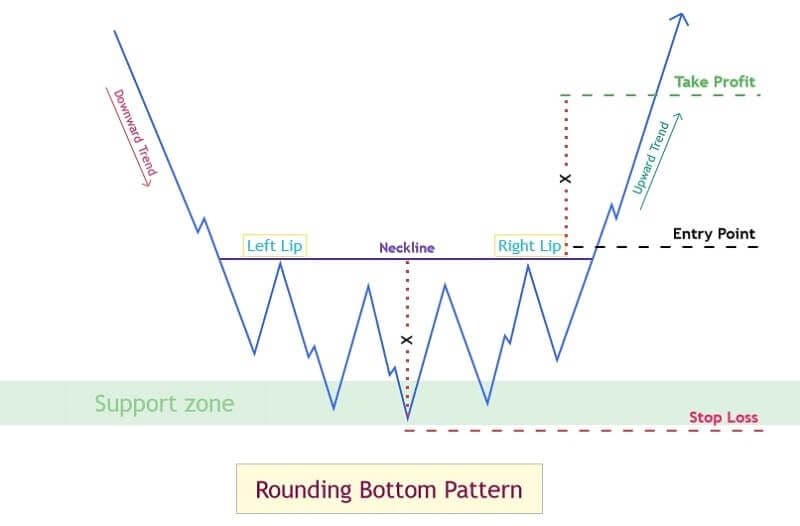
The lowest bottom
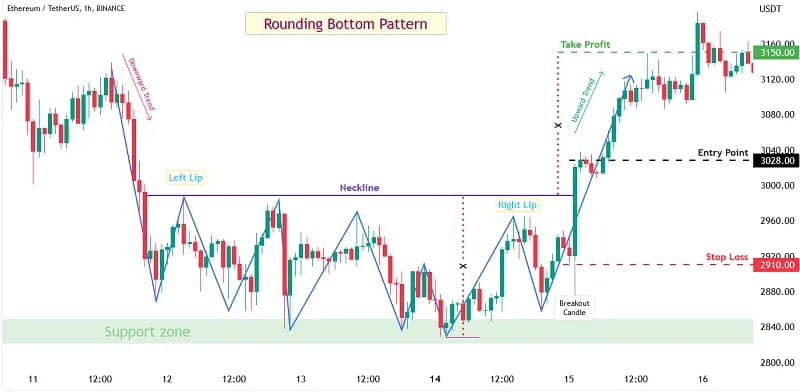
ETH/USDT chart in a 1-hour time frame
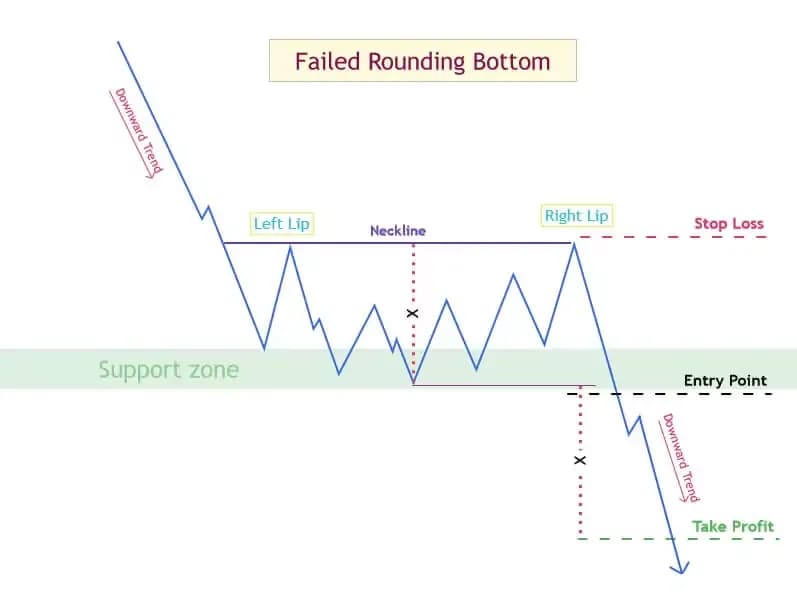
Failed Rounding Bottom Pattern
Common mistakes with rounding patterns
Four errors account for most of the money lost on these two shapes. Trading before the neckline breaks is the first. The curve on its own is not a signal, and a rounded top can grind sideways for weeks before it decides anything. Ignoring volume is the second: a break on thin volume usually falls straight back into the pattern. The third is mistaking a rounding bottom that opens with a gap for an island reversal, which behaves differently and needs a different stop. The fourth is trying to short a rounding top in a one-sided market such as stocks, where your broker cannot open a short at all. There the pattern is an exit signal, not an entry.
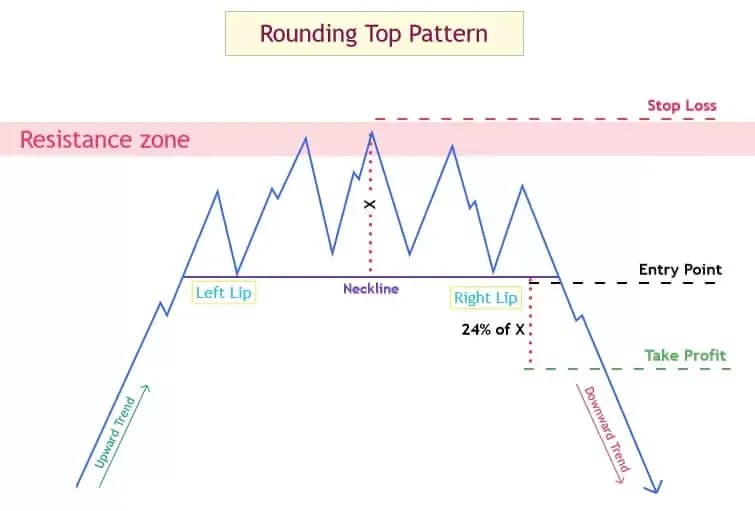
Vertical distance
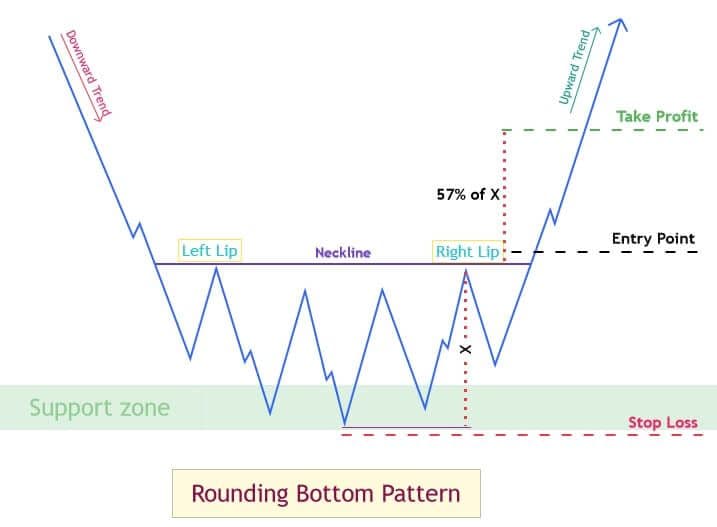
The lowest bottom for the rounding bottom pattern
Bottom line
Rounding tops and bottoms are slow, and that is their advantage. They give you days to prepare an order instead of seconds. Wait for the neckline break, check the volume on that candle, place the stop by the rules above, and treat the optimised targets seriously: 24% of the right-lip distance on a top, 57% on a bottom. One practical check before the first live order. Make sure your terminal draws horizontal lines properly and shows real traded volume, not tick volume. If it does not, compare regulated brokers and move to a platform that does.
FAQ
What is the rounding top and bottom pattern?
It is a reversal shape. A rounding top is one wide top made of several minor tops curved like an umbrella, and a rounding bottom is the same curve upside down, shaped like a bowl. The pattern completes when price returns to the neckline.
How do you trade a rounding pattern in 2026?
The rules have not changed. Wait for the neckline to break, ideally on a full breakout candle such as a marubozu, then enter in the direction of the break. The stop goes beyond the extreme of the pattern, the target equals the distance from the neckline to that extreme.
Why does this pattern matter for traders?
Because it marks a change of control, not a pause. On a rounding top the buyers run out of size at a resistance zone. In a one-sided market such as stocks that alone is a reason to close a long, even if you never take the short.
How long does a rounding pattern take to form?
Longer than most setups. Kirkpatrick and Dahlquist describe it as a long-term formation, and tall patterns carry more credibility than shallow ones. On a daily chart the curve often takes weeks, which is why the entry is easy to prepare in advance.
What happens if the pattern fails?
A rounding top fails when price climbs back above the highest top in the shape. That is a long entry with the stop under the breakout candle or the right lip. A rounding bottom fails when price drops under the lowest bottom, and that is a short with the stop above the right lip.
Find Your Perfect Broker: Explore Our List Now!
Choose the best with our expert-selected options


Find Your Perfect Broker: Explore Our List Now!
Choose the best with our expert-selected options
Discover top binary options brokers tailored to your region. Browse our curated lists by country: