Updated:November 11, 2026

12 min

How long does it take to learn binary options trading?
How long does it take to learn binary options trading? The theory is a matter of days. Consistency takes three to six months of practice, and that is the part nobody advertises. In 2026 binary options keep pulling in traders from every market, and most of them show up with the same two questions: what exactly is this instrument, and how long before the account stops shrinking.

Saqib Iqbal
Author

Updated October 23, 2026
How long does it take to learn binary options trading? The theory is a matter of days. Consistency takes three to six months of practice, and that is the part nobody advertises. In 2026 binary options keep pulling in traders from every market, and most of them show up with the same two questions: what exactly is this instrument, and how long before the account stops shrinking.
Binary options are an all or nothing contract. The trade either pays a fixed amount or returns nothing at all. Traders like the format because risk is capped at the stake, the result is known before you enter, and the structure takes a minute to explain.
How fast you get there depends on four things: market knowledge, risk management, strategy development and your psychological bandwidth. This guide covers each of them. Here is what you take away:
-
Realistic timeframe to learn binary options trading.
-
How trading tools enhance binary options decision-making.
-
Which global trading session could work best for you.
-
How expiration times and trading strategies together maximize profitability.
-
Join Quotex today and take the first step towards binary options trading with Quotex’s advanced tools, robust risk management, and free demo trading.
What are binary options and how do you work with them?
Binary options are financial instruments built on top of an underlying asset. That asset can be a stock, an index, a commodity or a cryptocurrency. The trade itself is short term. You speculate on where the price of the asset will be at a fixed moment in the future, and nothing else about the asset matters to the outcome.
The name gives away the mechanics. Binary means two outcomes, and there is no third. If the price finishes above your entry at expiry and you predicted a rise, you collect the predetermined payout. If it does not, the stake is gone in full.
An example makes it concrete. EUR/USD trades at 1.0850 at 11:30 AM and you expect it to be higher in fifteen minutes. You open a buy position and stake 100 dollars at a payout of 85 percent.
At 11:45 AM the contract settles. Price finished at 1.0857, so the forecast landed and the account receives 185 dollars, of which 85 is profit. Had price closed at 1.0849, one pip below your entry, the whole 100 dollars would be gone. The size of the move changes nothing here, only its direction.
Getting this right takes more than a guess. You need to read market conditions, follow both fundamental and technical analysis, and run solid risk management. Avoid long expiration times as well. Markets shift within seconds, so set expiry limits you can actually reason about.
How long will it take a beginner to master binary options trading?
For a beginner there is no fixed timeframe. You will meet traders who claim they learned it in a week and now clear six figures a month. Treat those claims as marketing. The theory of binary options really does fit into a few days. The practice does not.
The financial market runs on its own rules and it is genuinely complex. One global news headline can rewrite the picture in seconds. So once the theory is clear and practice begins, patience stops being a virtue and becomes a method. Give the process the time it asks for.
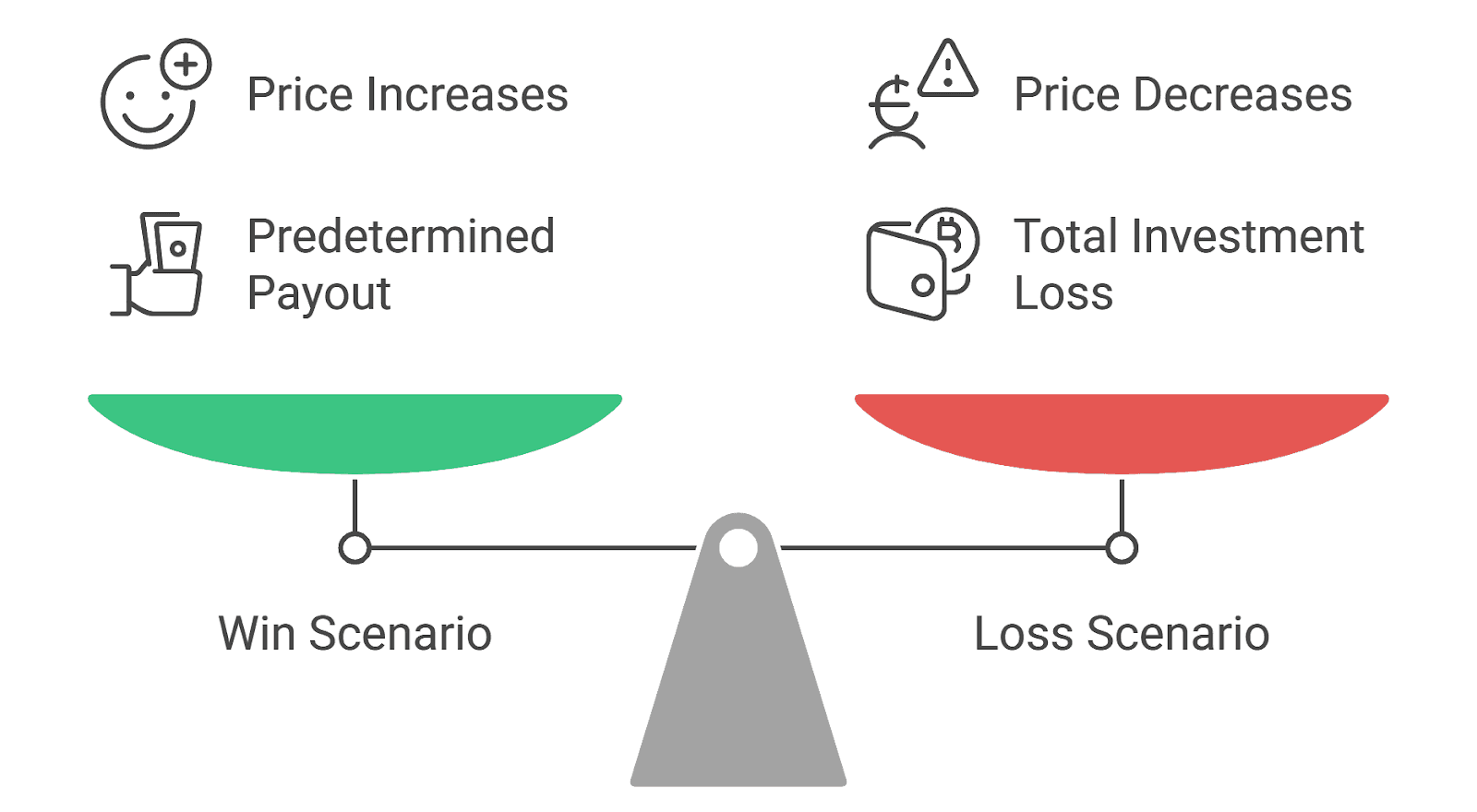
Binary Options scenarios
Every beginner starts from a different place, so there is no fixed limit on how quickly you become proficient. Four factors do most of the work:
-
A steady learning curve
-
Consistency and discipline
-
Decent market exposure
-
Good risk management
With all four in place, a realistic timeline runs three to six months. That period goes on demo trading and on learning how indicators, price action and expiration timing behave together. Mastery breaks down into three stages.
Initial stage: In this initial phase, you need to study the fundamentals, such as how assets and markets behave under different conditions and during various sessions. Next up is knowledge of technical analysis and tools, including support and resistance levels and trend indicators. Once you have addressed these issues, you can begin your demo trading journey. In 2026, one of your best demo trading options is IQCent, which helps beginners trade with zero financial risk. This allows traders to prepare for live trading as they navigate the platform's mechanics, execution, and payout structures.
Intermediate stage: Once you have completed demo trading, you can transition to live trading. During this, you begin by applying a single, well-tested strategy in the live market. However, stick to a small trade size. Follow this phase for a minimum of three months. Once it is over, you will be able to manage emotions, tackle losing streaks, and follow solid risk management rules.
Final stage: In this stage, you can gradually increase your trade sizes and start growing. You will inevitably make mistakes at all stages. However, to ensure long-term growth and success, you must maintain consistency and discipline.
Once you are profitable, the learning doesn’t end there. The most seasoned traders have been able to survive the market for all these years because of their ability to be flexible and adapt to different market conditions quickly. Therefore, regardless of your trading level, you will need to remain updated, realistic, patient, and adaptable.
Ready to practice binary options on demo trading? Join Quotex today, where you can demo trade for free.
Basics of short-term financial contracts
There is a lot to learn at the start. Your broker will show you the basics: how to open a trade, how to deposit, how to withdraw a payout. That is account mechanics, not trading, and it will not move your results.
For that you have to dig into sources that explain how a trade is actually built. Read enough material on binary options trading and a pattern appears. Professionals study the market and the behaviour of the asset before they place anything. Two disciplines cover most of that work:
Fundamental analysis
Technical analysis
Fundamental analysis deals with geopolitical and economic events that move the market. Technical analysis works from historical price movement. The market follows its own laws, and after a long stretch of one pattern a shift tends to follow.
Indicators are the next tool. Binary options are short term, so you work on low chart intervals: 60 seconds, five minutes, fifteen minutes. Indicators structure that data and mark the points worth watching. The usual set is short:
Support and resistance levels
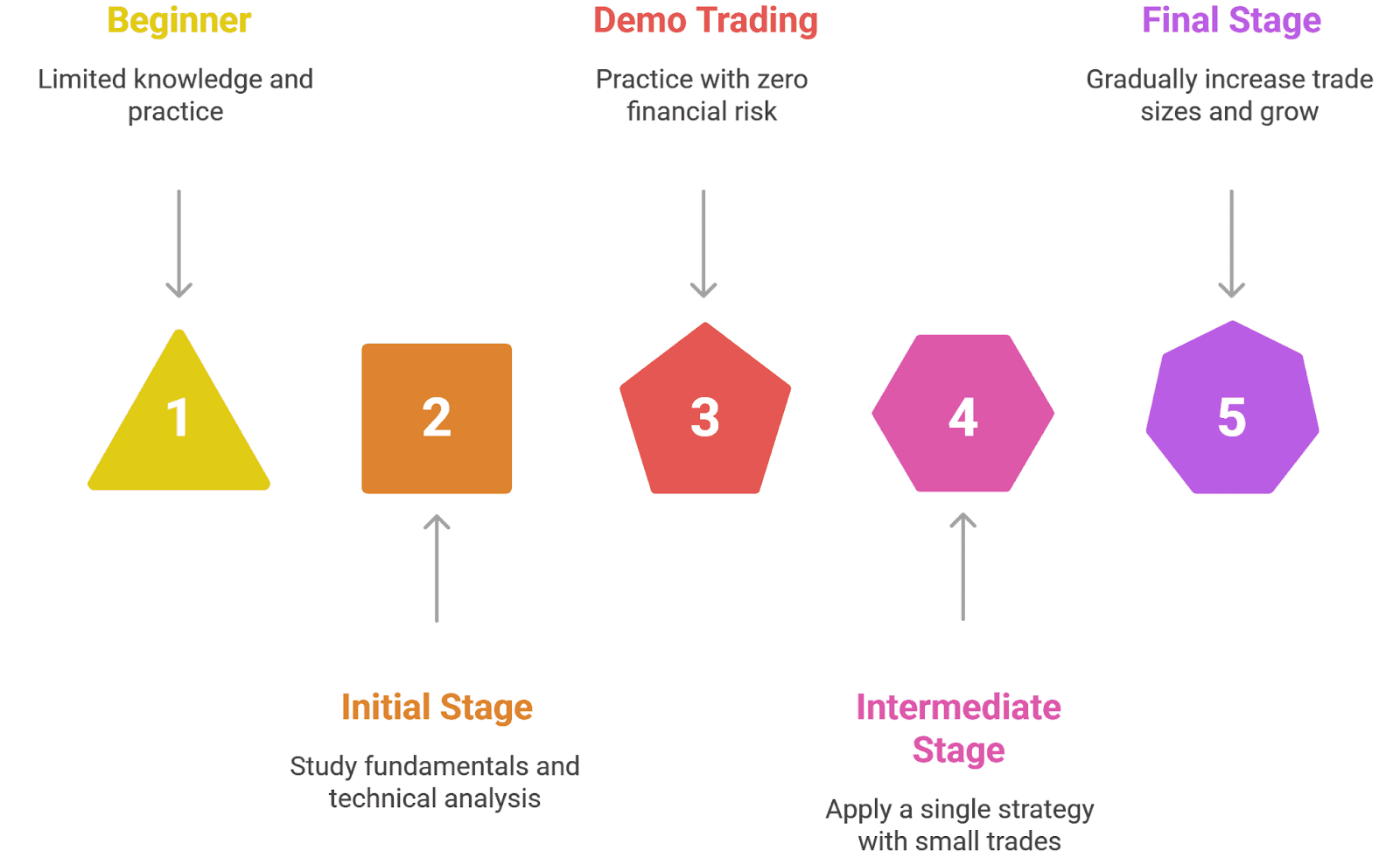
The Binary Options learning process
Trendlines
Moving averages
Volume
These tools tell you whether bullish or bearish pressure has the upper hand. From there you can read market patterns and make an informed decision instead of a guess. One caveat: simplicity wins. A chart with three indicators usually outperforms a chart with nine.
Risk management is the other half of the job. One bad decision on an oversized position ends the account. In practice it comes down to four habits:
-
Following accurate position sizes
-
Setting and following drawdown limits
-
Limiting risk per trade
-
Avoiding impulsive or revenge trading
All of the factors above matter together, not separately. Patience, consistency and discipline are what keep an account alive. You will make plenty of mistakes, and they are part of the learning curve rather than proof that the method fails.
What time is better to trade?
The market runs 24 hours a day, five days a week, Monday through Friday. Volatility, activity and liquidity shift constantly during that week. You can trade whenever you like. No session promises profit, and anyone who tells you otherwise is selling something.
Many professionals prefer the hours when global sessions overlap. Others do the opposite and work quiet, low volatility stretches. Both approaches have their followers.
If you lean towards higher volatility, learn the global session map first. There are four main sessions:
-
Sydney
-
Tokyo
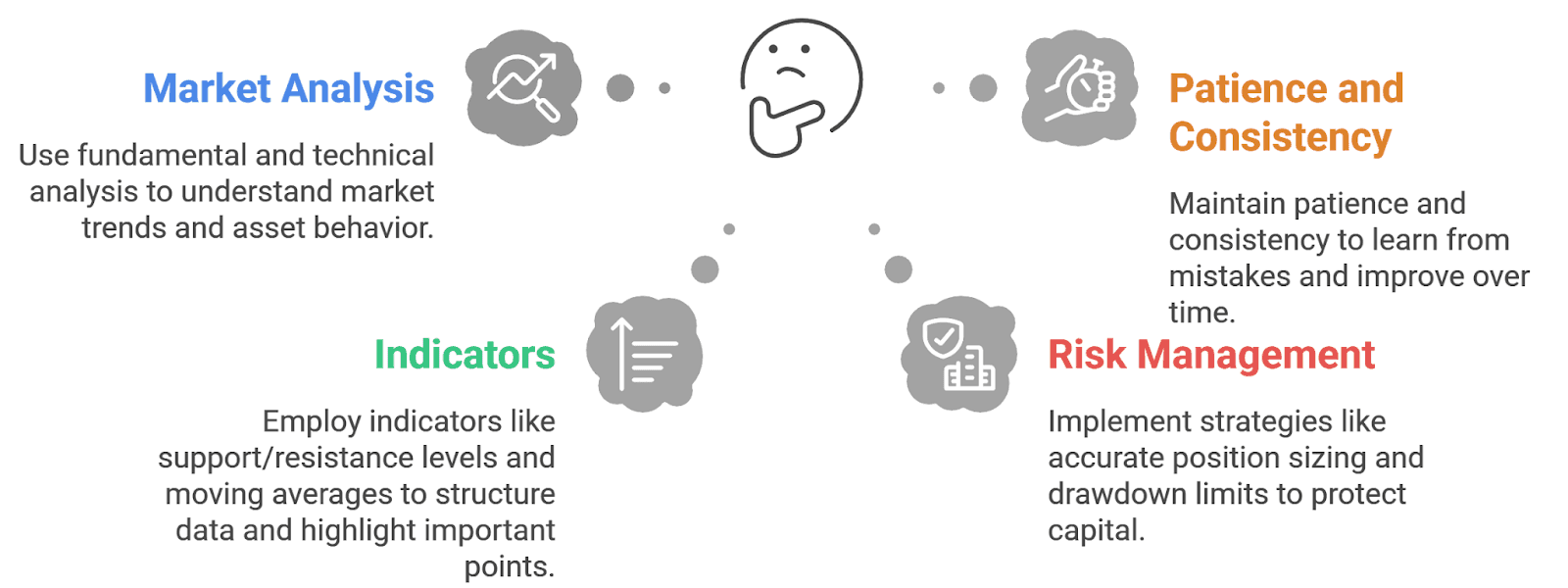
Short-term financial contracts
London
New York
Each session has its own character and suits a different type of trader. Anyone can trade any of them. The Sydney session opens the day with low volatility, so price moves slowly and setups are rare. It suits range based strategies.
The Tokyo session brings moderate volatility. Activity picks up, especially on the yen and other Asian assets. Watch for sudden moves when Japanese economic news lands.
The London session is the high volatility option. Liquidity and activity are at their strongest, trends run clean and direction is easier to read.
For maximum volatility, take the overlap of London and New York. This is the busiest window of the day. The opportunities are real and so is the amplified risk.
Beginners are better served by moderate liquidity and moderate volatility. Whichever session you pick, the requirements do not change: a tested strategy, suitable assets, consistent timing and execution, and goals you can actually hold to.
Trade expiration and trading strategies
A binary options position cannot be held indefinitely. You choose the expiration time up front, and that choice shapes the quality of the trade as much as the entry does. When the clock runs out you either take the payout or lose the stake.
Since binary options are short-lived, the main timeframes include:
30 seconds
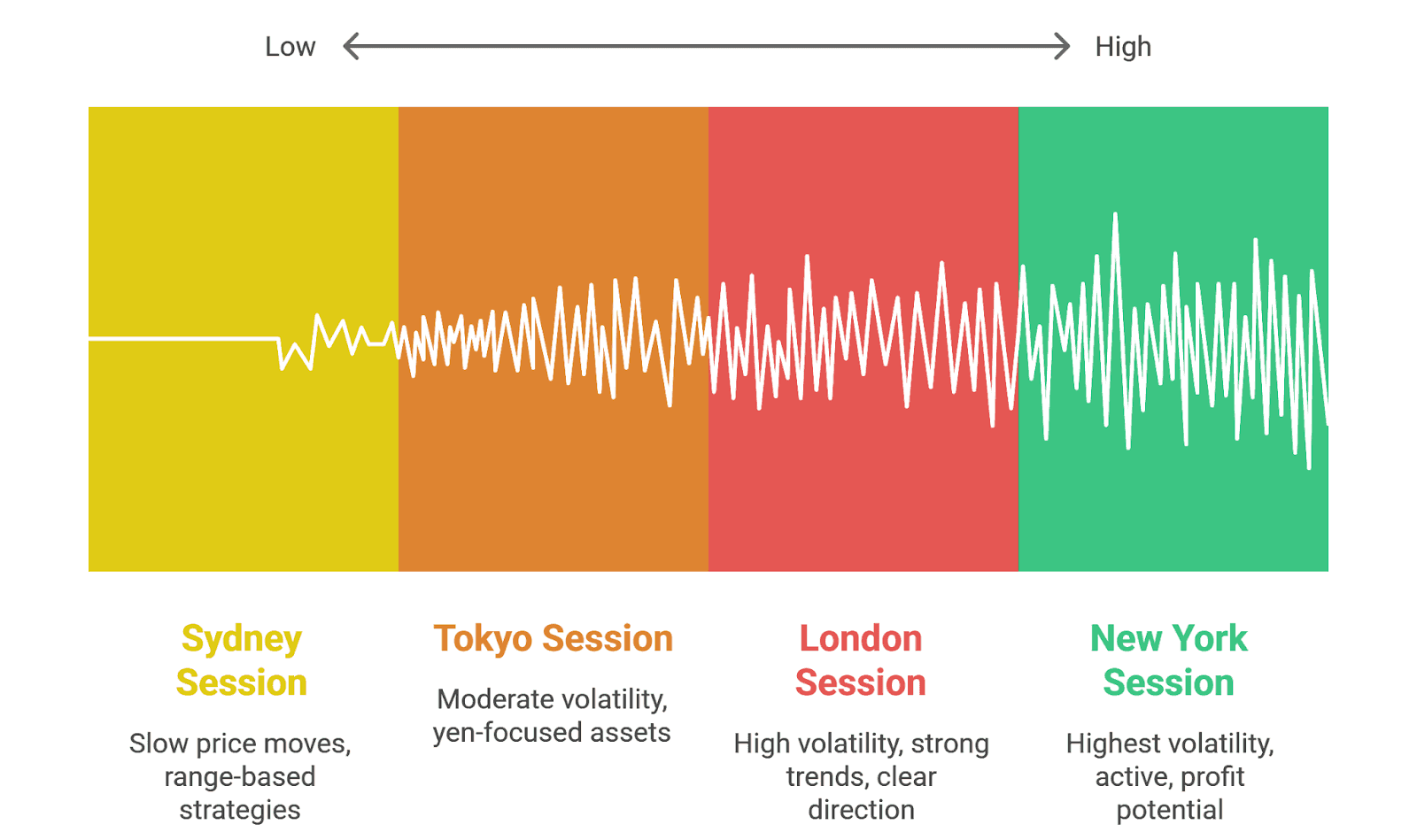
Best time to trade Binary Options
1 minute
15 minutes-30 minutes
1 hour
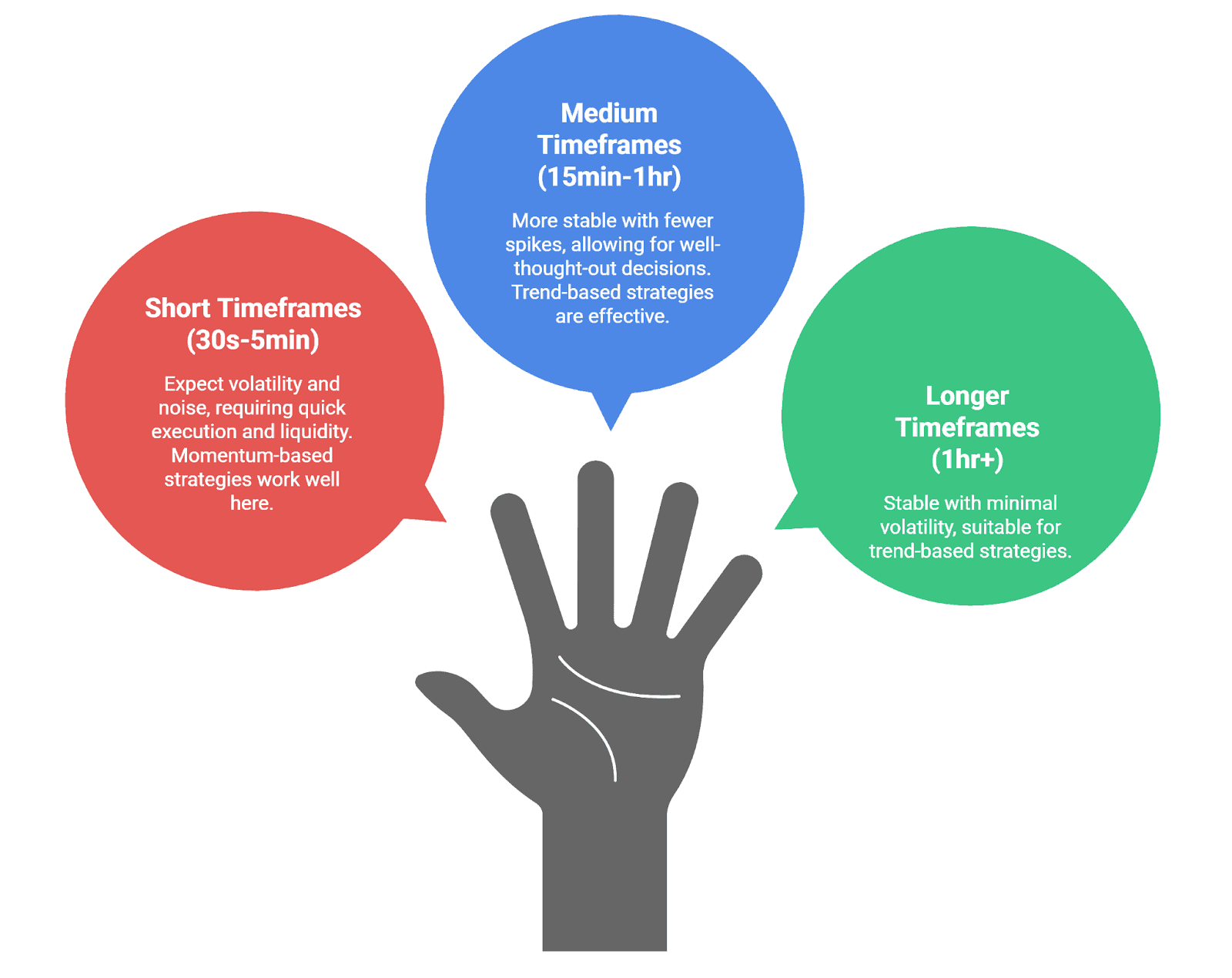
On 60 second to five minute trades, expect wider spreads, higher volatility and a lot of market noise. Those timeframes demand precise timing, fast execution and decent liquidity. The 15 minute to one hour range behaves more calmly, with fewer price spikes. There you have room to think, and decisions should line up with both fundamental and technical analysis.
Expiration and strategy are not separate choices. Each timeframe pairs with its own set of approaches. Momentum strategies fit short and medium expiries. Range strategies work when price is expected to stay stable. Trend strategies come into their own on medium and longer timeframes.
Whatever timeframe and strategy you settle on, learn how expiration behaves in each case. Watch how a strategy reacts to volatility and to the signals you follow. Then keep adapting, because a setup that worked all spring can stop working in a week.
A worked example: what the first three months look like
Put a calendar next to the theory and the timeline stops being abstract. Weeks one to four go on a demo account: twenty trades a week, one asset, one expiry, one strategy. Log every trade with entry, expiry, indicator reading and result. By the end of the month you have around eighty entries, which is enough to see whether the setup has any edge at all.
Weeks five to sixteen move to live money, and the numbers should stay small. On a 200 dollar account a 2 percent risk cap means 4 dollars per trade. At an 85 percent payout you need roughly 54 percent of trades to land just to break even, so a run of 50 percent is not bad luck, it is the maths working normally. Ten losing trades in a row costs 40 dollars here and nothing else. On a 20 dollar stake the same streak takes the account to zero. That difference, not the strategy, is what decides whether you are still trading in month four.
Binary Options trading strategies
Conclusion
Binary options can work in 2026 if you learn how the instrument behaves and respect the market rules. Beginner or professional, the requirement is the same: learn, adapt, persist. The traders who fail are usually the ones who skipped a stage to reach the money faster. If you are still choosing a platform, our list of binary options brokers is the place to start.
With research, practice and the right tools, favourable outcomes are realistic. Losses are still part of the process, and budgeting for them is what separates a plan from a hope. Before you fund an account, compare binary options brokers on payout percentage, minimum deposit and withdrawal terms, because those three numbers shape your results as much as any strategy does.
Ready to start your binary options journey? Join Quotex today, practice demo trading, test your strategies, and strengthen your risk management skills to excel in binary options.
FAQ
How long does it take to learn binary options trading?
The theory takes a few days. Reaching consistent results usually takes three to six months, split into demo practice, a live stage with minimum stakes, and a gradual increase in size. The timeline stretches if you skip the journal or change strategy every week.
How does binary options trading work in 2026?
You pick an asset, a direction and an expiry that runs from 30 seconds to about an hour. If price finishes on your side at expiry, the broker pays the agreed percentage of your stake. If it does not, the stake is lost in full, regardless of how far price moved.
How do I get started?
Open a demo account and stay there until your journal shows a repeatable setup. Learn support and resistance, trendlines, moving averages and volume before adding anything else. Then move to live trading with a risk cap of one to two percent of the account per trade.
What are the common mistakes?
Trading a live account before the demo results are stable. Raising stake size after a loss to win the money back. Stacking six indicators on one chart. And picking long expiries on a short term instrument, which leaves you holding a position you cannot manage.
Is binary options trading suitable for beginners?
It is approachable, not easy. Risk per trade is capped and the rules are simple, which helps at the start. The all or nothing payout is the catch: a fixed payout below 100 percent means you need well over half your trades to land before the account grows.
Find Your Perfect Broker: Explore Our List Now!
Choose the best with our expert-selected options
Find Your Perfect Broker: Explore Our List Now!
Choose the best with our expert-selected options
Discover top binary options brokers tailored to your region. Browse our curated lists by country: