Updated:November 11, 2026

15 min

Have you heard about crypto binary options?
Have you heard about crypto binary options? Most traders know crypto. Most know binary options. Far fewer know the two get sold together as one contract. Bitcoin or Ether is only the underlying asset, and the payout is fixed before you click. This guide covers how the contracts work. It also covers which platforms list them in 2026, the strategies and indicators traders lean on, and the risks that quietly empty beginner accounts.

Saqib Iqbal
Author

Updated October 23, 2026
Have you heard about crypto binary options? Most traders know crypto. Most know binary options. Far fewer know the two get sold together as one contract. Bitcoin or Ether is only the underlying asset, and the payout is fixed before you click. This guide covers how the contracts work. It also covers which platforms list them in 2026, the strategies and indicators traders lean on, and the risks that quietly empty beginner accounts.
What is crypto trading?
When trading crypto, you take a position against the dollar or any other crypto. You have to buy or sell virtual coins on an exchange, and can store them on a digital wallet such as CoinPayments. Even if you don’t own these coins, you can trade them. How, you may ask?

Crypto binary options illustration
Through CFDs, or contracts for difference. A CFD lets you take a long position when you expect a rise. Short works the same way in reverse. You never touch the coin. What you hold is a contract with the broker that settles on the price difference. Say you open a long CFD on BTC at 60,000 and close it at 63,000. That 3,000 move is yours, minus spread and any overnight financing. Leverage scales the result both ways.
You can buy (go long) when you see the crypto is going to rise. Similarly, you can sell (go short) if the crypto falls. With leveraging, it magnifies your profits or losses. So, to have exposure to the market, you need to have deposited funds.
Your profit or loss depends on the size of your deposit. A 2 percent move means one thing on 200 dollars and something else entirely on 20,000. So learn the market before you size up. Read the asset, know the hours when it trades thinly, and check what the funding costs you overnight.
What are binary options?
Binary means two outcomes. Yes or no, nothing in between. Is it risky? It is, and the risk is easy to underestimate. The interface makes the whole thing look like a coin flip with a button attached.
How do we trade crypto?
Binary options are options in which you make predictions about currency or other assets reaching a certain value by a certain date (the expiry date). The prediction is either a yes or a no.
When the binary option expires, you receive a previously agreed profit if your prediction was correct but you lose the amount you invested in the option if your prediction was wrong.
Oh, there is another thing to keep in mind. Once you make a decision, you can’t undo it. Once binary options come into effect, they operate automatically. So, you have to keep calm and make smart decisions.

Crypto trading illustration
How do crypto binary options work?
Cryptocurrencies trade on several decentralized exchanges. Bitcoin or other cryptos are just underlying assets in binary options. That is, you do not buy any cryptocurrencies, only the binary options contract from the broker.

What are binary options?
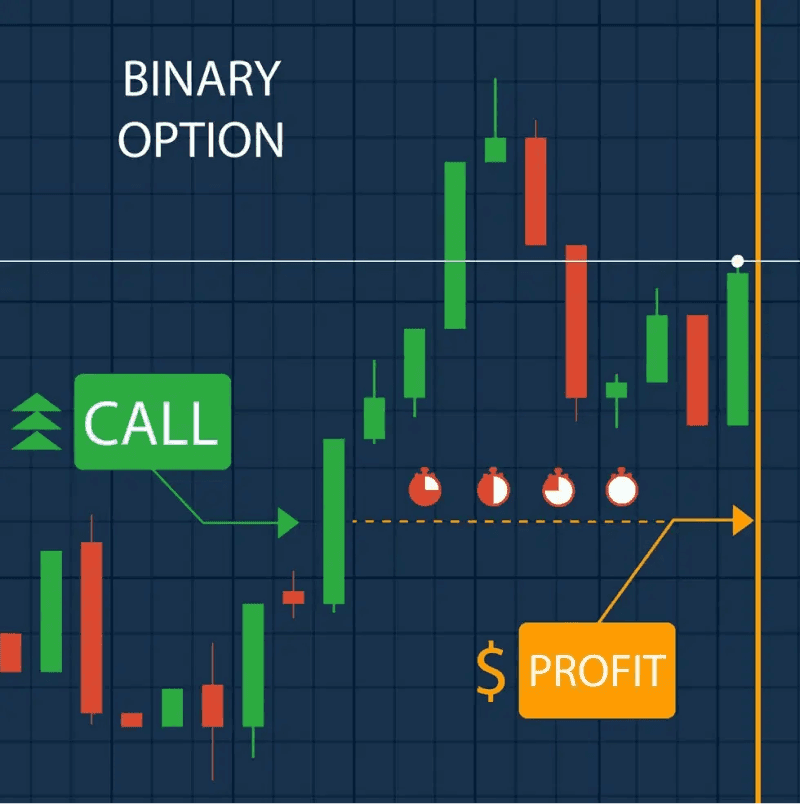
Binary options illustration
How does it work?
Bitcoin and other cryptocurrencies are volatile. That means the price changes quickly and hops around a lot. It is not uncommon for cryptos to fluctuate by 20 percent per day against the USD.

How do crypto binary options work?
As you are aware, the price of binary options must be higher or lower than your entry point. If the market moves so quickly, there is a greater probability that the price will move more points in your favor. So, that’s how crypto binary options work.
A worked example on a five minute BTC contract
Say you stake 100 dollars on a call contract on BTC. Expiry is five minutes, quoted payout 85 percent. Bitcoin sits at 61,400 when you open. If it prints 61,401 at expiry you get 185 dollars back, so 85 is profit. If it prints 61,399, the 100 is gone. Now look at a run of trades. Win ten and lose ten at that payout and you are down 150 dollars. You were right exactly half the time. To break even at 85 percent you need roughly 54 percent of trades to land. That threshold, not the strategy, is the number beginners never calculate. So compare brokers on payout percentage first.
Best platforms for crypto binary trading
Cryptocurrency volume keeps pulling brokers into binary contracts. So the platform you pick matters almost as much as the trade. The five below list crypto as an underlying asset and are widely used by retail traders. Check the regulation and the withdrawal terms before you fund an account.
1. IQ Option
IQ Option isn’t just perfect for novice traders and experts in this industry. It is a fantastic tool for individuals who need to master their trading. IQ Option was founded in 2013 by Dmitry Zaretsky.
It has its headquarters in St. Vincent and Grenadines. The platform permits over 250 currency pairs, more than 50 forex pairs, and trading in shares, stocks, forex, CFDs, and commodities. It also offers multiple account options, so you can pick the one you need based on your requirements.
IQ Option offers a demo account for testing and developing your trading skills. The interface is easy to use and copy trading is available too. Copy trading is useful for watching how someone else sizes a position. It is less useful as a substitute for your own plan. Full details on assets, payouts and withdrawals sit in our broker reviews.
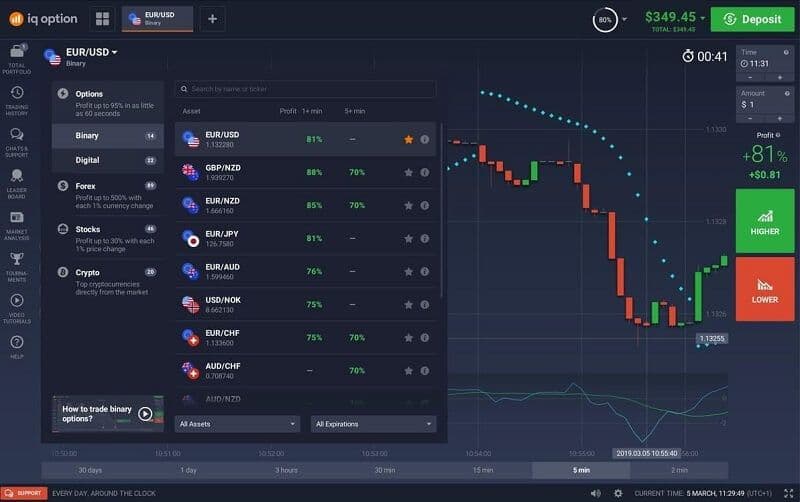
IQ options platform
2. Quotex
Quotex is a relatively new trading platform. It was developed in 2019 and is owned and managed by Cypriot Financial Holding, with headquarters in Seychelles. That last detail matters more than it sounds. Offshore registration usually means lighter oversight and slower recourse if a withdrawal stalls.
Quotex lists over 25 currency pairs, several cryptocurrencies, and commodities such as oil and gold. Payout rates sit among the higher ones in this group. The platform leans on transparency and a deep enough toolkit for chart work. Some competitors do not bother.
Support runs 24/7 in several languages and answers quickly. The interface is simple and a demo account opens at sign-up. Use it. Two weeks on demo will tell you more about your own discipline than any review can.
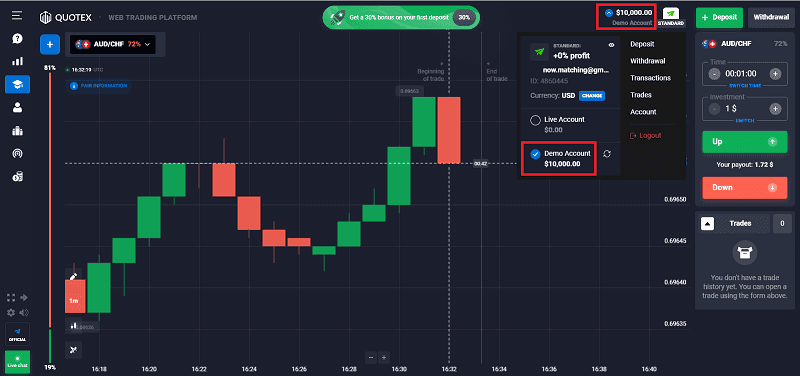
QUOTEX platform
3. Pocket Option
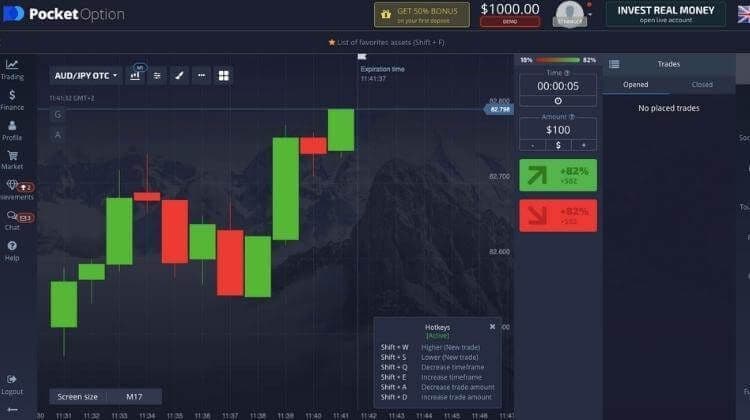
Pocket Option was established in 2017 by a group of talented IT and fintech experts. Gembell Limited is the owner of the broker and has its headquarters in the Marshall Islands. It offers more than 100 trading assets, including commodities, cryptocurrency, currency pairs, and many more.
Pocket Option advertises a payout rate of 95 percent and hands you a demo account at sign-up. Treat that number as a headline. Payout varies by asset and by expiry. The figure printed on the front page is usually the best case on the most liquid pair.
Pocket Option platform
4. Binomo
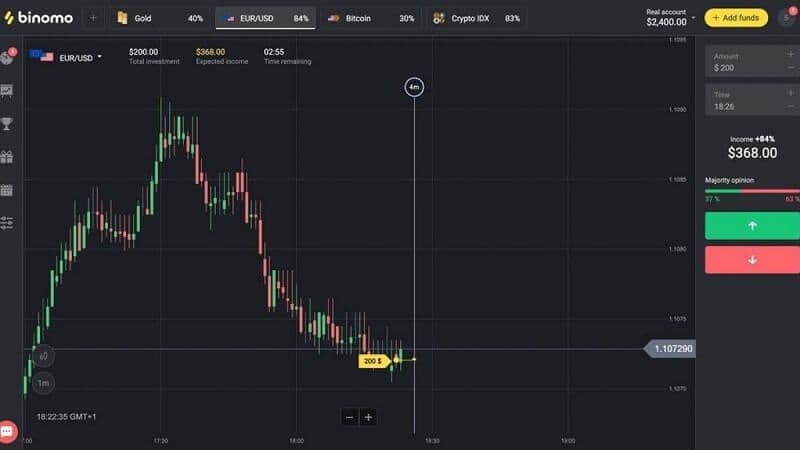
Binomo is a top-of-the-line trading platform with high-quality tools and analytical services. Binomo was established in 2014, with its headquarters in St. Vincent and the Grenadines. The platform offers more than 70 trading assets, including cryptocurrencies, stocks, indices, etc.
Binomo quotes a payout rate of 87 percent and a free demo account. Bonuses run up to 110 percent depending on your account type. Read the bonus terms first. Deposit bonuses here normally carry turnover requirements. Your balance stays locked until you have traded a multiple of it.
Binomo platform
5. Olymp Trade
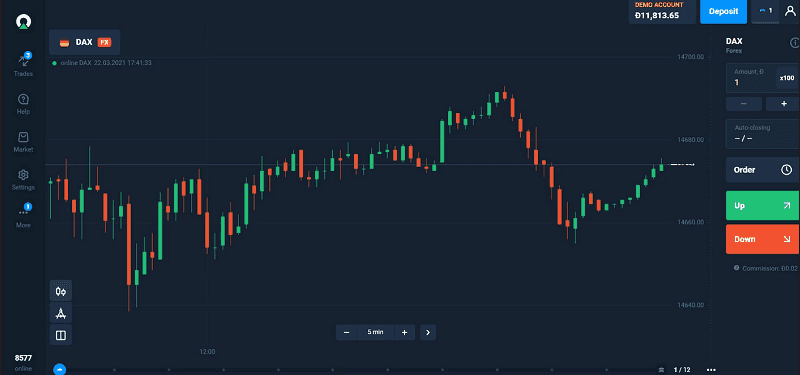
Olymp Trade was founded in 2017 and has been a well-known trading platform. Smartex International is the owner of the broker and has its headquarters in Russia. The platform offers 13 trading assets like currency pairs, indices, stocks, etc.
The maximum payout rate is 90 percent, and new users are offered a 100 percent trading bonus. As always, the number that matters is the turnover condition attached to the bonus rather than the headline percentage.
OlmypTrade platform
Best crypto binary options strategies
A plan is not optional here. Entering a binary trade without one is how most beginner accounts die. The fixed payout hides how fast small losses compound. The approaches below are what traders actually run on short expiries.

What are some of the best crypto binary options strategies?
1. The straddle strategy
You can use the straddle strategy combined with market news and events. Trades are usually placed before an important event or announcement. It is a trend-following strategy. The straddle strategy is popular among traders as one of the most reliable, even in an unstable market.
2. The MFI strategy
The Money Flow Index (MFI) strategy suits short expiries. It compares the money flowing into an asset with the money flowing out. The result is plotted between 0 and 100. A low reading points to selling pressure. A high one points to buying pressure. Most traders treat 20 and 80 as the lines worth acting on. On crypto it whipsaws hard during news.
3. Trend trading
Trend trading works for beginners and veterans alike. Read the trend and you already have a bias, which is most of the work on a binary contract. If the trendline slopes up, price is making higher lows and calls have the odds. If it slopes down, the reverse holds. The trap is the flat market. A trendline tells you nothing there, and the payout still charges full price for guessing.
4. Rainbow strategy
The rainbow strategy pairs signal reading with a close watch on news in the market you trade. It is a visual method above all. You are waiting for several averages to fan out in the same direction. That is the cleanest sign a move has momentum behind it rather than noise.
It utilizes essential signals to make dependable forecasts about the asset cost by utilizing different averages over various periods. A different color represents each period on the chart, hence the name Rainbow Strategy.
5. Candlestick strategy
Here you trade the candles themselves. Formations split into reversal and continuation patterns. A pin bar at a level you had already marked beats the same shape floating mid range. Read the pattern in context, never in isolation. Glance at the volume behind the candle before you act.
Best indicators for binary crypto options
Indicators are prediction aids, not answers. They lag price by design, and on a five minute crypto expiry that lag can be the entire trade. Used properly they filter out setups you should never have taken. The five below turn up most often on binary platforms.

Indicators are the trader’s predictive tools for market trends
1. Moving averages (MA)
The moving average is the one almost everybody starts with. It averages recent closes into a single line, which strips out the noise and leaves the direction. Traders watch where price sits relative to that line. They also watch where two averages of different lengths cross. On crypto the 20 and 50 period averages are common.
2. Awesome oscillator (AO)
The awesome oscillator, or AO, came from Bill Williams. It compares recent momentum against momentum over a longer window and prints the difference as a histogram. Bars flipping from red to green above zero suggest buyers are taking over. It reads momentum, not direction. Use it to confirm a trend, not to call one.
3. Average directional index (ADX)
The average directional index measures how strong a trend is, not which way it points. Readings above 25 usually mean the move has conviction. Below 20 the market is drifting, and that is exactly when short expiry binaries are hardest to win. Plenty of traders use ADX purely as a filter.
4. Relative strength indicator (RSI)
The relative strength indicator is range based. It runs from 0 to 100 and flags overbought and oversold conditions, conventionally above 70 and below 30. Be careful with it in a strong trend. Crypto can hold above 70 for days while price keeps climbing.
5. Parabolic SAR
The Parabolic SAR indicates the directional market changes. It is a math-based indicator. The indicator is presented as dots on a chart, either below the asset value (indicating a potentially bullish trend) or above it (a bearish trend).
Pros and cons of binary crypto options
Every gain and loss here comes down to price movement inside a fixed window. That makes the trade simple to describe and easy to misjudge. The list below sets out what genuinely works in your favour, and what quietly works against you.

Pros and cons of binary crypto options
Pros
Low probability of losses
There is a significant risk involved when trading binary options. But wait! Don’t lose hope and step back. Know that you have complete control over how much money is at stake. The agreements you’ll trade usually won’t have a substantial negative impact.
Risk management
Management of risk won’t be a critical concern right away in this procedure. You can monitor, record, and change the degree of risk based on your preferences. You shouldn’t enter large trades until you have the funds to risk hundreds of dollars. Just act wisely, and you’ll be sure to ace the trading!
Easily comprehendible
Trading binary options is simpler than conventional trading. The rules are short and the outcome is binary. There is no position sizing puzzle once you have picked your stake. That simplicity is why so many online traders start here. It is also why so many underestimate it.
Trade regardless of market conditions
Basic financial trading methods may have limitations due to market conditions. On the other hand, binary options allow you to profit both during price increases and price declines. As a result, you can access several other trading strategies.
Cons
Some don’t have demo accounts
Practising with pretend money first is reassuring when real cash is the next step. Some online brokers still offer no demo account at all. Others give you one that behaves nothing like the live feed during volatile hours. Check which kind you are getting before you deposit.
Few tools for trading
Most brokers hand you a chart and very little else. Research, education and market context are thin. The pace of the product leaves no time to go looking elsewhere. Beginners get overwhelmed quickly, which is why the losing streaks start early.
Uneven distribution of profits and losses
Unlike conventional trading, a losing binary contract takes the whole stake. There is no partial exit, no trailing stop, no getting out at half the damage. A win pays under 100 percent. A loss costs 100 percent. That asymmetry is the most important number here.
Is crypto binary trading worth it in 2026?
Crypto binary options give you defined risk and defined reward. That beats a leveraged CFD that can run straight past your stop. The cost is the payout asymmetry. You risk 100 to make 80 or 90. So you have to be right well over half the time just to stand still. Most people are not, at least not in the first year. If you want to try it anyway, start on a demo. Keep the stake at a size that would not bother you if it vanished, and log every trade with the reason you took it. Our list of regulated brokers is the place to start, together with the withdrawal terms attached to each one.
FAQ
What are crypto binary options?
They are fixed payout contracts where a cryptocurrency is the underlying asset. You predict whether the price will sit above or below a set level at a set expiry. You never own the coin. The broker pays an agreed percentage if you are right and keeps your stake if you are wrong.
How do crypto binary options work in 2026?
The mechanics have not changed. You pick an asset, a direction and an expiry, then stake an amount. At expiry the contract settles automatically against the market price. What has changed is availability: fewer regulated jurisdictions permit these products to retail clients, so most listings sit offshore.
Why does the payout percentage matter so much?
Because it sets your break even win rate. At an 85 percent payout you need about 54 percent of trades to land before you make anything. At 70 percent that rises near 59 percent. A couple of points of payout move that line further than switching indicators will.
What are the common mistakes?
Trading a flat market, chasing news candles, and doubling the stake after a loss. Beginners also take deposit bonuses without reading the turnover conditions, then find the balance locked. The quiet one is skipping the demo and learning position discipline with real money.
How do I apply this in practice?
Start on a demo for at least two weeks and log every trade with its reason. Trade one asset until you know its hours and its typical range. Use a trend filter to stay out of drifting markets. Keep the stake small enough that a losing streak changes nothing.
Find Your Perfect Broker: Explore Our List Now!
Choose the best with our expert-selected options
Find Your Perfect Broker: Explore Our List Now!
Choose the best with our expert-selected options
Discover top binary options brokers tailored to your region. Browse our curated lists by country: