Updated:November 11, 2026

5 min

COTI: Project and Price Outlook
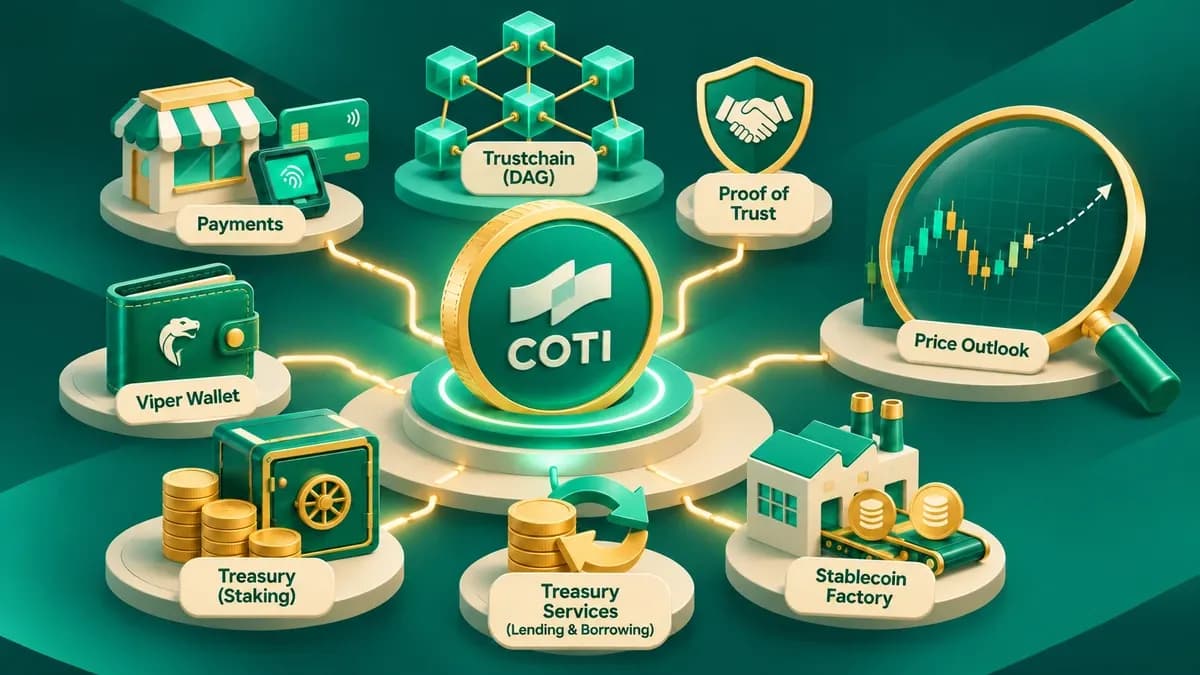
COTI is a payments-focused network built on its own Trustchain protocol, with a Treasury staking system and a Stablecoin Factory for businesses. Here is how the pieces fit together, and what to make of price forecasts for the token. Updated September 2026.

Pejman Zwin
Author
Updated October 23, 2026
COTI is a payments-focused network built on its own Trustchain protocol, with a Treasury staking system and a Stablecoin Factory for businesses. Here is how the pieces fit together, and what to make of price forecasts for the token. Updated September 2026.
COTI at a glance
-
Purpose: fast, low-cost decentralised payments for consumers and businesses
-
Core protocol: Trustchain, a layer one network using a DAG structure
-
Consensus: Proof of Trust, scoring participants by trust rather than by hash power
-
Treasury: staking system where ecosystem fees are redistributed to stakers
-
Stablecoin Factory: lets merchants issue their own stablecoins on Trustchain
-
Treasury Services: lending and borrowing of COTI tokens
-
Wallet requirement: Treasury deposits and staking require a Viper wallet
-
Other functions: multi-currency wallet, merchant payment solutions, crypto and fiat exchange
On price predictions
This page previously carried specific price targets for 2024 through 2026. Those numbers have been removed rather than replaced, and the reason is worth stating plainly.

Why COTI?
Multi-year price targets for a mid-cap token have no reliable basis. They are usually produced by extrapolating a chart or by applying a growth rate to a market capitalisation, and neither method accounts for the factors that actually move these assets: overall crypto market cycles, exchange listings and delistings, regulatory changes, and whether the underlying product finds users.
A prediction article that was wrong for two years running is not evidence that a correction is due. Treat every published target, including favourable ones, as an opinion with a marketing purpose behind it. What you can analyse instead is the project: what it does, who uses it, and whether the token has a role in that usage.
What COTI is
COTI is a decentralised payment system designed to be usable anywhere. It addresses a gap between two options that each have drawbacks: centralised payment platforms, which are efficient but require trusting an intermediary, and public blockchains, which are decentralised but have historically struggled with transaction speed and cost.
What technologies are behind COTI?
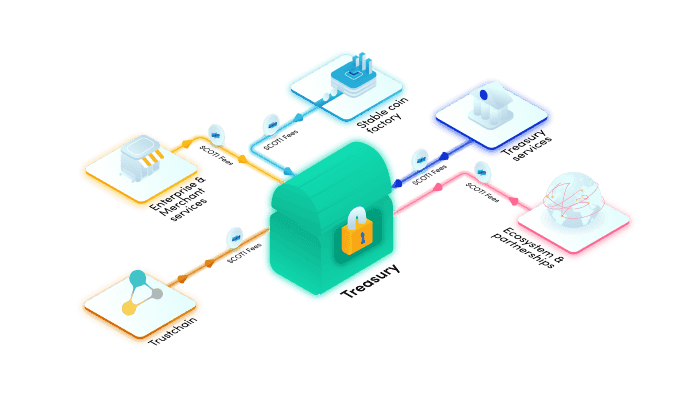
COTI’s ecosystem infographic published by COTI Inc.

What is COTI?
-
Create a multi-currency wallet usable across the ecosystem
-
Issue your own stablecoin through the Stablecoin Factory
-
Stake COTI tokens in the Treasury to earn a share of ecosystem fees
-
Build a payment solution for your own business
-
Lend and borrow COTI through Treasury Services
-
Exchange crypto, fiat and other tokens within the ecosystem
The technology
Trustchain is COTI's own layer one protocol, built on a directed acyclic graph rather than a linear chain of blocks.
A DAG is a graph structure where connections run in one direction and no path leads back to its starting point. Applied to transactions, this allows multiple confirmations to proceed in parallel rather than waiting for sequential blocks, which is where the throughput advantage comes from.
Proof of Trust is the consensus mechanism layered on top. Instead of validating through computational work, it weights participants by a trust score built from their transaction history.
Both choices are legitimate engineering trade-offs rather than guarantees. DAG throughput advantages depend on network conditions, and any reputation-weighted consensus concentrates influence among established participants. Neither is a reason to buy or avoid the token by itself.
Treasury and staking
Fees generated inside and outside the ecosystem flow back to the Treasury, and a proportion is distributed to those staking COTI tokens.
Staking is flexible and customisable: participants can choose parameters rather than accepting a single fixed term. Treasury deposits and staking require a Viper wallet, which integrates with the system.
One point to keep in mind: staking rewards are paid in COTI. If the token price falls further than the reward rate, the position loses value in fiat terms despite accruing more tokens. Calculate any yield in the currency you actually spend.
Stablecoin Factory
After the platform launched, merchants and businesses began issuing their own stablecoins through the Factory. These are built on Trustchain and intended for merchant use rather than exchange listing.
That distinction matters: a merchant-issued stablecoin circulating within one business is a settlement tool, not a tradable asset, and it carries the credit risk of its issuer rather than the backing of a regulated reserve.
How to evaluate COTI yourself
-
Check current network activity and transaction volume rather than social media sentiment
-
Look at whether merchants are actually using the payment products, adoption is the real variable
-
Read the staking terms directly from project documentation, including lock periods
-
Calculate staking yield in your own currency, not in tokens
-
Treat any specific multi-year price target you encounter as marketing, including optimistic ones
-
Compare regulated venues in our [[crypto brokers|/crypto-brokers]] section before buying
For related material on evaluating crypto projects and reading charts, see our trading guides.
COTI: frequently asked questions
What is COTI?
A payments-focused network built on its own Trustchain protocol, offering merchant payment solutions, a Treasury staking system and a Stablecoin Factory.
What is Trustchain?
COTI's layer one protocol, using a directed acyclic graph instead of a linear block chain, which allows transactions to confirm in parallel.
What is Proof of Trust?
A consensus mechanism that weights participants by a trust score built from transaction history, rather than by computational work.
How does Treasury staking work?
Ecosystem fees flow back to the Treasury and a share is distributed to stakers. Staking is flexible but requires a Viper wallet.
Can I create my own stablecoin?
Yes, through the Stablecoin Factory. These are built for merchant use rather than exchange trading, and carry the issuer's credit risk.

COTI price prediction
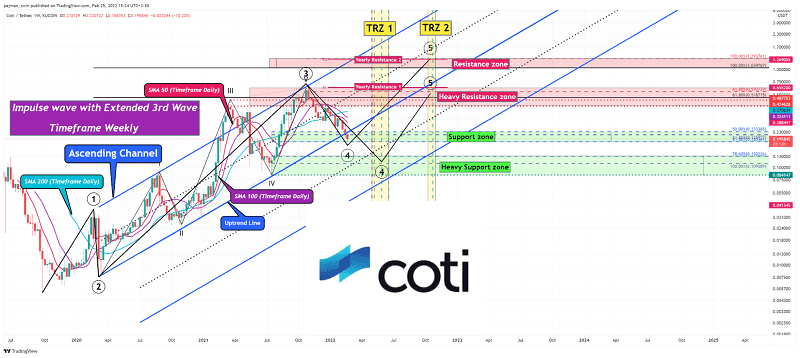
It is COTI’s price analysis

Technical analysis - COTI price

Who are COTI’s partners?

COTI products

Can you Create a Stablecoin?
Are COTI price predictions reliable?
No. Multi-year targets for mid-cap tokens extrapolate charts or growth rates without accounting for market cycles, regulation or actual adoption. Analyse the project instead.
Find Your Perfect Broker: Explore Our List Now!
Choose the best with our expert-selected options
Find Your Perfect Broker: Explore Our List Now!
Choose the best with our expert-selected options
Discover top binary options brokers tailored to your region. Browse our curated lists by country: